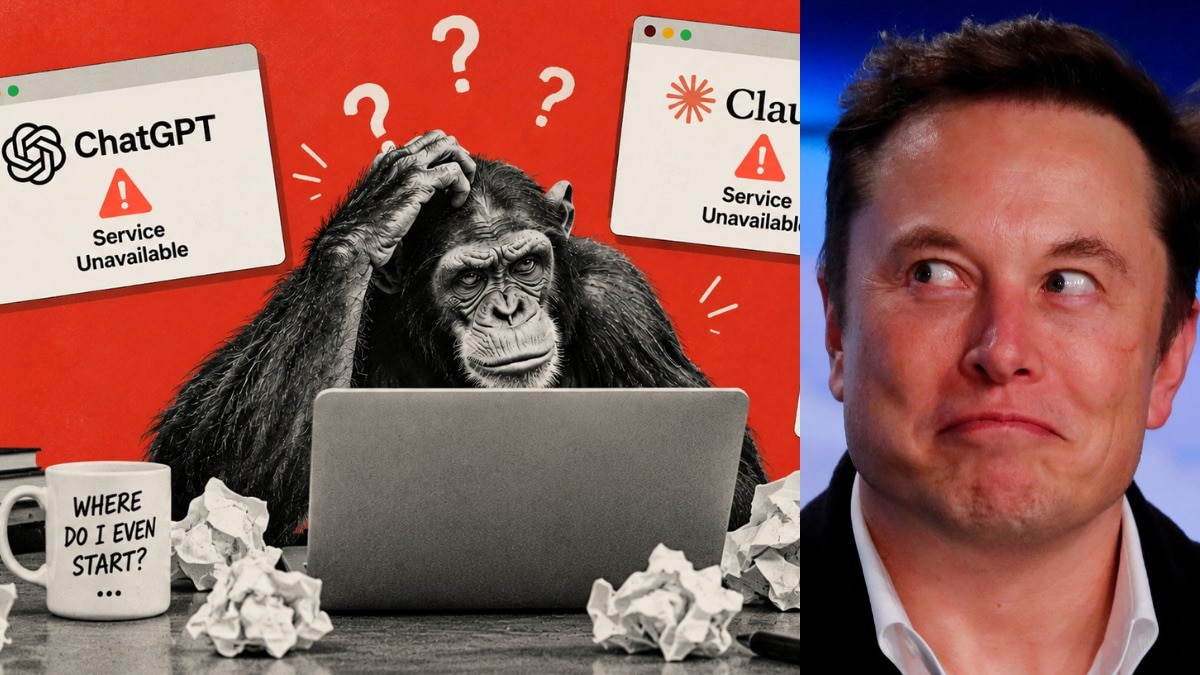
Tech billionaire Elon Musk has sparked a massive debate in the tech community by jokingly comparing human software developers who do not use artificial intelligence to "incompetent monkeys." Musk's comments highlight the rapid integration of AI tools in modern software engineering.
- Elon Musk jokingly compared human software developers working without AI tools to "incompetent monkeys."
- The comment highlights the growing necessity of AI integration, such as GitHub Copilot and xAI's Grok, in software development.
- Industry experts agree that while AI won't eliminate developer jobs, it will redefine the required skill sets.
Tech mogul and billionaire Elon Musk has once again stirred the pot in the global technology community. During a recent discussion, Musk took a sharp, humorous jab at traditional software developers who refuse to integrate Artificial Intelligence (AI) into their daily workflows, jokingly comparing their productivity levels to those of "incompetent monkeys."
Musk’s remarks underscore a pivotal shift in the software engineering landscape. With the rise of advanced generative AI tools like GitHub Copilot, OpenAI's ChatGPT, and xAI's Grok, the speed and efficiency of writing code have reached unprecedented levels. Developers who continue to write code completely manually are finding themselves at a severe disadvantage.
Why This Matters
BozokMedia analysis shows that Musk's provocative analogy touches upon a profound economic reality. The cost of software development is poised to drop dramatically, and the speed of product deployment will skyrocket. Companies that do not adopt AI-driven development workflows will struggle to compete with agile, AI-empowered startups.
"AI is not replacing developers, but developers who use AI will inevitably replace those who do not."
To understand the magnitude of this shift, it is essential to compare how traditional development practices stack up against modern, AI-assisted methodologies. The table below outlines the key differences in productivity and approach:
| Feature | Traditional Developers | AI-Assisted Developers |
|---|---|---|
| Coding Speed | Manual and slow, prone to syntax errors | Extremely fast, automated code generation |
| Debugging Time | Hours of manual testing and log checking | Instant error detection and automated fixes |
| Learning Curve | Requires memorizing extensive language syntax | Focuses on logic and architecture; AI handles syntax |
Historical Background
The evolution of software engineering has always been defined by abstraction. In the early days of computing, programmers had to manually punch holes in cards or write raw binary code. The introduction of compilers and high-level programming languages like C, Java, and Python was initially met with skepticism, yet they ultimately democratized technology. Elon Musk's long-standing relationship with AI—from co-founding OpenAI in 2015 to launching his own AI venture, xAI—gives him a unique vantage point on this transition. He views AI-assisted coding not as a luxury, but as the natural and necessary next step in this historical evolution.
Frequently Asked Questions
Q1: Will AI completely replace human software engineers?
Answer: No, AI is highly unlikely to replace human engineers entirely. Instead, it will shift their focus from repetitive syntax writing to high-level system architecture, security, and logical design.
Q2: What is Elon Musk's xAI doing to change coding?
Answer: xAI has developed Grok, an advanced AI model that is being integrated into various platforms to assist with real-time data analysis, problem-solving, and automated code generation.