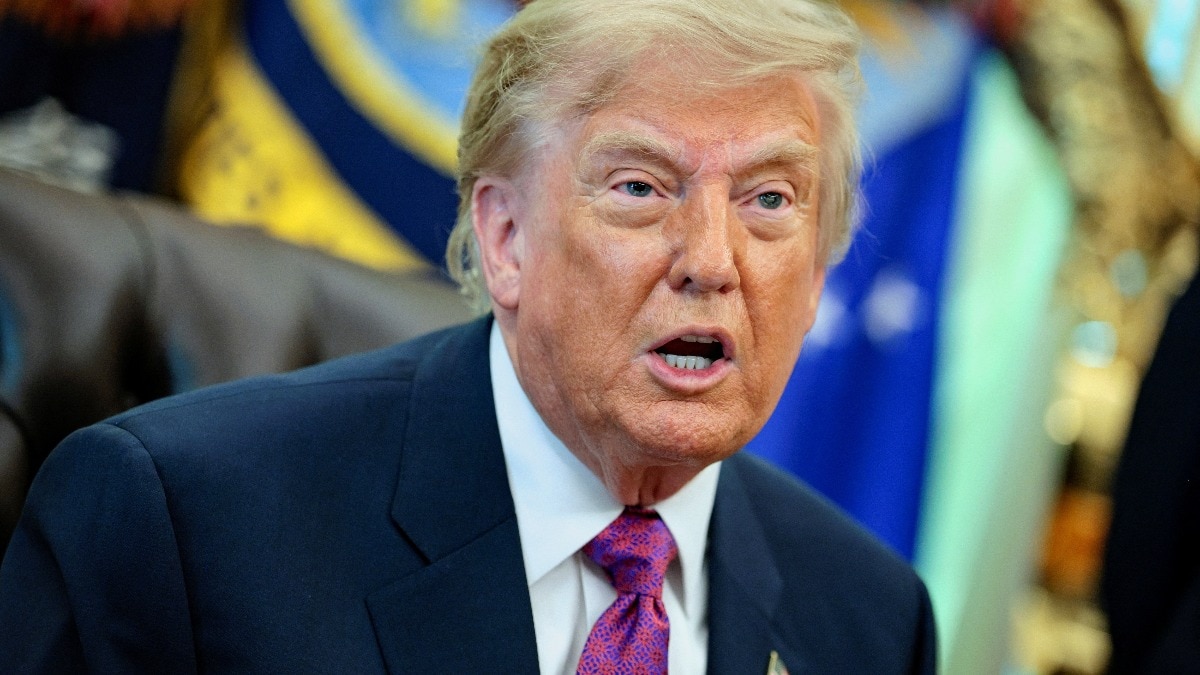
US President Donald Trump has labeled the AI race as a revolution larger than the internet, framing it as a decisive global contest between the US and China.
In a high-stakes geopolitical framing, US President Donald Trump has issued a blunt assessment of the global Artificial Intelligence (AI) race. During a recent wide-ranging interview, Trump characterized the AI surge not merely as a technological advancement, but as a revolution "bigger than the internet." His core message was uncompromising: in the race for AI supremacy, there is no middle ground—whoever wins, wins.
Trump positioned the development of AI as a critical contest of national survival, specifically pitting the United States against China. He urged American leadership to prioritize rapid construction and deployment over excessive caution, suggesting that the window to secure dominance is rapidly closing as the technology reshapes global power dynamics.
Why This Matters
BozokMedia analysis shows that Trump's rhetoric shifts the global AI discourse from 'safety and ethics' to 'speed and economic dominance.' By framing AI as an existential race against China, he is signaling a policy direction that favors aggressive industrial expansion and deregulation to ensure American hegemony in the digital age.
"Whoever wins with AI wins. And it's really right now, it's really between China and us."
Addressing the localized opposition to data centers, Trump utilized his real estate expertise to rebrand these massive facilities. Instead of viewing them as industrial burdens, he presented them as "economic jackpots" that can elevate property values and lower taxes for local municipalities. He warned that towns refusing to host data centers might face future economic decline compared to their neighbors.
Furthermore, Trump addressed energy concerns by claiming that the new generation of data centers he has approved are designed to be energy-independent. He asserted that these facilities will build their own power plants, generating surplus energy that flows back into the grid, thereby potentially lowering overall electricity costs for citizens.
The President also highlighted the transformative potential of AI in medicine, noting that breakthroughs are occurring at a pace that was previously thought to be decades away. This intersection of technology and biology reinforces his argument that AI is the ultimate tool for future prosperity.
Historical Background
The advent of the internet in the late 20th century fundamentally reorganized global commerce, communication, and social structures. Experts suggest that AI represents a similar, if not greater, shift by introducing autonomous decision-making and cognitive automation into the fabric of human civilization.
Frequently Asked Questions
1. Why does Trump compare AI to the internet?
He believes the scale of impact and the fundamental changes AI will bring to society will exceed those brought by the internet.
2. How will data centers affect the power grid according to Trump?
Trump claims new data centers will generate their own energy and actually contribute surplus power back to the grid.