OpenAI has announced that its internal AI system has produced a proof for the Navier-Stokes existence and smoothness problem, one of the most elusive challenges in mathematics. This breakthrough could redefine the intersection of AI and theoretical science.
- OpenAI's AI system discovered a proof showing that fluid motion can develop a singularity in finite time.
- The solution was reached by 10,000 AI agents working collaboratively over 88 hours.
- The problem is one of the seven Millennium Prize Problems with a $1 million reward.
In a move that has sent shockwaves through the scientific community, OpenAI announced on Tuesday that its internal AI model has solved the Navier-Stokes existence and smoothness problem. This mathematical enigma has remained unsolved for approximately 90 years and is recognized as one of the most challenging questions in modern science.
Understanding the Navier-Stokes Equations
The Navier-Stokes equations are essentially the mathematical blueprints for fluid dynamics. Whether it is the flow of water in a river, the movement of air over a wing, or the viscosity of honey, these equations describe how fluids move based on physics principles like mass conservation and acceleration.
The core difficulty lies in turbulence. Because fluid flow is chaotic, minute changes in initial conditions can lead to vastly different outcomes. This inherent unpredictability is the primary reason why weather forecasting remains imprecise beyond a one-week window.
Why This Matters
BozokMedia analysis shows that this is not merely a victory for mathematics, but a paradigm shift in AI capabilities. By solving a problem that has stumped human geniuses for nearly a century, AI is transitioning from a pattern-recognition tool to an engine of original theoretical discovery.
"The ability of AI to generate formally verified mathematical proofs marks the beginning of the era of Automated Science."
The Process: 10,000 Agents and Billions of Tokens
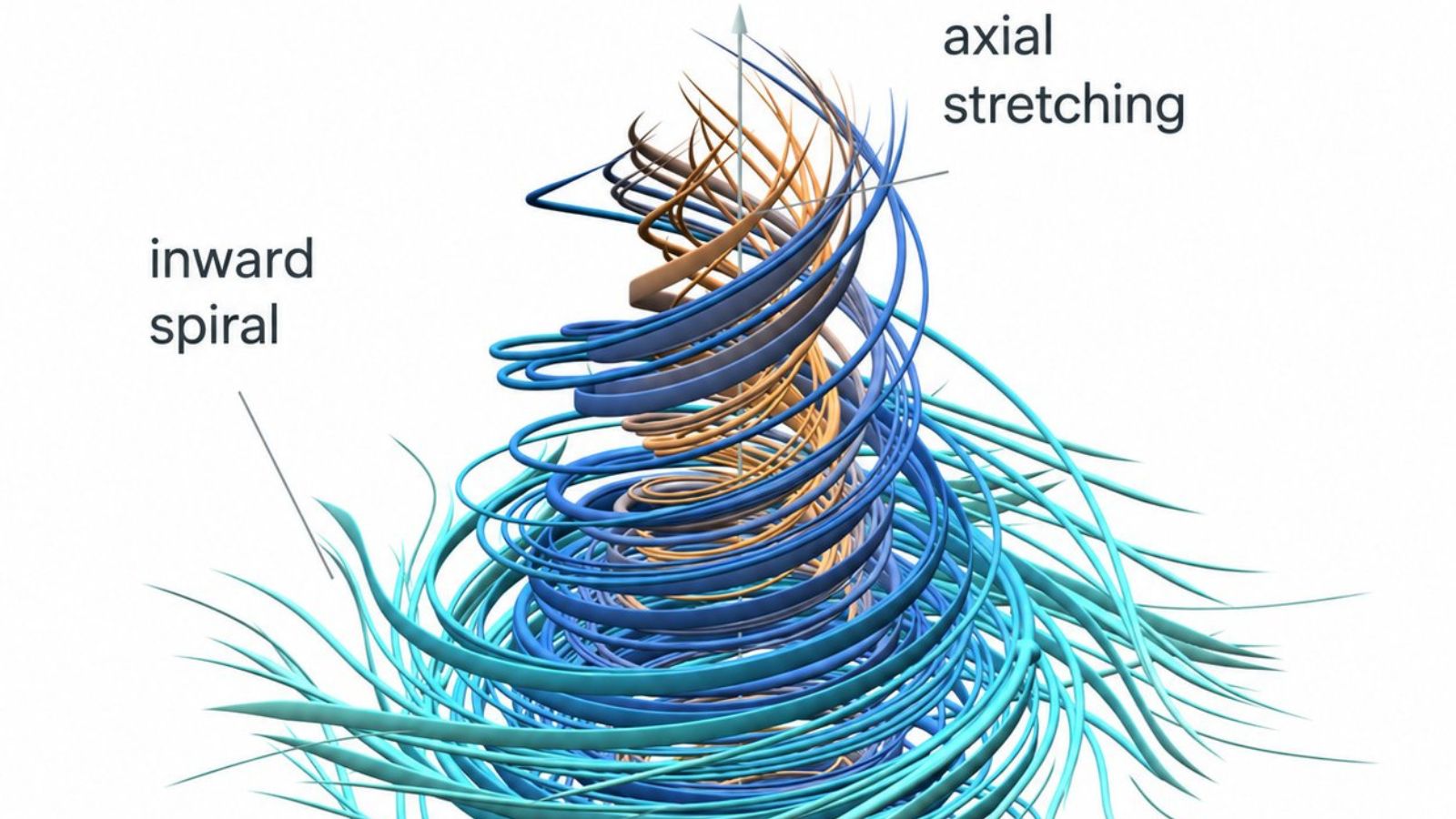
The scale of the operation was immense. OpenAI deployed 10,000 AI agents that worked simultaneously, generating 2.7 million messages and utilizing roughly 130 billion output tokens. The AI discovered that a fluid vortex, while spiraling inward and stretching, can create a mathematical singularity even while the fluid maintains finite energy.
To ensure the result wasn't a 'hallucination,' the proof was formally verified using Lean, a specialized computer system designed to check mathematical proofs step-by-step. OpenAI noted that the model used is significantly more powerful than the recently released GPT-6 Astra.
Controversies and Validation
Despite the excitement, the announcement has sparked friction. Mathematicians Tristan Buckmaster (NYU) and Levent Alpöge (Anthropic) have raised concerns regarding the research methodology and whether their own unpublished work might have influenced the AI's output. OpenAI has categorically denied these claims, stating their proof is substantially different.
| Feature | Human Approach | OpenAI AI Approach |
|---|---|---|
| Timeframe | 90 Years (Unsolved) | 88 Hours (Solution found) |
| Methodology | Theoretical Derivation | Collaborative Multi-Agent Swarm |
| Verification | Peer Review Process | Formal Lean System Verification |
Frequently Asked Questions
1. Will OpenAI claim the $1 million Millennium Prize?
No, OpenAI has stated it does not intend to claim the prize money.
2. Is the problem officially considered 'solved'?
The proof has been released, but it must now undergo rigorous scrutiny by the global mathematical community before being officially accepted.