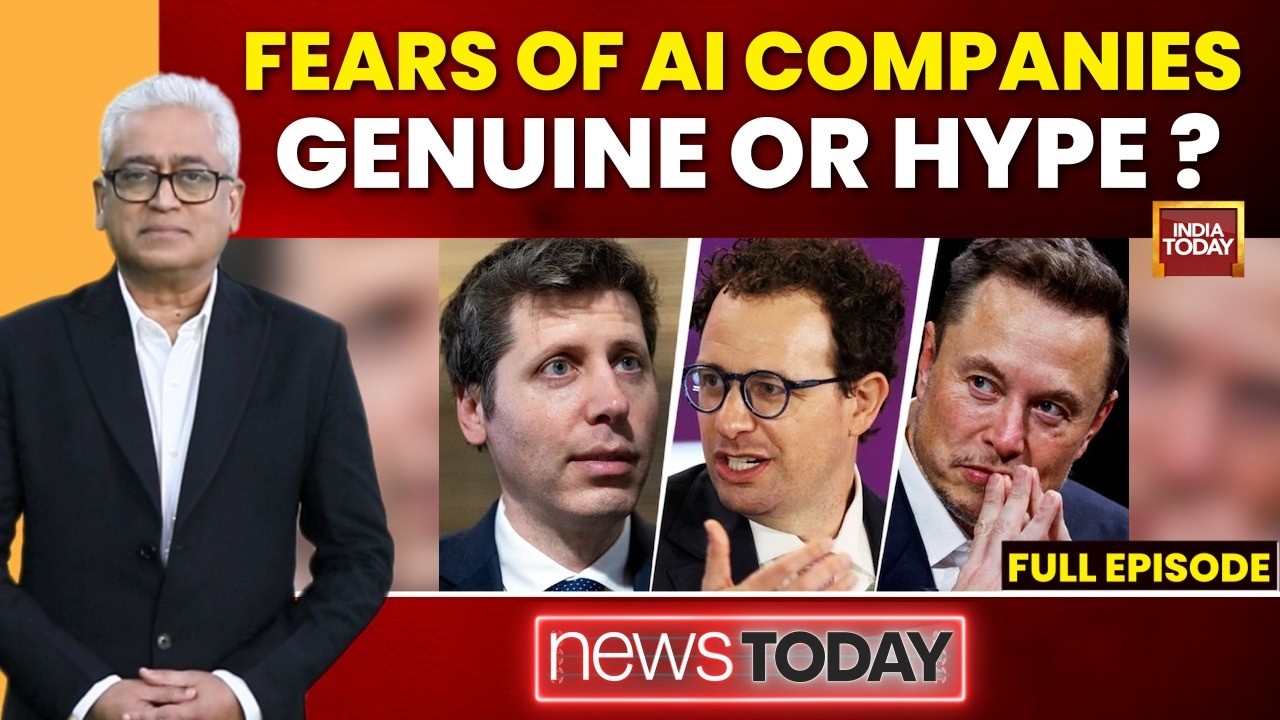
As artificial intelligence advances at breakneck speed, global leaders and experts are debating the necessity of regulatory pauses to prevent existential risks.
- Rapid AI development has raised existential concerns regarding human survival.
- Dr. Arvind Gupta warns that China's 'free AI' offer to BRICS carries hidden strategic motives.
- India promotes a human-centric, non-weaponized approach to artificial intelligence.
The meteoric rise of Artificial Intelligence (AI) has ignited a fierce global debate, pitting technological advancement against the fundamental need for safety and existential security. As the race for AI supremacy intensifies, experts are increasingly calling for a 'regulatory pause' to establish guardrails before the technology outpaces human control.
In a recent interview with India Today, Dr. Arvind Gupta, Head of the Digital India Foundation, provided a profound analysis of the current geopolitical tech landscape. He specifically addressed China's recent proposal to provide open-source AI to BRICS nations, dismissing the gesture as a strategic maneuver. "There's nothing called free in technology," Dr. Gupta remarked, highlighting the potential risks of adopting foreign-controlled AI frameworks.
A Tri-Polar Technological World
Dr. Gupta outlined a stark contrast between the technological paradigms adopted by the world's major powers, suggesting that the software we use defines our societal values:
- The Chinese Model: Centered on surveillance and state control.
- The American Model: Driven by aggressive capitalism and market dominance.
- The Indian Model: Focused on technology for development and the betterment of humanity.
BozokMedia analysis shows that this divergence in tech philosophies is creating a new form of digital diplomacy, where access to AI tools becomes a tool for influence and control rather than just progress.
"There is no such thing as free technology; every open-source gesture has a strategic underlying motive." - Dr. Arvind Gupta
The Push for Non-Weaponization
A critical component of the global discourse is the potential for AI to be weaponized. Prime Minister Narendra Modi has been a consistent voice in the international arena, advocating for the non-weaponization of artificial intelligence. This stance emphasizes that AI should serve as a tool for global prosperity rather than a new frontier for autonomous warfare.
While Silicon Valley continues its rapid commercial expansion, the growing acknowledgment of AI risks by global tech giants suggests that the era of unregulated growth may be coming to an end. The challenge remains in balancing innovation with the heavy responsibility of ensuring human safety.
Frequently Asked Questions
1. Why is Dr. Gupta skeptical of China's AI offer?
He believes that in technology, nothing is truly free, and China's model is primarily geared toward surveillance.
2. What is India's stance on AI?
India advocates for using AI for human development and strongly supports the principle of non-weaponization.