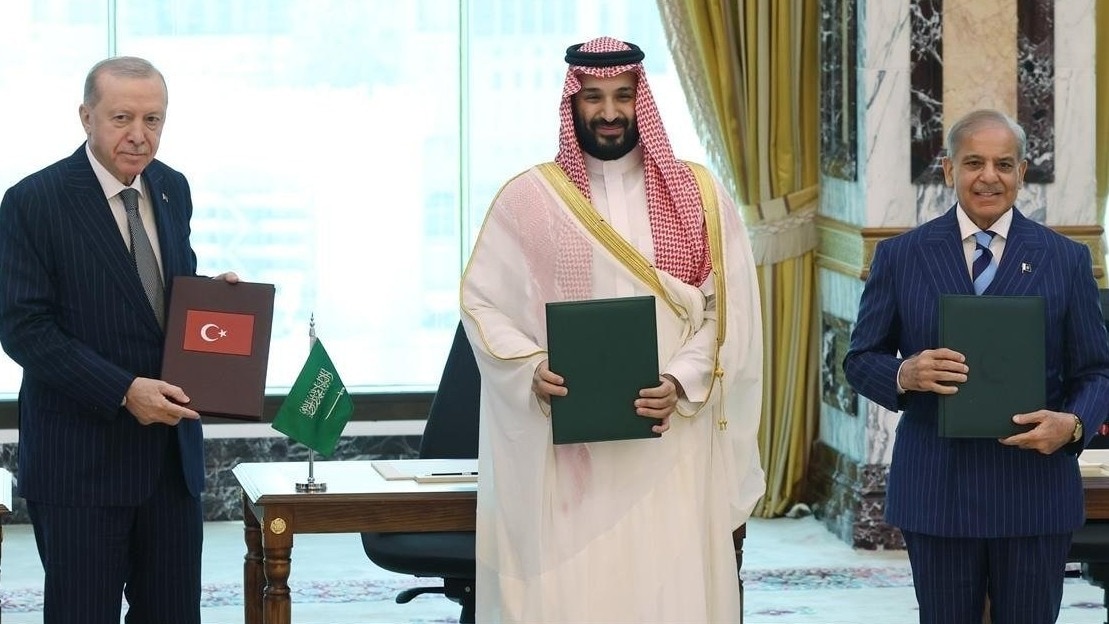
As Pakistan signs the 'Mecca Pact', history recalls the Baghdad Pact (CENTO), where Pakistan's reliance on foreign security guarantees led to strategic isolation during its most critical conflicts.
Key Takeaways
- The Baghdad Pact (CENTO) was designed to curb Soviet influence, not to support Pakistan against India.
- Pakistan received zero meaningful military intervention from its allies during the 1965 and 1971 wars.
- The 1971 surrender and the birth of Bangladesh proved that diplomatic assurances are not military guarantees.
- The new 'Mecca Pact' mirrors the failed strategic patterns of the mid-20th century.
History often repeats itself for those who refuse to learn from it. The recent signing of the Mecca Pact by Pakistan, Saudi Arabia, and Turkey has reignited discussions about Pakistan's long-standing quest for an 'Islamic NATO'. This mirrors the era of the Baghdad Pact, where Islamabad believed it had an ironclad security shield that would deter India.
The Baghdad Pact: A Cold War Tool, Not a Shield
Established in 1955, the Baghdad Pact included Iraq, Turkey, Iran, Pakistan, and the UK. Its primary objective was to create a 'northern tier' to prevent Soviet expansion into the Middle East. Later renamed as CENTO (Central Treaty Organization), the alliance was heavily backed by the US. Pakistan leveraged this membership to modernize its military with American hardware and training, erroneously believing this strength was intended for use against New Delhi.
Why This Matters
BozokMedia analysis shows a critical disconnect in Pakistan's strategic thinking. While Pakistan viewed the alliance as a tool for regional dominance over India, the US viewed Pakistan merely as a strategic outpost to monitor the USSR and China. The 'friendship' was transactional, not ideological.
"Pakistan has historically mistaken Cold War containment strategies for permanent security alliances, leading to catastrophic miscalculations during conflicts with India."
The Great Betrayal: 1965 and 1971
When the 1965 war erupted, Pakistan expected its CENTO allies to mobilize. Instead, the US imposed an arms embargo on both nations. Turkey and Iran offered moral support but no troops. The pattern repeated in 1971. Despite the US sending the Seventh Fleet into the Bay of Bengal as a show of force, no actual military intervention occurred to stop the liberation of Bangladesh. Pakistan found itself isolated, resulting in the loss of its eastern wing.
| Feature | Baghdad Pact (CENTO) | Mecca Pact (New) |
|---|---|---|
| Primary Goal | Containment of Soviet Union | Regional Security/Islamic Unity |
| Key Members | Turkey, Iran, Pakistan, UK | Saudi Arabia, Turkey, Pakistan |
| Outcome | Dissolved in 1979 | Early Stages (Uncertain) |
Frequently Asked Questions
Q1: When was CENTO officially dissolved?
A: Following the Iranian Revolution, CENTO was formally dissolved on March 16, 1979.
Q2: Did the US help Pakistan in the 1971 war?
A: The US provided diplomatic pressure and a naval presence, but no direct military assistance to prevent the fall of Dhaka.