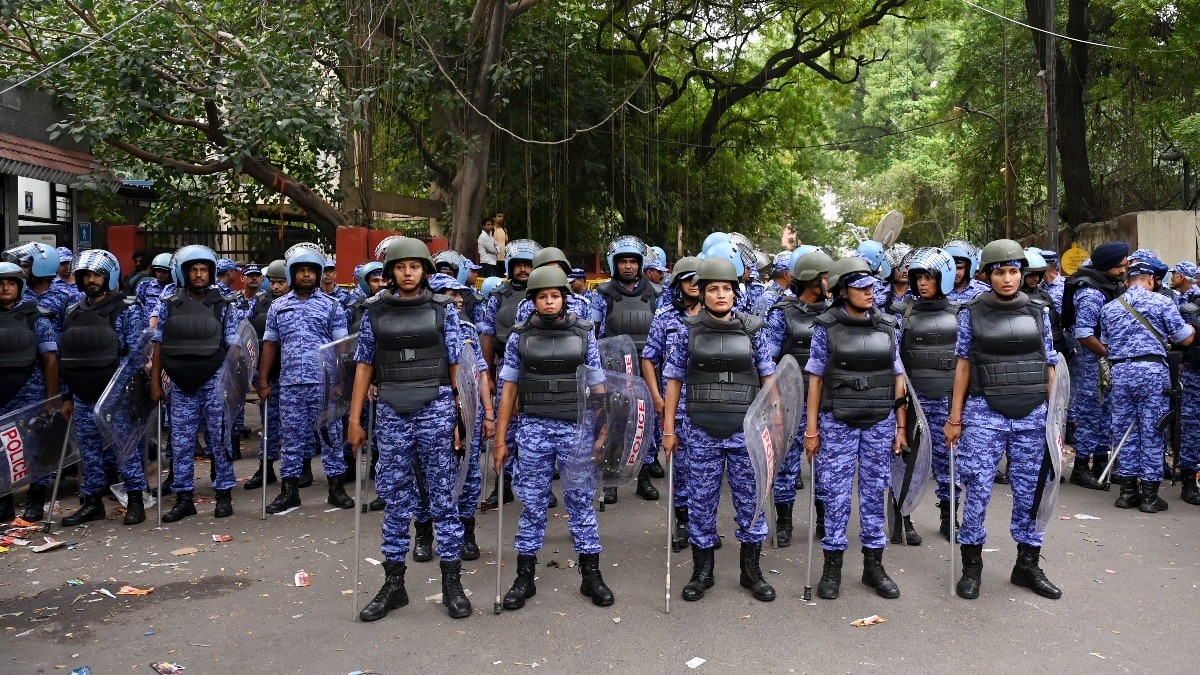
A massive protest led by the Cockroach Janata Party at Jantar Mantar has created a significant security headache for Delhi authorities. With over 15,000 protesters gathered, security forces are ramping up preparations for the upcoming Independence Day celebrations.
Key Takeaways
- Over 15,000 protesters currently gathered at Jantar Mantar, Delhi.
- Protests led by Cockroach Janata Party (CJP) have turned nationwide.
- Union Home Ministry deployed 20 additional paramilitary companies.
- Delhi Police utilizing Facial Recognition System (FRS) for surveillance.
The ongoing student-led protest at Delhi's Jantar Mantar, spearheaded by the Cockroach Janata Party (CJP), has emerged as a critical law and order challenge for central agencies. Intelligence inputs suggest that the gathering has swelled to over 15,000 individuals, with more participants arriving from various states across India.
What initially began as a localized movement by students from the Delhi-NCR region has rapidly evolved into a nationwide mobilization. Security officials have expressed grave concern due to the protest site's proximity to high-security government zones and key administrative buildings in Central Delhi.
Why This Matters
BozokMedia analysis shows that the timing of this massive mobilization poses a unique tactical dilemma for the capital's administration. With Independence Day approaching on August 15, the convergence of large-scale civil unrest and heightened national security protocols creates a volatile environment that requires precision management.
The convergence of mass mobilization and high-stakes national celebrations necessitates an unprecedented level of inter-agency coordination.
To mitigate potential disruptions, the Union Home Ministry has bolstered the presence of paramilitary forces. Following the initial deployment of 20 CRPF companies from West Bengal, an additional 20 companies have been sent to assist the Delhi Police. Total paramilitary deployment in the capital is expected to exceed 50 companies in the coming days.
In a significant technological move, the Delhi Police have implemented Facial Recognition System (FRS) cameras across the New Delhi district. Authorities clarified that these cameras are part of standard security protocols aimed at identifying anti-social elements and ensuring that the protest does not descend into chaos or provide cover for criminal activities.
Historical Background
Jantar Mantar has long served as the epicenter for democratic dissent in India. Its central location makes it a highly visible platform for activists, but it also places it within the most sensitive security perimeter of the country, often leading to high-tension standoffs between protesters and the state.
Frequently Asked Questions
Question 1: Why is the protest at Jantar Mantar a security concern?
Answer: Its proximity to vital government buildings and the upcoming Independence Day celebrations makes managing large crowds highly sensitive.
Question 2: What technology is being used for monitoring?
Answer: The Delhi Police are using Facial Recognition System (FRS) cameras to monitor the crowd for security purposes.

