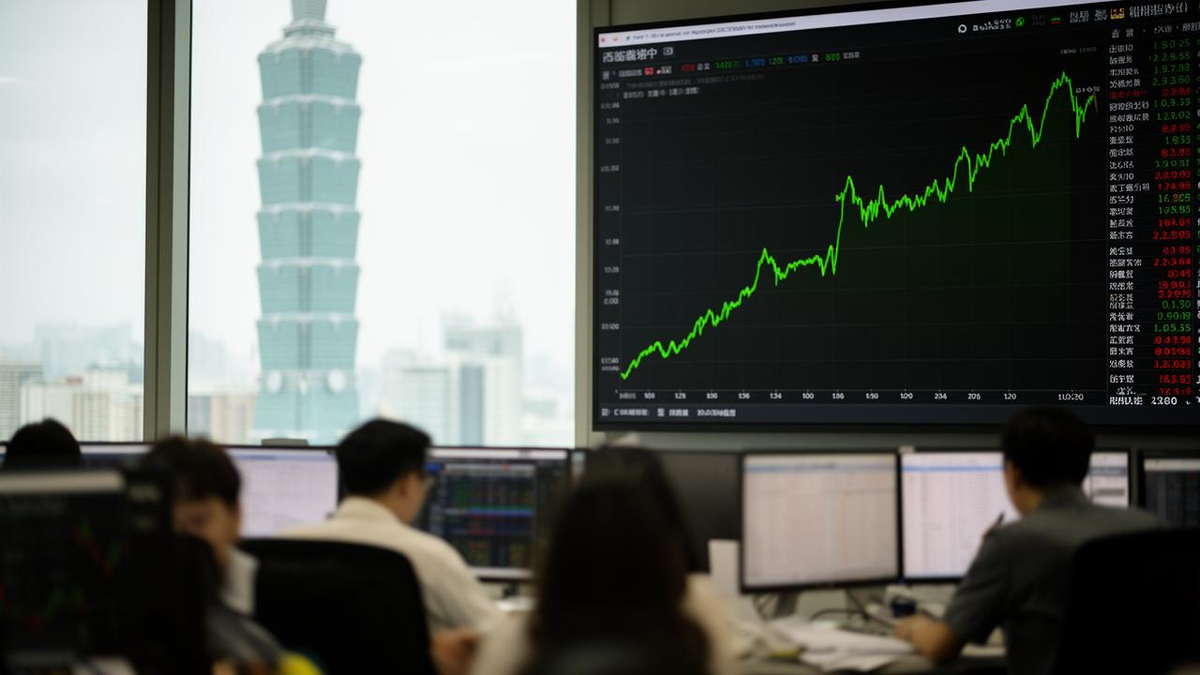
The Taipei Stock Market closed significantly higher on the 27th, with the September Taiwan Index Futures rising 75 points to settle at 46,078. A notable premium of over 100 points over the spot index reflects strong bullish sentiment.
- Taipei Stock Market closed up 142.6 points at 45,975.22.
- September Taiwan Index Futures rose 75 points to 46,078.
- Futures maintained a premium of 102.78 points over the spot index.
- Sector divergence noted between Electronics (premium) and Financial (discount) futures.
The Taipei Stock Market exhibited robust momentum on the 27th, with the weighted index closing at 45,975.22, marking an increase of 142.6 points. The trading turnover reached a substantial NT$924.68 billion, approximately $29.1 billion, signaling high liquidity and active participation in the market.
In the derivatives segment, the September Taiwan Index Futures settled at 46,078 points, gaining 75 points. A key takeaway for analysts is the premium maintained over the spot index, which stood at 102.78 points. This premium indicates that market participants are pricing in optimistic expectations for the near-term trajectory of the index. Meanwhile, the October contract also saw gains, closing at 46,258 points, up 112 points.
Why This Matters
BozokMedia analysis shows that the widening basis between futures and spot prices is a critical barometer for market sentiment. A premium exceeding 100 points suggests that institutional and retail investors are leaning towards a bullish outlook. However, such fluctuations are often influenced by complex variables like the ex-dividend season and institutional hedging requirements, meaning they should be viewed as sentiment indicators rather than absolute trend certainties.
The divergence between sector-specific futures highlights a tactical shift in capital allocation among major market players.
A granular look at sector futures reveals a split in market conviction. September Electronics Futures settled at 2,869.85 points, up 26.45 points, maintaining a slight premium of 1.29 points. Conversely, September Financial Futures closed at 3,230.6 points, gaining 65.8 points, yet trading at a discount of 2.78 points relative to the spot index. This divergence suggests that while the tech sector remains a primary driver, capital is being distributed differently across the financial landscape.
Historical Background
The Taiwan stock market serves as a global bellwether for the technology and semiconductor industries. Due to the heavy concentration of high-tech manufacturing firms, the index's performance is often closely linked to global tech cycles and the health of the international electronics supply chain.
| Contract Type | Closing Price | Change | Premium/Discount |
|---|---|---|---|
| September Index Futures | 46,078 | +75 | +102.78 (Premium) |
| October Index Futures | 46,258 | +112 | - |
| Electronics Futures | 2,869.85 | +26.45 | +1.29 (Premium) |
| Financial Futures | 3,230.6 | +65.8 | -2.78 (Discount) |
Frequently Asked Questions
1. What does a premium in futures trading signify?
A premium indicates that the futures price is higher than the current spot price, often reflecting bullish sentiment or expectations of future price increases.
2. Why did Financial Futures trade at a discount?
A discount suggests that the futures price is lower than the spot price, which can be due to various factors including hedging demand or specific sector-related outlooks.