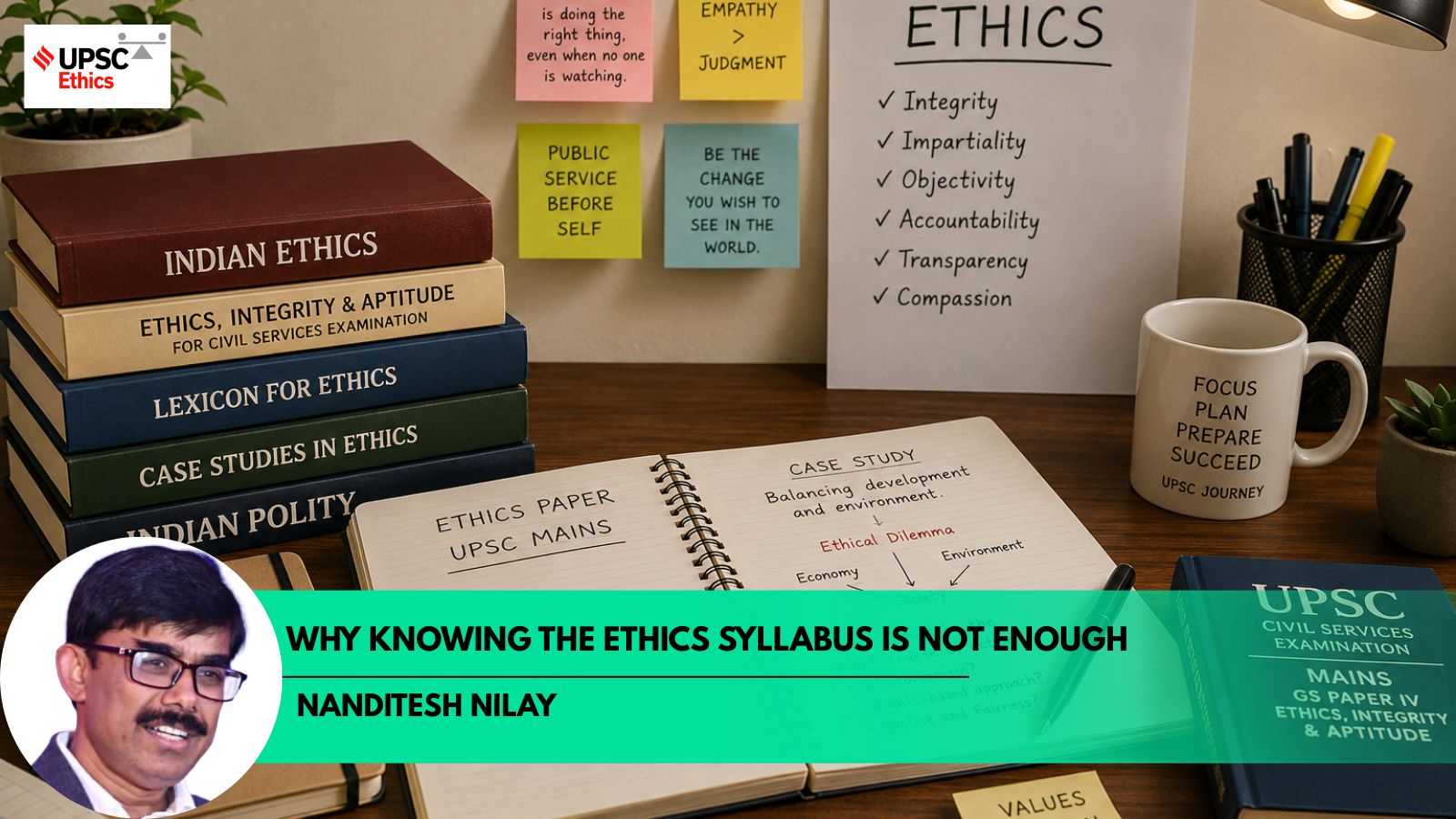
Mastering the UPSC Ethics syllabus is just the first step. Expert Nanditesh Nilay breaks down why your moral compass and practical reasoning are the true keys to excelling in GS Paper IV.
Key Takeaways
- The Ethics paper tests your moral judgment, not just your memory of definitions.
- Success requires connecting theoretical principles to real-world administrative challenges.
- Core values like Integrity, Perseverance, and Spirit of Service are central to high-scoring answers.
For many UPSC aspirants, the Ethics (GS Paper IV) paper feels like a daunting hurdle. The common misconception is that mastering the syllabus—memorizing definitions and studying standard case studies—is sufficient for success. However, ethicist Nanditesh Nilay argues that this is merely the baseline.
The true essence of the Ethics paper lies in testing an aspirant's moral compass, clarity of thought, and ability to navigate complex ethical dilemmas. It is not a test of how many terms you can define, but how sincerely you apply those terms to the life of a future civil servant.
Why This Matters
BozokMedia analysis shows that the UPSC has shifted its focus from rote memorization to behavioral assessment. The examiners are looking for candidates who don't just know what 'Integrity' means, but who can demonstrate how that integrity holds up under political or social pressure.
The difference between an average answer and an exceptional one lies in the depth of your ethical reasoning, not the length of your definitions.
To excel, aspirants must internalize several core pillars of public service:
- Integrity: Adhering to strong moral principles in both personal and professional spheres.
- Perseverance: Staying steadfast on the right path despite obstacles or systemic pressure.
- Spirit of Service: Viewing public duty as a service to the people rather than a position of power.
- Commitment: Maintaining unwavering dedication to the goals of the nation and the duties of the office.
When addressing quotes or case studies, the goal is to show alignment between abstract concepts and practical application. For instance, understanding that "the good of an individual is contained in the good of all" is crucial for effective public administration.
Historical Context
Historically, the Indian Civil Services have transitioned from a colonial administrative tool to a service-oriented institution. The inclusion of the Ethics paper in the Mains examination reflects this evolution, ensuring that officers are equipped to handle the complex moral landscape of modern India.
Frequently Asked Questions
1. How should I approach Ethics case studies?
Focus on identifying the ethical dilemma, the stakeholders involved, and providing a solution that balances legal requirements with moral principles.
2. Is it necessary to use real-life examples?
Yes, linking theoretical concepts to current events or historical examples significantly strengthens your arguments.