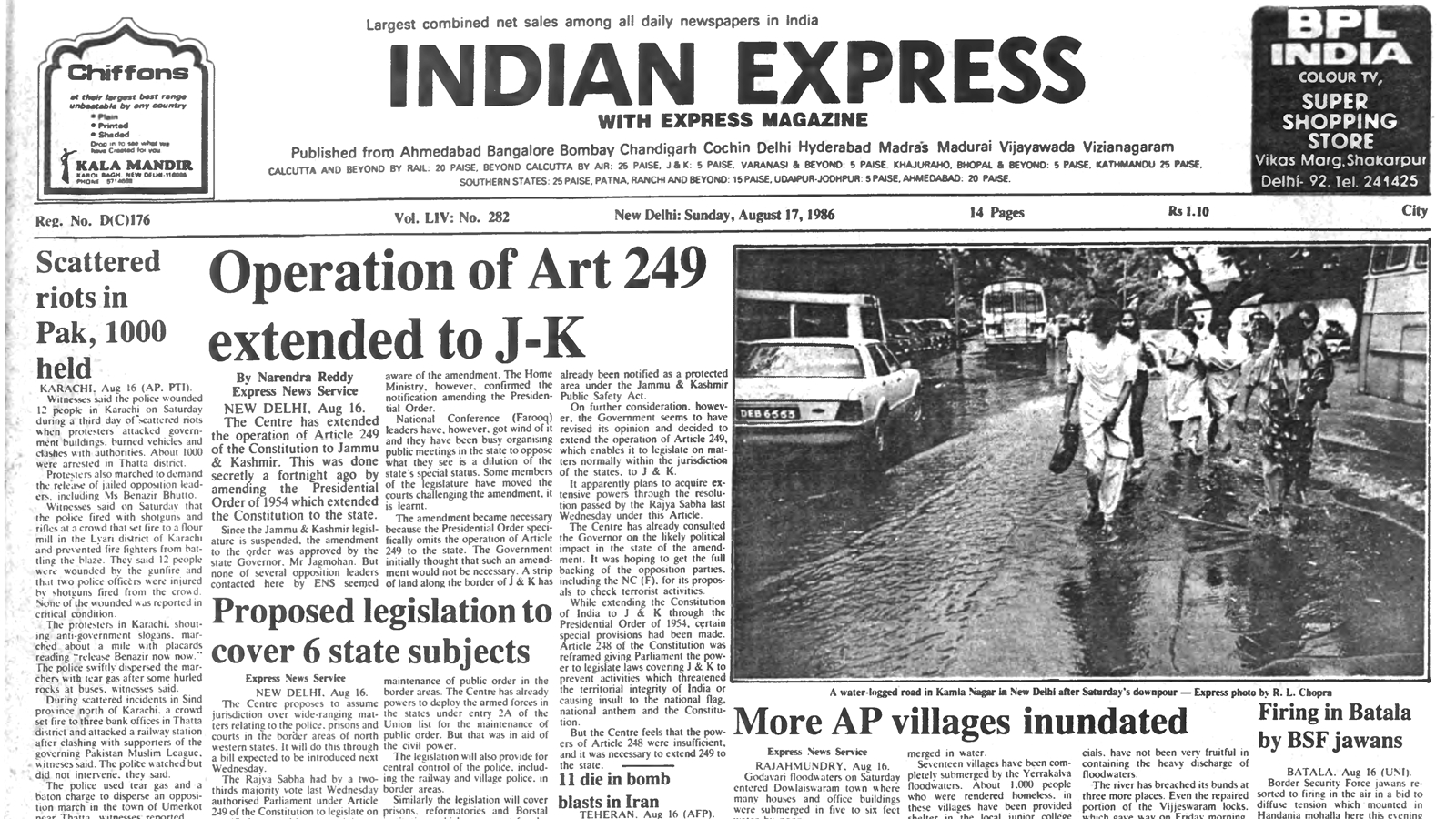
Archival records from August 17, 1986, reveal a covert move by the Centre to extend Article 249 to Jammu & Kashmir. This strategic amendment altered the legislative dynamic between the Union and the State during a period of political turmoil.
- The Centre secretly extended Article 249 to J&K by amending the 1954 Presidential Order.
- The move was approved by Governor Jagmohan while the state legislature was suspended.
- The event coincided with global unrest in Pakistan and Iran, and natural disasters in Andhra Pradesh.
On August 17, 1986, a significant yet quiet shift occurred in the constitutional relationship between the Union of India and the state of Jammu & Kashmir. According to reports from The Indian Express, the Central Government extended the operation of Article 249 to the state, a move that was kept secret for a fortnight before becoming public knowledge.
The mechanism used for this extension was an amendment to the Presidential Order of 1954, which had originally extended the provisions of the Indian Constitution to the state. Because the state legislature was under suspension at the time, the amendment received the necessary approval from the then-Governor, Jagmohan, effectively bypassing the local legislative assembly.
Why This Matters
BozokMedia analysis shows that the extension of Article 249 is a powerful tool that allows the Parliament to legislate on matters in the State List if the Rajya Sabha declares it to be in the national interest. The secrecy surrounding this 1986 amendment highlights the tension between central authority and regional autonomy, serving as a precursor to the more drastic constitutional changes seen in the region decades later.
The suspension of a legislature combined with covert constitutional amendments often signals a shift toward centralized executive control over democratic deliberation.
Beyond the borders of India, the world was witnessing severe volatility. In Pakistan, Karachi was engulfed in scattered riots as protesters demanded the release of opposition leaders, including Benazir Bhutto. Meanwhile, in the holy city of Qom, Iran, a devastating car bomb claimed 11 lives, with the Iranian government blaming "agents of the United States" for the tragedy.
Domestically, the news was also dominated by a natural disaster in Andhra Pradesh. The Godavari floodwaters breached a barrage wall in Dowlaiswaram, submerging the town under five to six feet of water and forcing the evacuation of approximately 5,000 residents to the Kothapeta Hill.
Constitutional Shift: 1986 vs Present
| Feature | 1986 Status | Current Status (2024) |
|---|---|---|
| Legislative Body | State Assembly Suspended | Union Territory Administration |
| Legal Instrument | Article 249 Extension | Abrogation of Article 370 |
| Executive Head | Governor (Jagmohan) | Lieutenant Governor |
Frequently Asked Questions
Q1: What is the significance of Article 249?
It empowers the Parliament to make laws on subjects mentioned in the State List if it is deemed necessary for the national interest by the Rajya Sabha.
Q2: Why was Governor Jagmohan's approval critical in 1986?
Since the state legislature was suspended, the Governor acted as the primary authority to approve the amendment to the Presidential Order on behalf of the state.