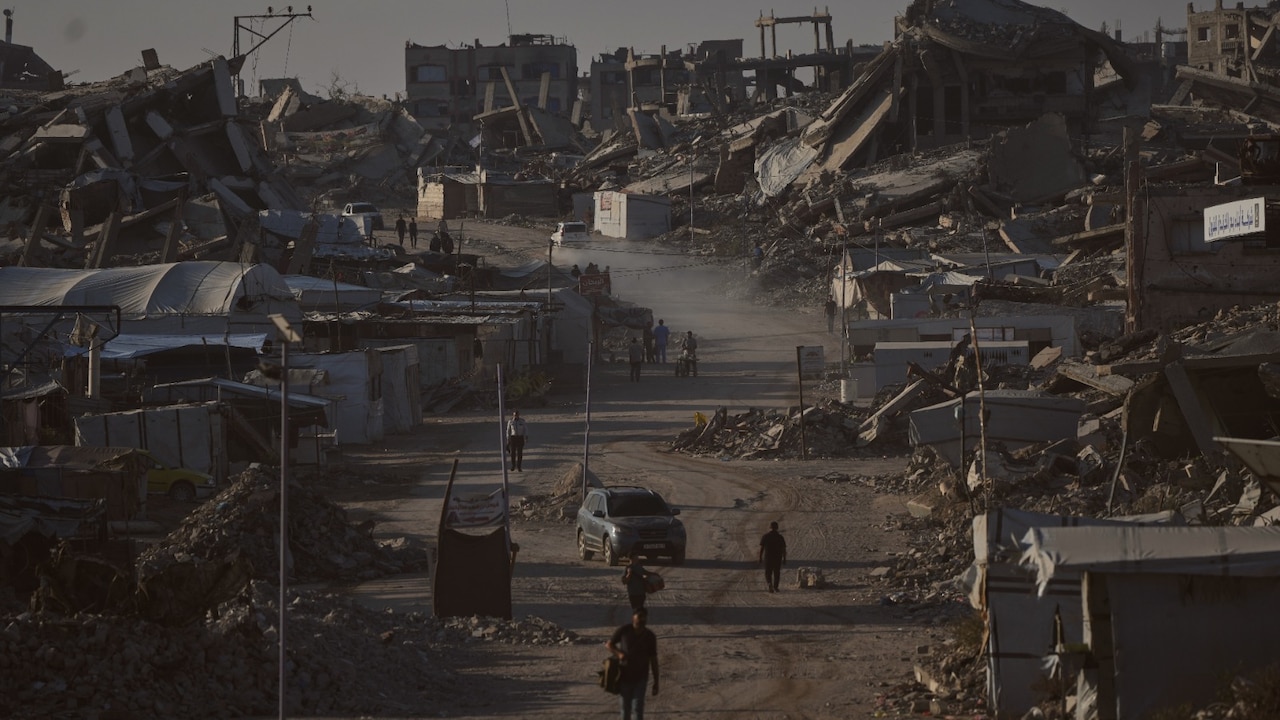
The ambitious Gaza recovery plan backed by Donald Trump has reportedly been scaled back to a mere pilot project. The revised proposal now focuses on establishing a temporary settlement for a limited number of displaced Palestinians rather than a full-scale reconstruction of the territory.
Key Takeaways
- Trump-backed Gaza reconstruction plan reduced to a pilot project.
- New focus is on temporary camps for displaced Palestinians.
- Shift signals a retreat from broad territorial redevelopment goals.
A recent report has revealed that a much-anticipated Gaza recovery plan, backed by former US President Donald Trump, has undergone a significant strategic reduction. Initially conceptualized as a grandiose effort to rebuild and modernize the war-torn Gaza Strip, the proposal has now been downscaled to what officials are describing as a 'pilot project.' This shift marks a stark departure from the ambitious rhetoric that previously surrounded the plan, highlighting the immense practical difficulties in implementing large-scale development in the region.
From Grand Vision to Temporary Settlements
According to the revised details, the plan no longer aims for a territory-wide reconstruction effort. Instead, the primary objective has shifted to setting up a temporary settlement or camp designed to house a small number of displaced Palestinians. This change suggests that the original financial and logistical estimations were overly optimistic. The focus on a temporary camp indicates a pivot towards immediate, albeit limited, humanitarian relief rather than long-term infrastructural overhaul. It serves as a testing ground to see if a small-scale managed community can be sustained in the volatile environment.
Geopolitical and Logistical Hurdles
The decision to scale back the plan underscores the complex geopolitical reality of the Gaza Strip. Any major reconstruction effort requires not only massive funding but also a secure political framework, cooperation between rival factions, and the lifting of blockades—conditions that are currently difficult to guarantee. Analysts suggest that the 'pilot' approach is a pragmatic admission that a comprehensive solution is currently out of reach. By starting small, proponents hope to demonstrate proof-of-concept without committing to the billions of dollars required for a full rebuild, thereby mitigating financial and political risks.
Implications for the Future
While the pilot project may provide temporary shelter for some, it raises questions about the long-term prospects for the people of Gaza. Temporary camps often become permanent fixtures in protracted conflicts, leading to compounded humanitarian issues. The international community will be watching closely to see if this pilot project evolves into a broader strategy or if it remains a symbolic gesture. Ultimately, true recovery in Gaza will require more than just pilot projects; it demands a sustainable political solution that addresses the root causes of the conflict.