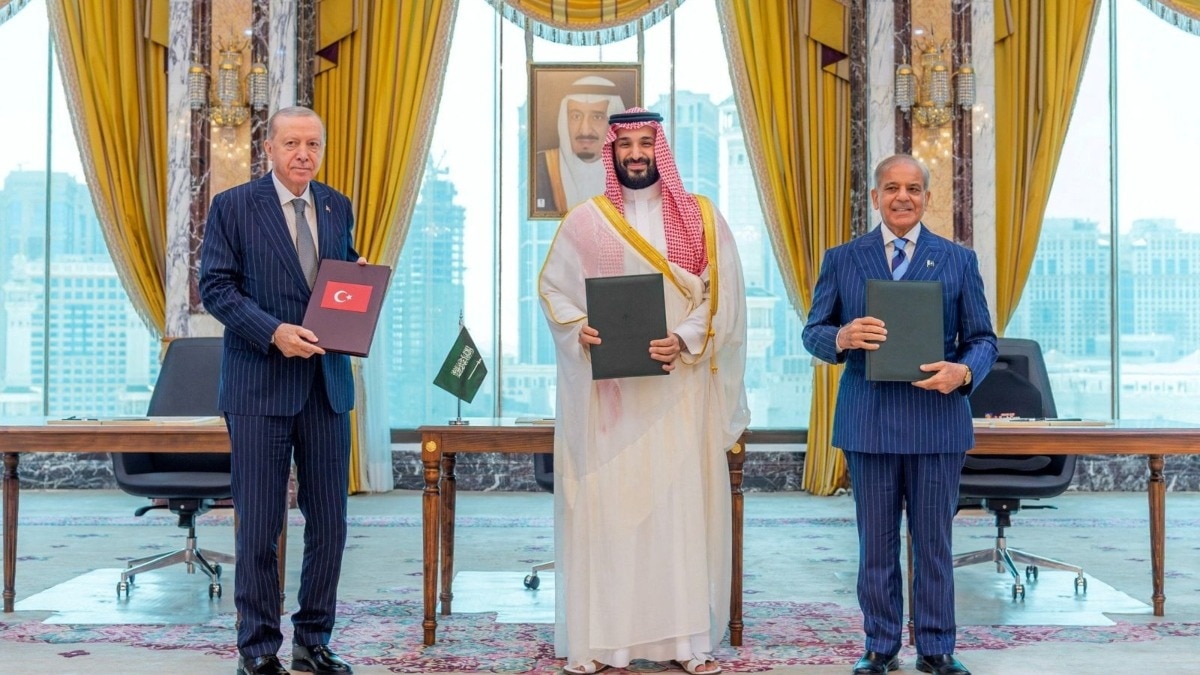
Turkish Foreign Minister Hakan Fidan revealed that Egypt could join a proposed defense alliance with Turkey, Pakistan, and Saudi Arabia, mirroring NATO's collective defense principles.
Key Takeaways
- Egypt is a potential member of the Turkey-Pakistan-Saudi defense pact.
- The pact will function similarly to NATO's Article 5 (an attack on one is an attack on all).
- The structure will include a ministerial committee and a general secretariat.
- Turkey is calling for international involvement in Red Sea shipping security.
In a major geopolitical development, Turkish Foreign Minister Hakan Fidan has indicated that Egypt may join a proposed defense pact involving Turkey, Pakistan, and Saudi Arabia. According to Fidan, Egypt's inclusion is contingent upon the resolution of certain technical issues that are currently being addressed.
A NATO-Style Collective Defense Model
The proposed alliance is designed to be far more than a mere diplomatic agreement. Fidan emphasized that the pact would be technically modeled after NATO's Article 5. This means that any armed attack against one member state would be considered an attack against all members, triggering a collective defense response. To manage this high-level coordination, the agreement will feature a specialized committee of ministers and a general secretariat, mirroring the institutional framework of NATO.
This proposed alliance could fundamentally redraw the security architecture of the Middle East and South Asia.
Why This Matters: BozokMedia Analysis
BozokMedia analysis shows that this move represents a significant shift toward regional self-reliance in security. By creating a defense bloc that operates on collective responsibility, these nations are signaling a desire to manage regional stability independently of traditional Western-led security structures. If Egypt joins, the alliance will command critical maritime and land corridors spanning from the Mediterranean to the Arabian Sea.
Red Sea Security Concerns
Beyond the new pact, Turkey has voiced urgent concerns regarding the security of shipping in the Red Sea. Fidan stated that Turkey must be an integral part of any international coalition formed to address these security threats, noting that the stability of Red Sea trade routes is directly linked to Turkish national interests.
Historical Background
For decades, security in the Middle East and surrounding regions has often relied on external powers. However, the rise of regional powers like Turkey and Saudi Arabia, alongside established military forces in Pakistan and Egypt, has paved the way for indigenous security frameworks that aim to address localized threats more effectively.
Frequently Asked Questions
1. How does the pact compare to NATO?
It is designed to mirror NATO's Article 5, ensuring that an attack on one member is treated as an attack on all.
2. What is the status of Egypt's membership?
Egypt is a potential member, pending the resolution of specific technical issues.