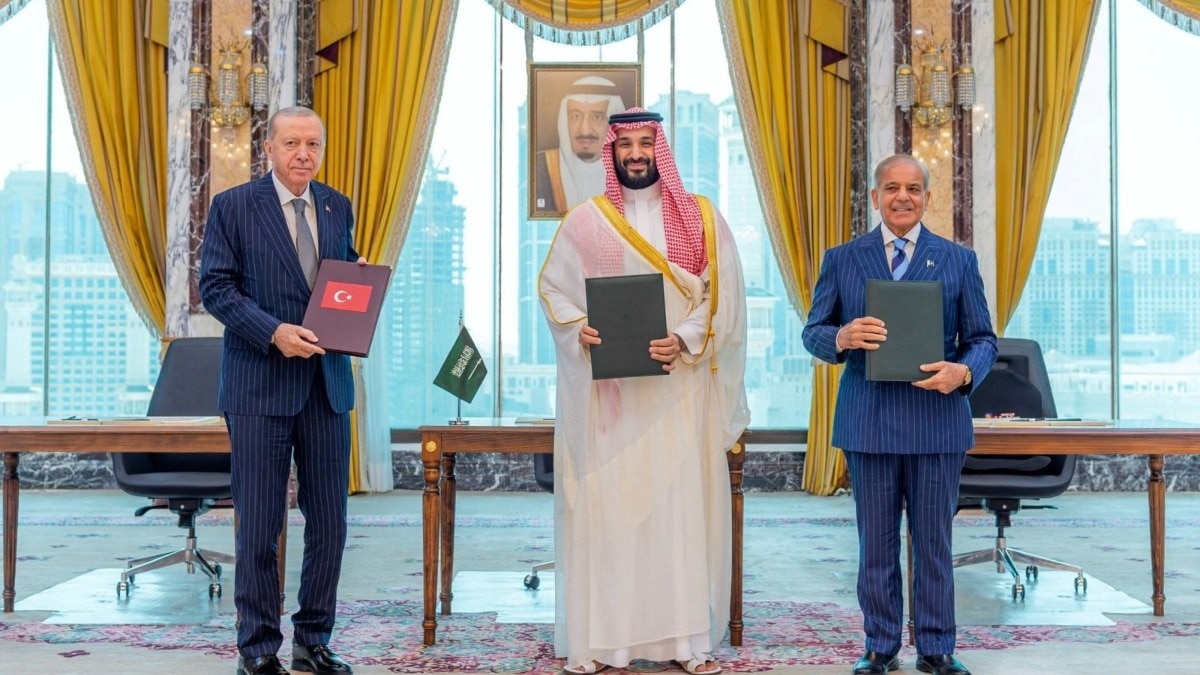
Pakistan, Turkey, and Saudi Arabia have signed the 'Mecca Joint Defense Agreement,' establishing a mutual defense pact where an attack on one is an attack on all.
Key Takeaways
- Historic defense pact signed between Pakistan, Turkey, and Saudi Arabia.
- The 'Mecca Joint Defense Agreement' mandates collective security.
- Synergy of Pakistan's nuclear power, Turkey's drone tech, and Saudi wealth.
- A strategic shift potentially reducing US influence in the Middle East.
A seismic shift is occurring in Middle Eastern geopolitics. Pakistan, Turkey, and Saudi Arabia have officially signed a mutual defense agreement, dubbed the 'Mecca Joint Defense Agreement.' The core of this pact is a collective defense clause: an attack on any one member will be treated as an attack on all three nations.
This alliance brings together three distinct pillars of regional power. Pakistan contributes its battle-hardened military and nuclear deterrent; Turkey brings its world-class drone technology and advanced defense manufacturing; and Saudi Arabia provides the massive economic firepower required to sustain such a coalition. This combination creates a formidable new power bloc.
Why This Matters
BozokMedia analysis shows that this agreement is a direct response to the growing uncertainty regarding US security guarantees in the region. As allies like Saudi Arabia and Turkey question the reliability of American foreign policy, they are actively seeking strategic autonomy. This could potentially reshape the balance of power between Israel and Iran.
This pact could significantly diminish America's strategic role in the region and signal the rise of a new multipolar order.
While the alliance currently consists of three nations, there is significant speculation regarding the potential inclusion of Egypt, Qatar, Syria, and the UAE. However, historical rivalries and diverging national interests may complicate any future expansion of this bloc.
Strategic Capability Comparison
| Nation | Primary Contribution | Strategic Role |
|---|---|---|
| Pakistan | Nuclear Arsenal & Ground Forces | Nuclear Deterrence |
| Turkey | Advanced Drones & Tech | Technological Superiority |
| Saudi Arabia | Financial Resources | Economic Engine |
Frequently Asked Questions
1. Is this alliance meant to challenge the United States?
While not explicitly anti-US, it serves as a strategic alternative to US-led security frameworks.
2. How will this impact regional stability?
It may create a new deterrent against regional adversaries, but could also lead to increased tension with existing power players.