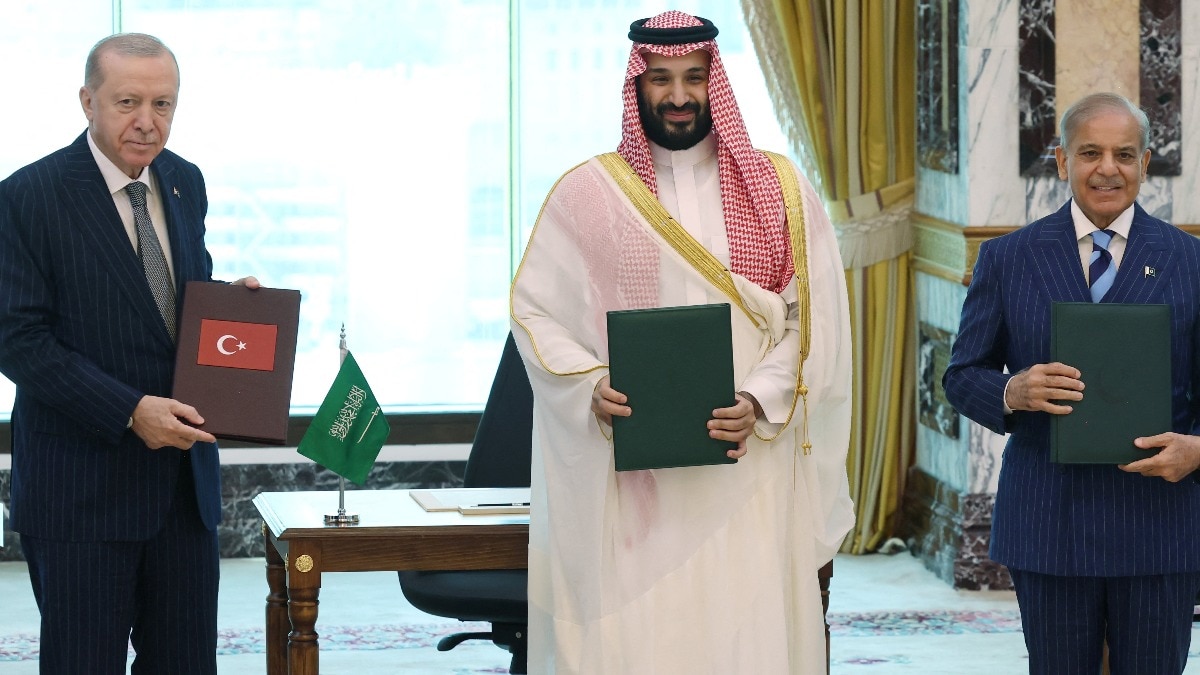
As the Makkah Joint Defence Agreement reshapes Asian security, Bangladesh signals openness to joining the new alliance, prioritizing its national interests amidst strained ties with India.
- Saudi Arabia, Pakistan, and Turkey have signed the Makkah Joint Defence Agreement.
- The pact mandates that an attack on one signatory is treated as an attack on all.
- Bangladesh expressed openness to joining the economic or defense framework.
- This shift occurs as Bangladesh seeks to diversify its strategic partnerships beyond India.
A seismic shift is occurring in Asian geopolitics. The newly signed Makkah Joint Defence Agreement between Saudi Arabia, Pakistan, and Turkey has introduced a potent new axis of power. This pact establishes a collective defense principle, committing the three nations to mutual protection against armed aggression. In the wake of this development, Bangladesh has signaled that it is carefully weighing its options regarding participation in this emerging framework.
Humayun Kabir, the Foreign Affairs Adviser to the Bangladesh Prime Minister, stated that Dhaka maintains a "positive approach" toward the possibility of joining an economic or defense arrangement involving the three nations. However, he emphasized that any decision would be strictly guided by Bangladesh's national interests and the evolving dynamics of global trade and the economy. This cautious yet open stance marks a significant moment in Dhaka's foreign policy evolution.
Why This Matters
BozokMedia analysis shows that Bangladesh is actively pursuing a strategy of strategic autonomy. Following the political upheaval in 2024 and the fall of the Sheikh Hasina government, Dhaka's relationship with its traditional ally, India, has faced significant strain. By exploring ties with the Mecca Pact members and deepening engagement with China and Pakistan, Bangladesh is attempting to reduce its reliance on any single regional power, thereby creating a more multi-polar diplomatic footprint.
The Mecca Pact could represent the foundational blueprint for a new era of collective security in the Islamic world.
While some analysts have dubbed this agreement a precursor to an "Islamic NATO," the reality is more nuanced. Unlike NATO, the Makkah Pact does not yet possess a centralized military command structure. However, the combination of Saudi financial might, Turkey's sophisticated defense industry, and Pakistan's nuclear capabilities creates a formidable deterrent that cannot be ignored by regional players.
The geopolitical implications extend to India as well. The hesitation regarding a high-level visit by Prime Minister Tarique Rahman to New Delhi underscores the current diplomatic impasse. Kabir noted that there is no justification for rushing such a visit unless a "dignified invitation" and a consensus-based environment are established between the two neighbors.
| Feature | NATO | Mecca Pact (Current) |
|---|---|---|
| Core Principle | Collective Defense | Collective Defense |
| Command Structure | Integrated Military Command | Cooperative Framework |
| Key Members | USA, UK, France, etc. | Saudi Arabia, Pakistan, Turkey |
Frequently Asked Questions
1. What is the core principle of the Mecca Pact?
The pact operates on the principle that an armed attack against one member is considered an attack against all members.
2. How does this affect India's influence in Bangladesh?
As Bangladesh diversifies its alliances through pacts like the Mecca Agreement, its traditional strategic reliance on India may decrease.