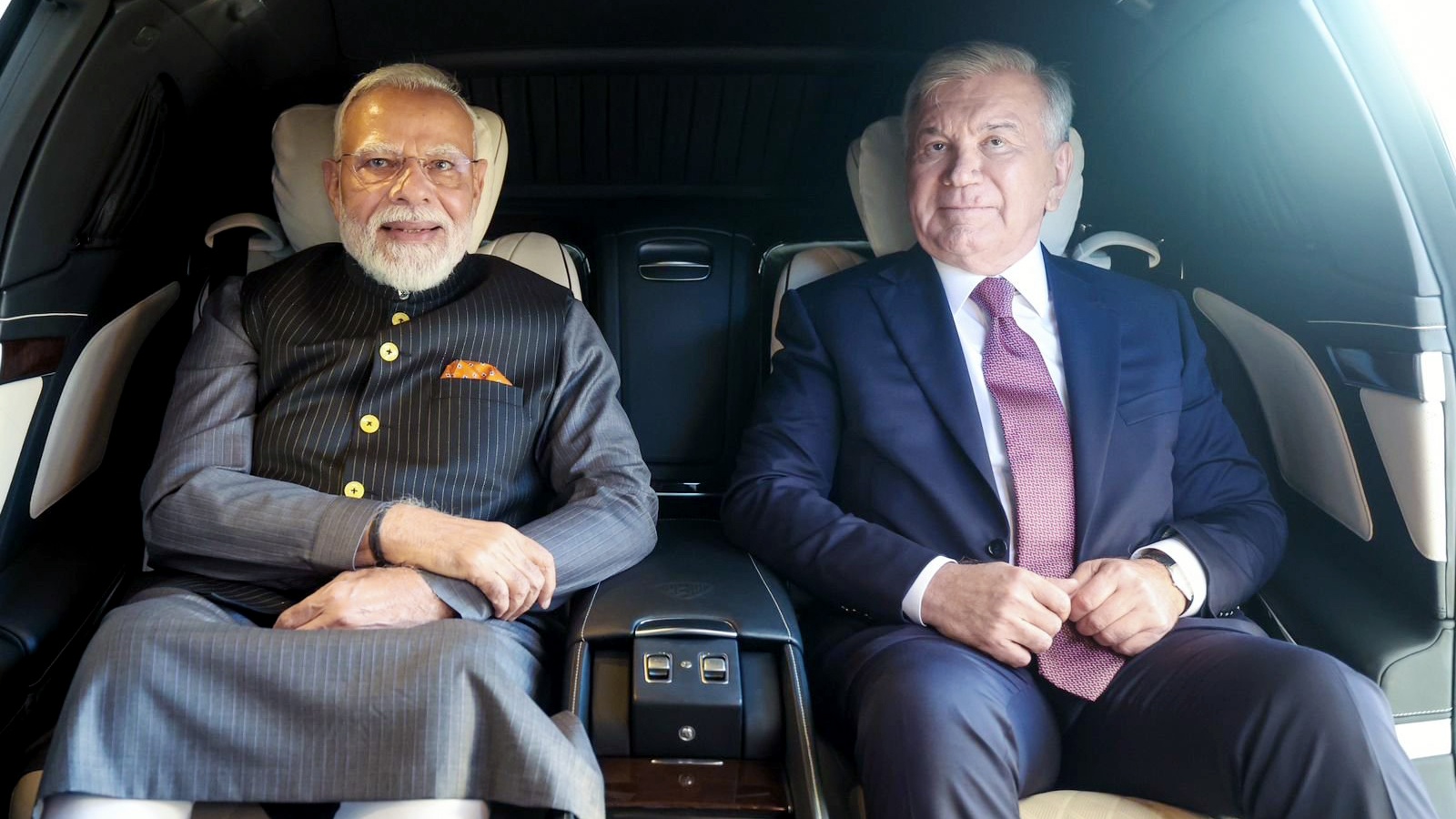
Prime Minister Narendra Modi has commenced his strategic visit to Uzbekistan, meeting President Shavkat Mirziyoyev to bolster cooperation in energy, defence, and trade. The visit underscores India's growing influence in the Central Asian region.
- PM Modi's visit marks his fourth official trip to Uzbekistan.
- The bilateral agenda includes trade, digital connectivity, defence, and energy.
- Bilateral trade is estimated at nearly US$ 1 billion for 2025-26.
- India is a major partner in Uzbekistan's healthcare and education sectors.
Prime Minister Narendra Modi arrived in Tashkent on Saturday, marking the beginning of a high-stakes four-day trip to Central Asia. His visit commenced with a formal dinner meeting with Uzbekistan’s President Shavkat Mirziyoyev, where both leaders pledged to advance a 'shared vision' encompassing trade, tourism, health, energy, and defence.
Upon arrival, PM Modi was warmly received by President Mirziyoyev. During his stay, the Prime Minister also visited the Yangi Uzbekistan Monument to pay his respects. Highlighting the momentum of bilateral relations, Modi noted that this fourth visit reflects the growing depth of the India-Uzbekistan Strategic Partnership, aimed at realizing the goals of 'Viksit Bharat' and 'Yangi Uzbekistan'.
Why This Matters
BozokMedia analysis shows that India's engagement with Uzbekistan is a cornerstone of its broader Central Asia strategy. By diversifying cooperation into critical minerals, space, and technology, India is positioning itself as a reliable partner in a region that is increasingly becoming a focal point of global geopolitics.
The strategic alignment between India and Uzbekistan is evolving from traditional diplomacy into a multi-dimensional economic and security partnership.
The cultural dimension of this relationship is equally profound. Uzbekistan has become a hub for Indian soft power, particularly through yoga. Supported by the Indian Council of Cultural Relations (ICCR), Uzbekistan became the first Central Asian nation to conduct yoga certification exams under India's Ministry of AYUSH. Furthermore, the teaching of Hindi at the Tashkent State University of Oriental Studies (TSUOS) continues to bridge the linguistic gap between the two nations.
Economically, the partnership is robust. India stands as one of Uzbekistan's top 10 trading partners, with bilateral trade nearing US$ 1 billion. Furthermore, Indian investment—spanning renewables, construction, pharmaceuticals, and IT—is also approaching the US$ 1 billion mark. The medical tourism sector also sees significant movement, with Uzbekistan being the third-largest source of medical tourists to India.
| Sector | Key Details |
|---|---|
| Bilateral Trade | Approx. US$ 1 Billion |
| Indian Investment | Approx. US$ 1 Billion |
| Medical Tourism | 3rd Largest Source Country |
| Education | 4 Indian Universities in Uzbekistan |
Following his engagements in Tashkent, PM Modi is scheduled to travel to Bishkek, Kyrgyz Republic, to attend the 26th Shanghai Cooperation Organisation (SCO) Summit. This summit is particularly significant as it marks 25 years of the SCO, providing a platform for India to further its regional vision.
Frequently Asked Questions
1. What are the primary sectors of cooperation between India and Uzbekistan?
The primary sectors include trade, investment, critical minerals, healthcare, digital connectivity, energy, and defence.
2. How has India contributed to the cultural landscape of Uzbekistan?
India has supported the establishment of the Yoga Federation of Uzbekistan and has long-standing academic ties through the promotion of the Hindi language.