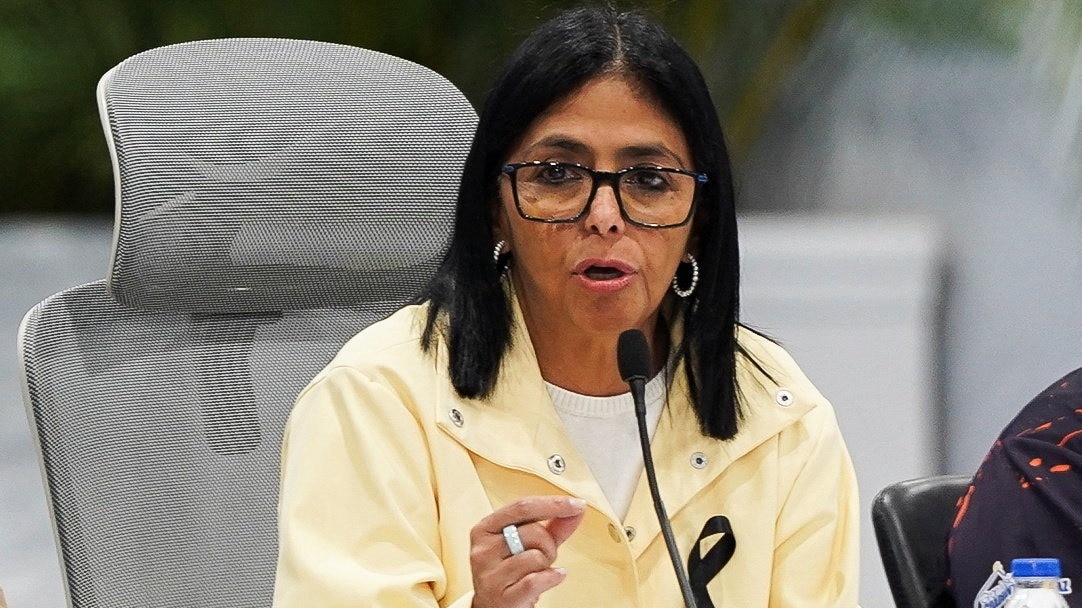
Venezuelan interim President Delcy Rodriguez has hailed a 25-year energy agreement with the US as a 'historic' move to revive the economy. The deal aims to boost crude production to 1.5 million barrels per day.
- A 25-year strategic energy agreement has been reached between Venezuela and the US.
- The production target is set at 1.5 million barrels of crude oil per day (bpd).
- Venezuela claims full sovereignty and ownership over its natural resources.
- The deal is projected to generate approximately $209 billion in revenue for Venezuela.
Venezuelan interim President Delcy Rodriguez has officially described a new energy accord with the United States as a 'historic' milestone. Speaking in a late-night address, Rodriguez emphasized that the deal is designed to revitalize the nation's battered economy and significantly bolster government revenue, ultimately shaping the country's long-term economic trajectory.
The bilateral project is slated to span 25 years and focuses on the development of 17 strategic oilfields. According to Rodriguez, the primary objective of this specific agreement is to increase crude oil output to 1.5 million barrels per day (bpd). She further clarified that this figure pertains specifically to the US-Venezuela partnership, while a broader national strategy includes the development of eight additional greenfield oil blocks to expand the energy sector.
Why This Matters
BozokMedia analysis shows that this agreement represents a major geopolitical shift in the energy sector. By integrating American capital and technological expertise, Venezuela seeks to overcome years of underinvestment and sanctions. For the United States, securing access to a portion of Venezuela's massive reserves—estimated at over 65 billion barrels—could serve as a critical tool to stabilize and lower domestic fuel prices.
This deal is a high-stakes gamble to trade resource access for economic survival and energy stability.
The announcement follows a statement from US President Donald Trump, who indicated that American companies would gain partial control over Venezuela's vast reserves. Trump noted that this partnership would allow private US businesses to help revive the South American nation's energy industry while providing a steady stream of crude to the American market.
From a fiscal perspective, Rodriguez estimated that at a benchmark price of $65 per barrel, the agreement could inject roughly $209 billion into the Venezuelan state. She detailed that approximately $19 from every barrel produced under this arrangement would flow directly to the Venezuelan government. Despite the economic promise, the move has not been without controversy; pro-government groups in Caracas recently staged protests against the increased US presence in the country.
Historical Background
Venezuela holds the world's largest proven oil reserves, yet its production has plummeted to roughly 1.25 million bpd due to chronic mismanagement, lack of infrastructure investment, and heavy international sanctions. This recent deal aims to bridge the massive gap between current output and the country's true geological potential.
Frequently Asked Questions
1. How long will the US-Venezuela oil agreement last?
The agreement is a long-term bilateral project intended to remain in force for 25 years.
2. Does the US have total control over Venezuelan oil?
No, President Rodriguez has explicitly stated that Venezuela retains ownership and sovereignty over its natural resources.