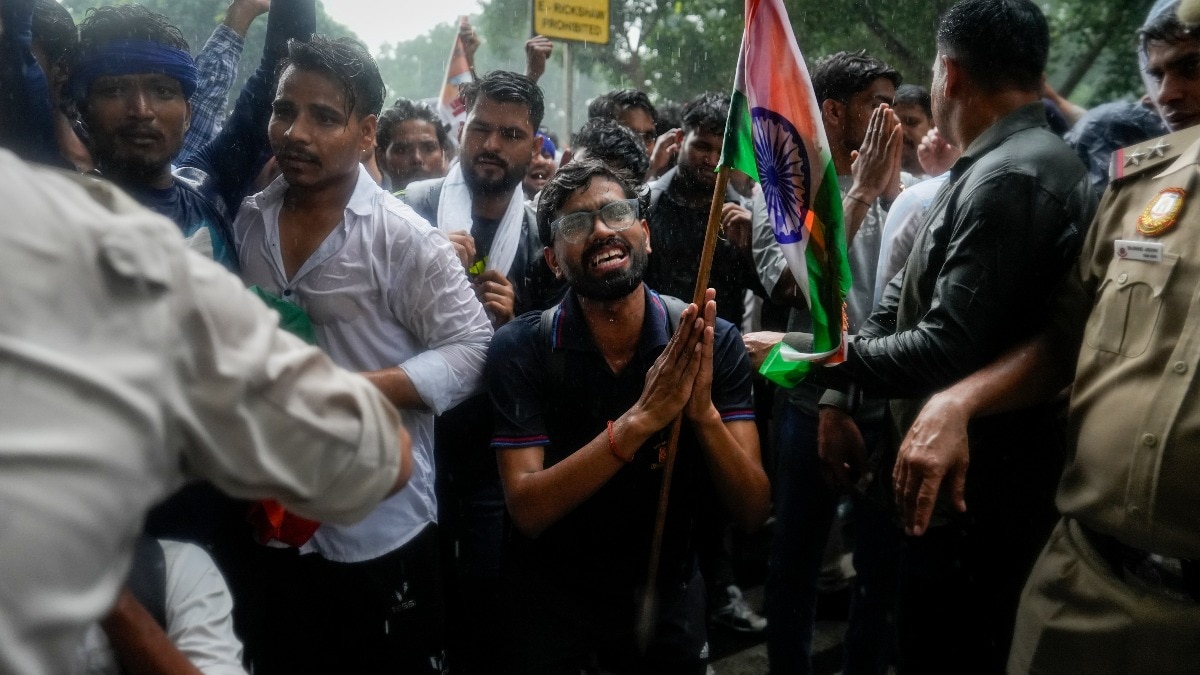
Nagina MP Chandra Shekhar Azad has launched an overnight sit-in protest at the Parliament premises, demanding the resignation of the Education Minister following alleged brutality against protesting students.
Key Takeaways
- Nagina MP Chandra Shekhar Azad is staging a sit-in protest near the Ambedkar statue in Parliament.
- The protest demands the resignation of Union Education Minister Dharmendra Pradhan over paper leak allegations.
- Azad compared the police action against students to the Jallianwala Bagh massacre.
- MP Hanuman Beniwal has extended solidarity to the protest.
Chandra Shekhar Azad, the founder of the Azad Samaj Party (Kanshi Ram) and Member of Parliament from Nagina, continued his intense protest within the Parliament premises on Tuesday. Demonstrating solidarity with students facing systemic irregularities in examinations, Azad has undertaken an overnight sit-in protest near the statue of Dr. B.R. Ambedkar.
In a poignant statement to the press, Azad expressed his deep anguish over the recent crackdown on student demonstrators. "I didn’t witness the Jallianwala Bagh massacre, but the scenes that unfolded today certainly reminded me of that dark chapter in history," he remarked, referring to the alleged brutality faced by students and young girls at Jantar Mantar. He emphasized that peaceful expression is a constitutional right and any use of force against it is an attack on democracy itself.
Why This Matters (इसके मायने क्या हैं)
BozokMedia analysis shows that this protest marks a significant escalation in the friction between the youth population and the current administration. As the backbone of India's future economy, any instability in the examination and recruitment processes directly threatens social mobility and public trust in state institutions.
The involvement of multiple opposition leaders, including Rajasthan MP Hanuman Beniwal, suggests that the issue of paper leaks and student rights is becoming a unified political front. This could force the Union government to shift its focus from administrative management to substantive legislative reform regarding educational integrity.
"The stability of a democracy is measured by how it treats its most vulnerable and vocal protesters."
Historical Background
The history of student movements in India has often been the catalyst for massive political shifts. From the anti-emergency movements to recent protests against farm laws and examination irregularities, students have consistently played a pivotal role in challenging the status quo. The recurring issue of 'paper leaks' has become a systemic crisis in the Indian competitive exam landscape, affecting millions of aspirants annually.
| Aspect | Student/Protester View | Government/Official View |
|---|---|---|
| Exam Integrity | Systemic failure and corruption | Occasional lapses being addressed |
| Police Conduct | Brutality and suppression of rights | Maintenance of law and order |
| Leadership Demand | Resignation of Education Minister | Maintaining administrative stability |
Frequently Asked Questions (अक्सर पूछे जाने वाले प्रश्न)
Question 1: What is the primary cause of the protest?
Answer: The protest is centered on alleged paper leaks in examinations and the subsequent police crackdown on students.
Question 2: Who is supporting Chandra Shekhar Azad?
Answer: MP Hanuman Beniwal and other regional leaders have expressed solidarity with his protest.