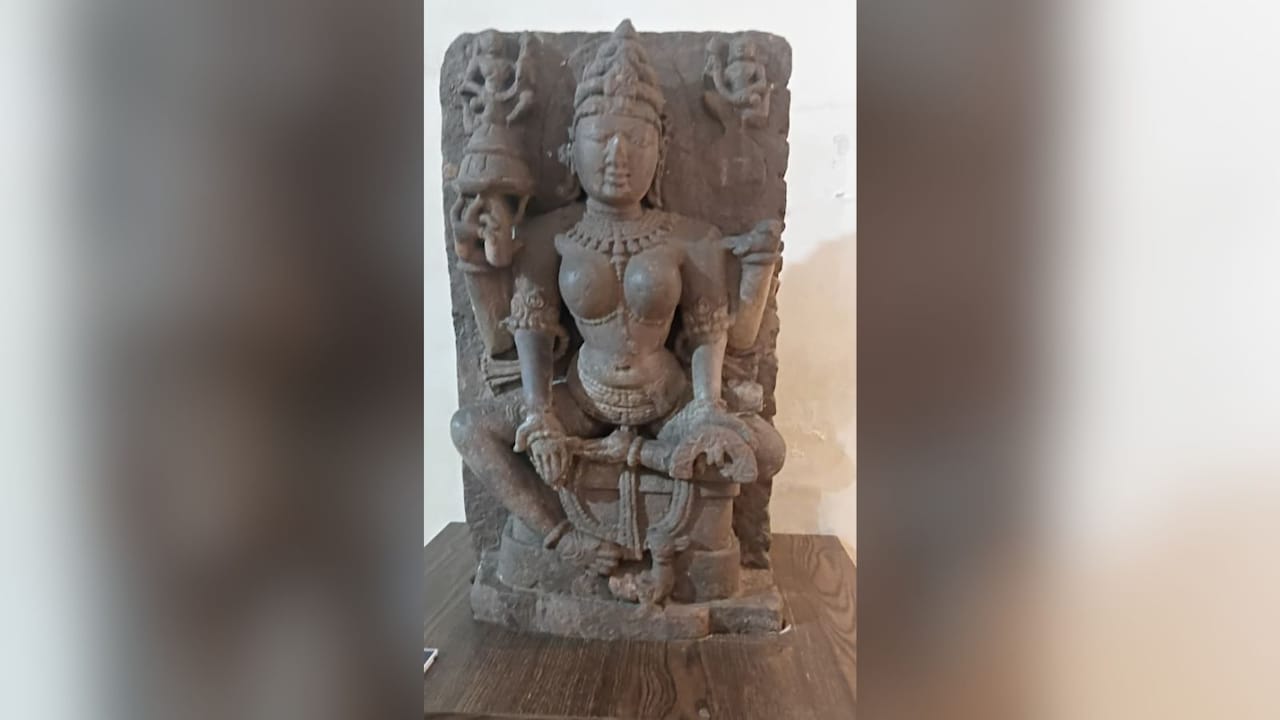
A centuries‑old museum statue, long thought to depict Saraswati, has now been re‑identified by scholars as one of the rareest sculptural representations of the goddess Gayatri, reshaping our understanding of Indian religious art.
मुख्य बिंदु (Key Takeaways)
- The museum statue is now recognized as a rare depiction of Goddess Gayatri.
- Previously classified as Saraswati for nine centuries, new stylistic analysis overturns that view.
- The discovery will influence interpretations of Indian religious iconography and heritage.
One of the most visited pieces in a leading Indian national museum has been on display for roughly 900 years as a representation of the goddess Saraswati. Recent scientific scrutiny, however, has upended that long‑standing label, revealing the figure to be an exceptionally rare sculpture of Goddess Gayatri.
Iconographic Background
Gayatri, the personification of the ancient Vedic mantra that bears her name, is traditionally portrayed with five petals, multiple heads, or a distinctive five‑plume aura. Saraswati, by contrast, is the patron of knowledge, music, and the arts, commonly shown with a veena, four arms, and a serene countenance. Recognizing the subtle visual cues that differentiate the two deities is essential for scholars tracing the evolution of Indian iconography.
The Discovery Process
Lead conservation scientist Dr. Ambika Verma and her team began a detailed surface‑imaging study in early 2023. High‑resolution microscopy uncovered faint line work consistent with Gayatri’s classic attributes—most notably a trinetra (three‑eyed) motif and a five‑plume crown—while the signature veena of Saraswati was conspicuously absent. Radiometric dating of the alloy placed the statue’s creation in the mid‑9th to 10th century CE, aligning with a period known for syncretic artistic expressions.
Historical and Cultural Implications
This re‑classification challenges the prevailing narrative that Gayatri was primarily a mantra rather than a visual deity in early medieval India. If such sculptures were indeed worshipped as a goddess, it suggests a more prominent cultic role for Gayatri during that era, potentially reshaping scholarly discourse on the integration of Vedic deities into localized pantheons.
Future Directions
The Department of Archaeology has logged the find as a national heritage milestone and plans a systematic review of comparable artifacts across museum collections. Academic conferences are already scheduling panels to discuss how this revelation may affect the broader understanding of religious symbolism in South Asian art.