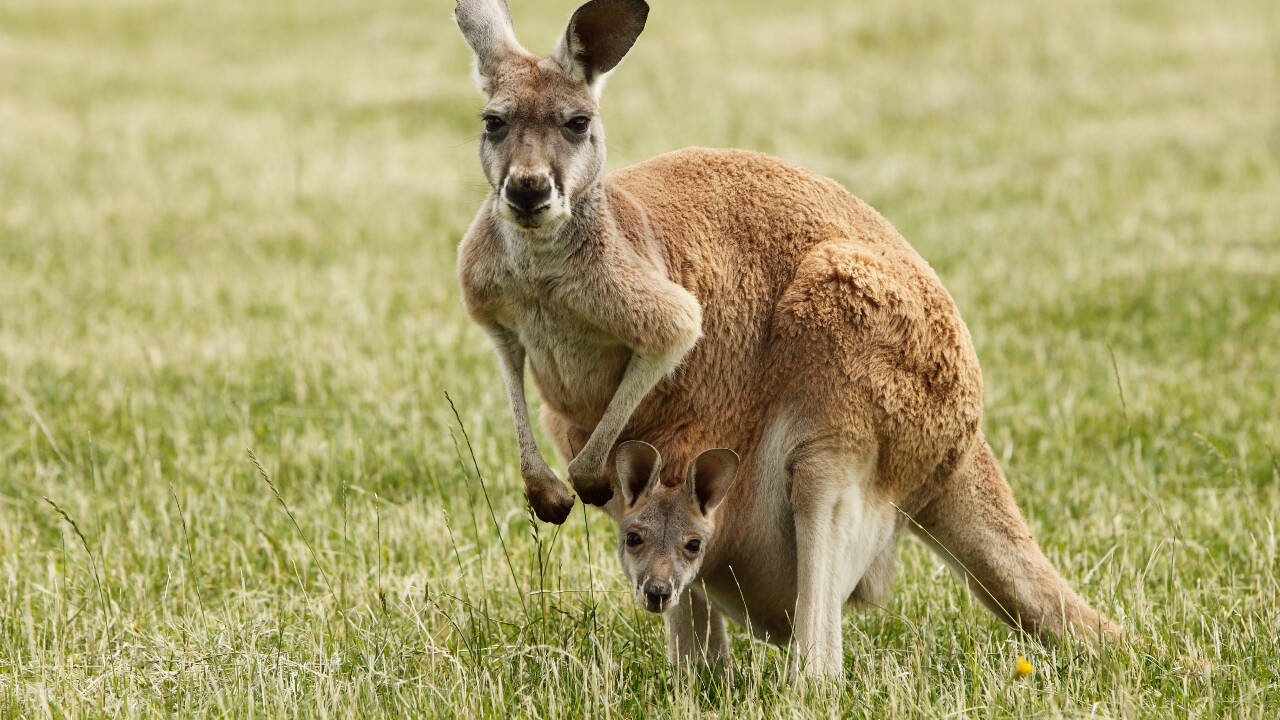
Scientists have discovered that newborn kangaroos develop their forelimbs before birth, enabling them to crawl to the mother’s pouch immediately after birth. This breakthrough reshapes our understanding of marsupial evolution and limb development.
Key Takeaways
- Newborn kangaroo forelimbs develop rapidly before birth
- This early development allows the joey to reach the pouch within minutes of birth
- The study provides fresh insight into limb‑priority evolution in marsupials
Kangaroos, like other marsupials, are born at an extremely undeveloped stage—tiny, blind, hairless, and comparable in size to a jellybean. Yet within moments of emerging from the birth canal, the joey must climb unaided to its mother’s pouch, latch onto a nipple, and continue its growth for several months.
Historical Background
Marsupials differ fundamentally from placental mammals because they have a short gestation period. Consequently, their young are born at a developmental stage equivalent to an early embryo of placental species. Traditional research assumed that skeletal development proceeded uniformly, but recent findings highlight that the forelimbs mature far earlier than the rest of the skeleton, providing a functional advantage essential for survival.
Why This Matters
According to BozokMedia analysis, the discovery underscores how evolutionary pressures can prioritize specific body parts to ensure immediate post‑natal survival. Early forelimb development equips newborn kangaroos with the strength and dexterity needed to reach the protective pouch, dramatically increasing their chances of surviving the vulnerable first hours of life.
This insight also has broader implications for developmental biology and medicine. Understanding how certain limbs can be accelerated in their growth may inspire new approaches to congenital limb deficiencies and regenerative therapies in humans.
"We found that marsupial forelimbs rapidly develop over a four-day period, going from a flat, featureless bud to fully functional arms with claws, which completely challenges our current understanding of limb development in vertebrates," Dr. Axel Newton explained.
Frequently Asked Questions
Q1: How long does it take a newborn kangaroo to reach the pouch?
A1: The joey typically makes the climb within a few minutes after birth, using its newly formed forelimbs.
Q2: Do all marsupial species exhibit this early forelimb development?
A2: While the pattern is common across many marsupials, the exact timing and rate can vary slightly among different species.