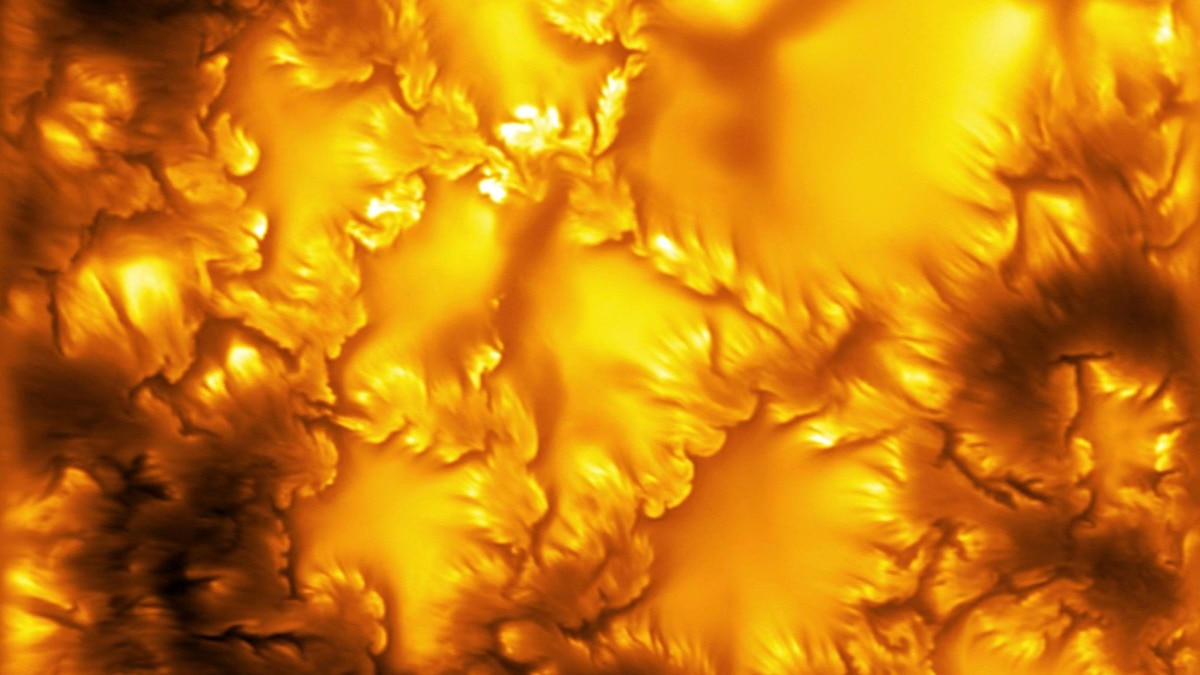
Groundbreaking images from the Daniel K. Inouye Solar Telescope have captured the Sun's surface in unprecedented detail, revealing swirling plasma patterns akin to a Van Gogh painting. These observations mark the first detection of Kelvin-Helmholtz instabilities on a star, offering crucial insights into the Sun's magnetic energy and the origins of powerful solar storms.
Key Takeaways
- The Daniel K. Inouye Solar Telescope has captured the highest-resolution images of the Sun's surface to date.
- The images reveal swirling, Van Gogh-like patterns identified as Kelvin-Helmholtz instabilities (KHI).
- This marks the first time KHI, typically seen on Earth and gas giants, has been observed on a star.
- The discovery is critical for understanding the Sun's magnetic energy transfer and the triggers of solar flares and coronal mass ejections.
Astronomers have achieved a monumental breakthrough in solar observation, capturing the most detailed images ever of the Sun's visible surface, known as the photosphere. Utilizing the powerful Daniel K. Inouye Solar Telescope in Hawaii, scientists have unveiled intricate, swirling patterns of superheated plasma that bear a striking resemblance to the brushstrokes of a Vincent Van Gogh masterpiece. These unprecedented observations are not merely aesthetic; they represent a significant step forward in understanding the fundamental dynamics of our star.
The newly identified structures are not random formations but have been scientifically categorized as Kelvin-Helmholtz instabilities (KHI). This phenomenon occurs when fluids or gases moving at different speeds interact, generating characteristic wave-like vortices. While KHI has been previously observed in various terrestrial environments, including oceans, lakes, and cloud formations, and even in the atmospheres of gas giants like Jupiter and Saturn, its detection on the surface of a star is a historic first. Co-lead author Friedrich Woger of the National Solar Observatory explained, "The interface can become unstable and develop wave-like vortices that grow in size until they break apart, not unlike waves out on a lake or out on the ocean in windy conditions."
Why This Matters
BozokMedia analysis shows that this discovery holds immense implications for solar physics. One of the long-standing mysteries in heliophysics is why the Sun's outer atmosphere, the corona, is millions of degrees hotter than its visible surface. The constant twisting and redistribution of energy and magnetic fields generated by these Kelvin-Helmholtz instabilities could provide a vital clue. Researchers believe this process may explain how magnetic energy accumulates, eventually leading to explosive events such as solar flares and coronal mass ejections (CMEs). These powerful solar eruptions are not just academic curiosities; they have tangible effects on Earth, capable of disrupting satellites, GPS navigation, communications networks, and even power grids.
"The Sun and Sun-like stars are extremely dynamic systems, characterized by a whole spectrum of rapid, explosive events within their magnetic elements. How these explosions are triggered is one of the main frontiers in modern solar physics," stated David Kuridze, an astronomer and co-lead author.
The Inouye Solar Telescope's advanced capabilities allowed researchers to resolve structures as small as approximately 19 kilometers across, with the observed vortices extending up to roughly 170 kilometers. These whirlpools, composed of highly energetic plasma, were captured in time-lapse sequences, revealing their dynamic growth and evolution. This new window into the Sun's photosphere, a layer only about 100 km deep compared to the Sun's 1.4-million-km diameter, promises to unlock deeper understandings of stellar energy transport and the mechanisms behind solar activity, not just for our Sun but potentially for other stars across the universe.
Frequently Asked Questions
- What are Kelvin-Helmholtz instabilities (KHI)?
- KHI are wave-like vortices formed when two fluids or gases move past each other at different speeds, creating shear and turbulence. They are common on Earth in oceans and clouds, and now, observed on the Sun.
- Why is observing KHI on the Sun significant?
- It's the first time KHI has been directly observed on a star. This discovery helps scientists understand how magnetic energy is transported and built up on the Sun, potentially explaining the superheated corona and the triggers for solar flares and coronal mass ejections.