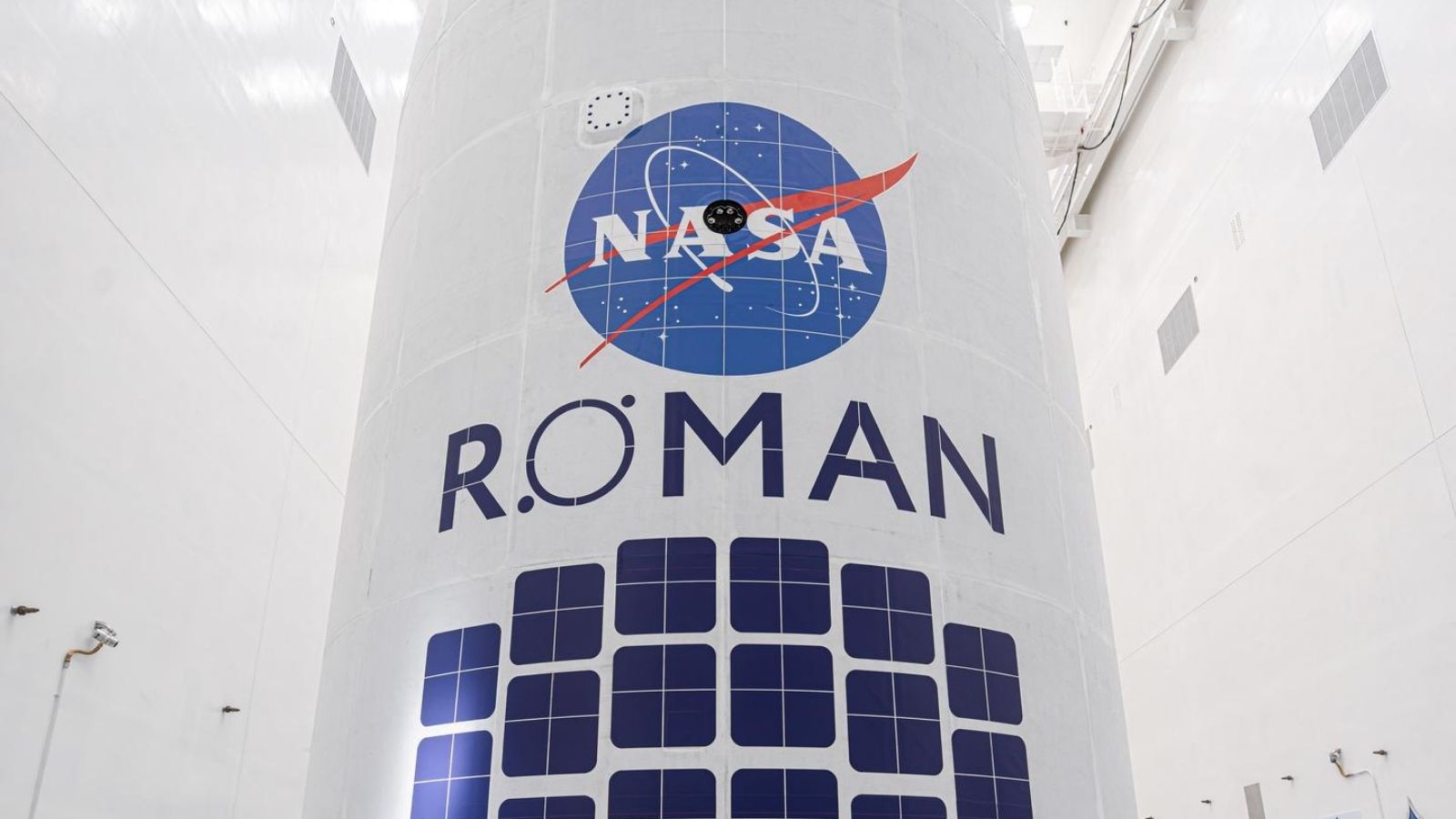
NASA's Nancy Grace Roman Space Telescope is set to launch today via a SpaceX Falcon Heavy rocket. The mission aims to map vast regions of the cosmos to uncover the mysteries of dark energy and dark matter.
- The Nancy Grace Roman Space Telescope launches today from Kennedy Space Center, Florida.
- It will be positioned at the Sun-Earth Lagrange point 2 (L2), 1 million miles from Earth.
- The mission focuses on wide-field surveys to investigate dark energy, dark matter, and exoplanets.
NASA's Nancy Grace Roman Space Telescope is poised for liftoff aboard a SpaceX Falcon Heavy rocket from Launch Complex 39A at the Kennedy Space Center in Florida. The first launch window is scheduled to open at 7.26 am EDT (approximately 5 pm IST) on Sunday, August 30, marking a pivotal moment in modern astrophysics.
Upon successful launch, the observatory will embark on a journey toward the second Sun-Earth Lagrange point, known as L2. Located roughly 1.6 million kilometers from Earth, this position provides the telescope with a stable, unobstructed view of the deep sky, essential for conducting high-precision surveys of the universe.
Why This Matters
BozokMedia analysis shows that the Roman telescope fills a critical gap in our current observational capabilities. While the Hubble and James Webb telescopes act as 'deep-dive' instruments—focusing on specific, tiny patches of the sky with extreme detail—Roman is designed for 'breadth.' By surveying vast areas of space rapidly, it will act as a cosmic scout, identifying anomalies and targets that other telescopes can then study in depth.
"Hubble and James Webb effectively 'peer through a keyhole at the universe,' while Roman will 'kick the door down.'" - Nicky Fox, NASA Associate Administrator for Science.
The primary scientific objectives include investigating the nature of dark energy and dark matter, which together make up the vast majority of the universe's mass-energy content. Additionally, the telescope will employ advanced coronagraphy to directly image exoplanets, potentially revealing whether other planetary systems mirror our own or if we are truly alone in the cosmos.
Following the launch, the spacecraft will undergo a rigorous three-month commissioning phase. This period involves instrument deployment, calibration, and system checkouts while traveling to L2. NASA anticipates releasing the first groundbreaking science images in early 2027.
Weather remains a critical variable, with the 45th Weather Squadron reporting a 50% chance of favorable conditions for Sunday. However, backup launch windows on Monday and Tuesday offer improved prospects as tropical disturbances are expected to shift westward.
Comparison of Major Observatories
| Feature | Hubble (HST) | James Webb (JWST) | Roman (RST) |
|---|---|---|---|
| Observation Style | Narrow/Deep | Ultra-Narrow/Deep | Wide-Field/Survey |
| Primary Goal | Visible/UV Light | Infrared/Early Universe | Dark Energy/Cosmic Mapping |
Frequently Asked Questions
Q1: How does Roman complement the James Webb Space Telescope?
A: Roman identifies vast areas of interest through wide-field surveys, which James Webb can then target for high-resolution, detailed analysis.
Q2: When will the first images be released?
A: NASA expects to release the first scientific images in early 2027, following a three-month calibration period.