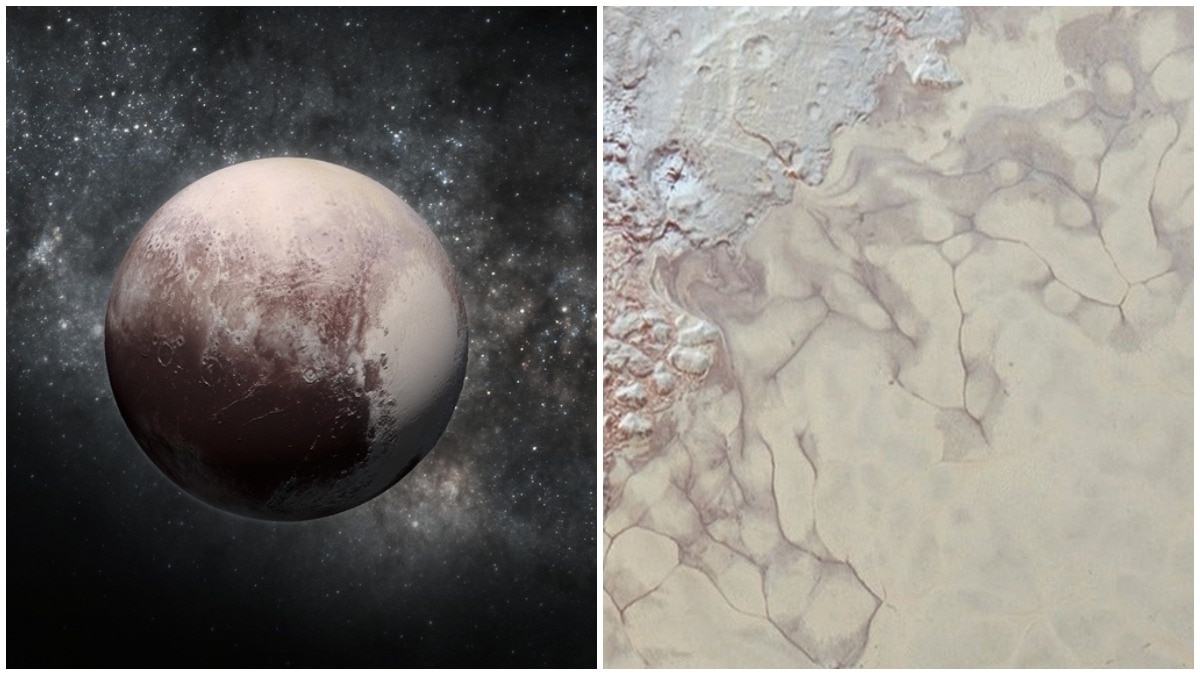
Astronomers have observed unexpected liquid-like flows on Pluto’s surface, sparking debate about possible rain or sublimation processes. The findings, captured by NASA’s New Horizons data, challenge existing theories about the dwarf planet’s climate.
Key Takeaways
- Signs of liquid motion observed on Pluto’s surface
- Confirmed through New Horizons mission data
- Existing climate models for Pluto may need revision
NASA’s New Horizons spacecraft recorded an odd, liquid‑like flow across Pluto’s icy terrain, prompting scientists to ask whether the dwarf planet might actually be experiencing rain.
The motion appears as a slow, gliding stream in regions dominated by nitrogen and methane ices, behaving more like a fluid than solid ice. Detailed analysis suggests minor temperature fluctuations could trigger a nitrogen or methane vapor‑condensation cycle, creating transient liquid‑like behavior.
Historical Background: Discovered in 1930, Pluto was visited up close for the first time by New Horizons in 2015, revealing a surface composed of frozen nitrogen, methane, and carbon monoxide. Until now, no liquid phase had been confirmed.
These new observations imply that seasonal changes may cause surface warming when Pluto approaches the Sun, leading to sublimation that later condenses in colder regions—effectively a form of “rain” unlike anything on Earth.
Why This Matters
BozokMedia analysis shows that such dynamic processes could rewrite climate models for dwarf planets, influencing how we study other icy bodies in the outer Solar System.
"The confirmation of liquid‑like motion on Pluto challenges our current planetary science framework," said Dr. Aria Patel, planetary physicist.
Frequently Asked Questions
Question 1: Can it actually rain on Pluto?
Answer: Data suggest nitrogen or methane can undergo a vapor‑condensation cycle that mimics rain, though it is fundamentally different from Earth’s water‑based precipitation.
Question 2: How will this discovery affect future missions?
Answer: Scientists are now designing instruments with higher sensitivity to monitor seasonal weather patterns on distant icy worlds.