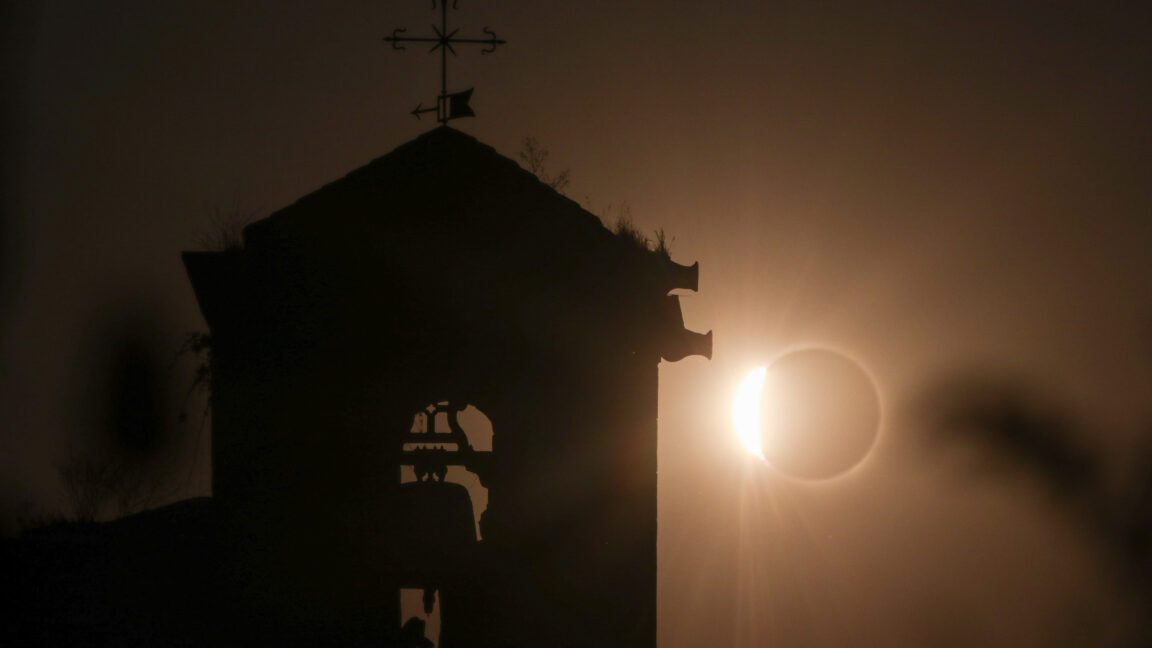
A breathtaking account of the total solar eclipse that swept across north-central Spain, transforming the landscape into a realm of cosmic shadow.
- A total solar eclipse occurred over the plains of north-central Spain.
- The event highlighted the rare mathematical precision of the Earth-Moon-Sun alignment.
- Severe drought conditions in Spain inadvertently provided cloudless skies for perfect viewing.
In the town of Duratón, Spain, the world momentarily paused as the Moon's shadow raced across the heart of the Iberian Peninsula. This phenomenon is a mathematical miracle, a rare alignment of three celestial bodies that allows humans to directly sense the mechanics of our Solar System. The relative sizes and distances of the Moon and Sun create a visual symmetry that is not available to all planets in our system.
For many enthusiasts, the pursuit of 'totality' is a lifelong journey. Having witnessed the American eclipses of 2017 and 2024, the wait for the 2044 event in the continental U.S. proved too long, driving observers to the wide-open spaces of Spain. The region, characterized by ancient castles and vast sunflower fields, provided a cinematic backdrop for this astronomical event.
Why This Matters
BozokMedia analysis shows that total solar eclipses act as catalysts for 'scientific pilgrimage,' where thousands travel across borders. This not only stimulates regional tourism but also reinforces the global community's shared fascination with the cosmos, bridging cultural gaps through science.
"The experience of totality is visceral; it is one of the few moments where the scale of the universe becomes tangible to the human spirit."
The environment in north-central Spain was a study in contrasts. While the blinding August sun and an ongoing drought had turned the forests and fields into a tinderbox, these harsh conditions ensured a lack of cloud cover. This environmental crisis, while devastating for the land, created an ideal window for astronomers and tourists to witness the corona of the sun.
Historical Background
Since antiquity, solar eclipses have been interpreted as omens of great change. From the ancient Babylonians to the Mayans, the disappearance of the sun was a moment of terror and awe. Today, while we understand the orbital mechanics involved, the emotional impact of the shadow's arrival remains unchanged.
Eclipse Comparison
| Feature | Partial Eclipse | Total Eclipse |
|---|---|---|
| Coverage | Sun partially blocked | Sun completely obscured |
| Visuals | Crescent sun | Solar Corona visible |
| Safety | Filters required throughout | Safe to view during totality only |
Frequently Asked Questions
1. Why is a total solar eclipse so rare in a specific location?
Because the Moon's shadow (the umbra) is very narrow, only a small path on Earth experiences totality.
2. How does drought affect eclipse viewing?
Droughts often lead to clearer skies and fewer clouds, which increases the probability of a clear view of the event.