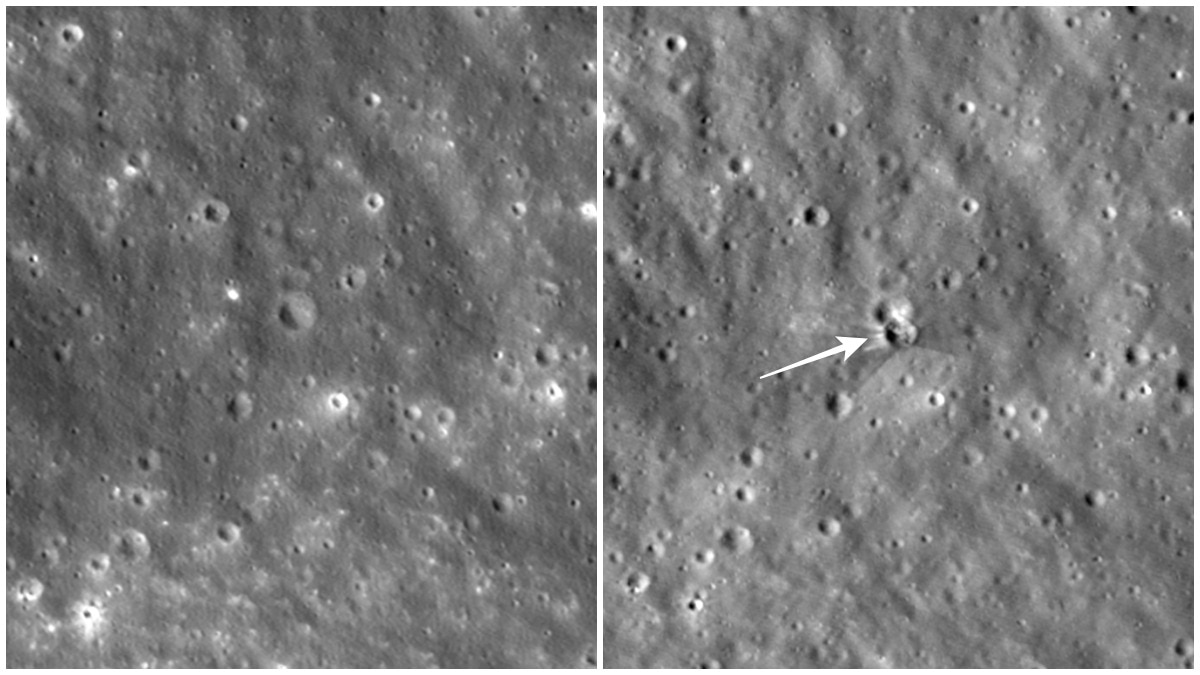
NASA’s Lunar Reconnaissance Orbiter (LRO) has delivered the most detailed photographs yet of a fresh 18‑meter-wide crater created when a SpaceX Falcon 9 upper stage slammed into the Moon on August 5. International collaboration and cutting‑edge camera tech gave scientists a rare chance to study a brand‑new impact site in unprecedented detail.
- Falcon 9 upper stage struck the Moon on Aug 5, forming an ~18 m wide crater.
- LRO captured high‑resolution images showing a 60‑ft (18 m) diameter and <10‑ft (3 m) depth.
- South Korea’s Danuri orbiter provided corroborating data, enabling precise mapping.
Event Overview
SpaceX’s Falcon 9 booster, launched in January 2025 as part of the Firefly Blue Ghost 1 mission, spent months orbiting Earth before its upper stage impacted the lunar surface on August 5. The collision created a fresh crater that quickly became a target for lunar observers worldwide.
LRO’s Imaging Campaign
NASA’s Lunar Reconnaissance Orbiter, which circles the Moon every two hours, photographed the impact site between August 11 and 12. Engineers had to tilt the spacecraft during each pass so its Narrow‑Angle Camera could point at the spot while flying roughly 60 miles (100 km) above the surface at about one mile per second.
Technical Challenges and Solutions
Timing was critical: a 10‑second error would have shifted the target by nearly 10 miles, moving it out of the frame. The LRO’s Narrow‑Angle Camera, capable of resolving objects as small as three feet, captured the crater under multiple lighting conditions to ensure accurate measurements.
Crater Characteristics
The images reveal a roughly 60‑ft (18 m) wide, less‑than‑10‑ft (3 m) deep depression. Bright and dark rays radiate outward—dark rays are ancient regolith altered over billions of years by solar wind and micrometeorites, while bright rays consist of fresh material excavated from deeper layers during the impact.
International Cooperation
Amateur astronomers first tracked the rocket’s trajectory using publicly available data. NASA’s Center for Near‑Earth Object Studies refined the impact coordinates, which were then shared with South Korea’s Korea Pathfinder Lunar Orbiter (Danuri). Danuri imaged the crater within minutes of impact, confirming the location to within about 0.6 miles (1 km). Combining Danuri and LRO observations now provides a precise, three‑dimensional map of the new feature.
Why This Matters
BozokMedia analysis shows that human‑made debris continues to reshape the lunar landscape, a factor that must be considered for future lunar bases and resource‑extraction plans. This event also offers a real‑time laboratory for studying impact physics, ejecta distribution, and space‑debris interactions on an airless body.
"The Falcon 9 impact gives us a live case study of how artificial objects modify the Moon’s surface," says Dr. Anita Sharma, planetary geophysicist.
Frequently Asked Questions
Q1: Will this crater affect upcoming lunar missions?
A: While the crater is relatively small, cumulative impacts could influence site‑selection for habitats or scientific installations, especially if debris fields grow.
Q2: How long will the LRO continue operating?
A: NASA plans to keep LRO active through at least 2028, allowing it to monitor future impacts and map the Moon’s evolving terrain.