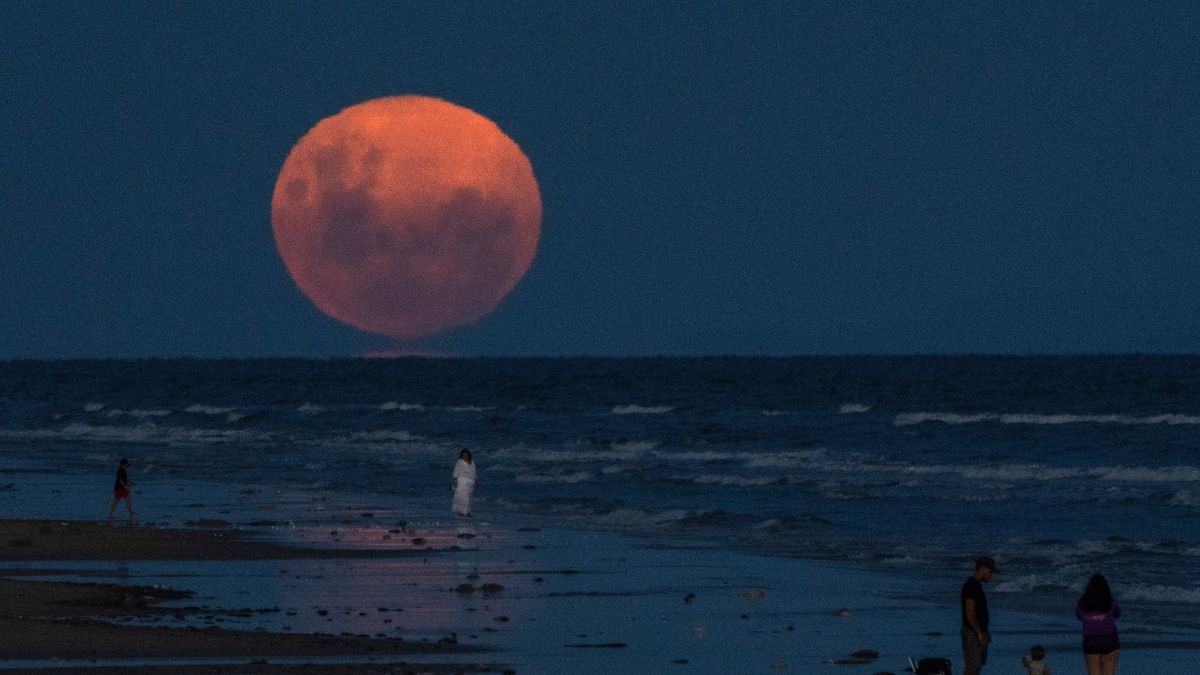
A spectacular near-total lunar eclipse is approaching, providing a rare celestial display. The Americas are positioned perfectly to witness this breathtaking astronomical event.
- A near-total lunar eclipse is set to occur in the coming days.
- The Americas will have the most optimal viewing conditions.
- This event offers a unique opportunity for amateur and professional astronomers alike.
Space enthusiasts are in for a celestial treat as a near-total lunar eclipse prepares to grace the night sky. According to recent astronomical forecasts, the Americas are in a prime geographic position to witness this magnificent event, offering clear and unobstructed views for millions of residents across the continent.
A lunar eclipse occurs when the Earth moves between the Sun and the Moon, casting its shadow across the lunar surface. In a 'near-total' eclipse, the Moon does not pass entirely through the darkest part of Earth's shadow (the umbra), but rather skirts the edge, often resulting in a striking deep orange or reddish hue across the lunar landscape.
Why This Matters
BozokMedia analysis shows that such celestial phenomena serve as powerful tools for public engagement in science. Beyond the aesthetic beauty, these events drive significant interest in STEM education and provide a moment of global unity as people look upward at the same cosmic event.
A near-total lunar eclipse is a masterclass in celestial mechanics, offering a mesmerizing glimpse into the orbital dance of our solar system.
The visibility of this eclipse depends heavily on local weather conditions and the Moon's position in the sky relative to the observer's horizon. For those in North and South America, the timing is expected to be particularly favorable for long-duration viewing.
Historical Background
Throughout human history, lunar eclipses have been documented by nearly every major civilization. From the ancient Babylonians to the Maya, these events were often interpreted as omens. Today, however, they are celebrated as predictable and scientifically significant events that help us understand the Earth-Moon-Sun relationship with extreme precision.
Frequently Asked Questions
Question 1: Is it safe to look at a lunar eclipse with the naked eye?
Yes, unlike solar eclipses, lunar eclipses are completely safe to view without any special protective eyewear.
Question 2: What equipment do I need to see it?
While binoculars or a small telescope can enhance the experience, the eclipse is clearly visible to the naked eye.