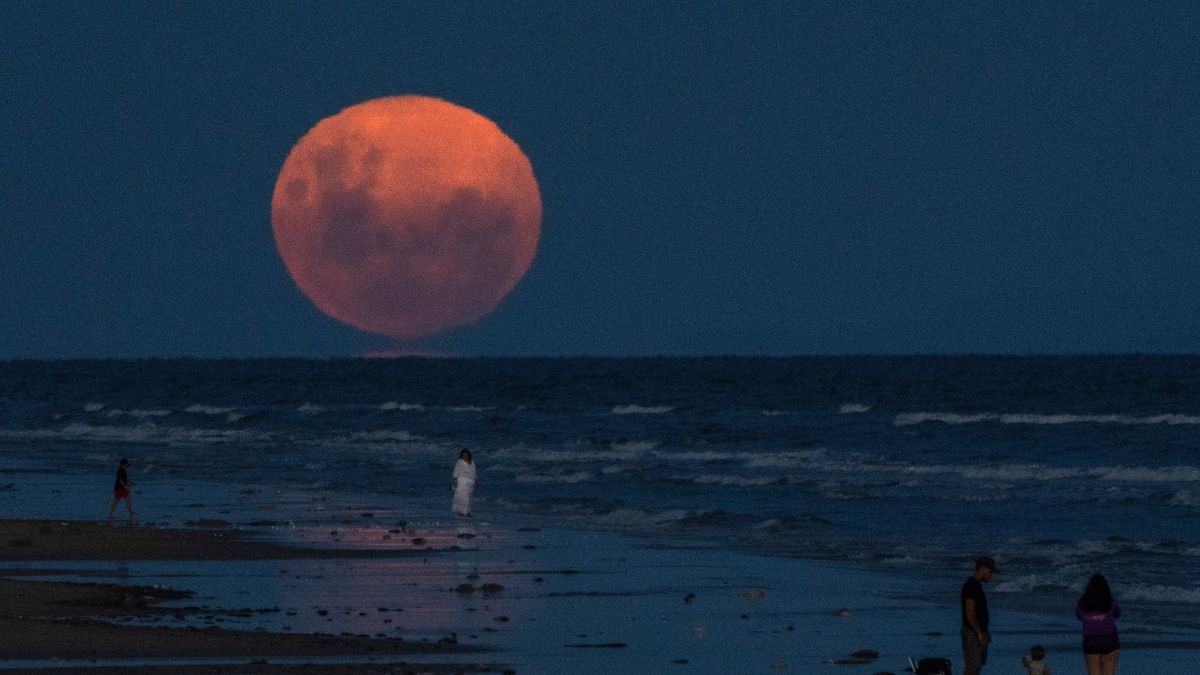
On August 28, a deep partial lunar eclipse will plunge 93% of the Moon into Earth's shadow, nearly mimicking totality. Discover the scientific reason behind this distinction.
- On August 28, the Moon will enter Earth's darkest shadow, covering 93% of its diameter.
- Despite the massive coverage, it remains classified as a 'Partial Lunar Eclipse.'
- The event will be visible in the Americas, Europe, and Africa, but not from India.
The celestial stage is set for August 28, as the Moon prepares to dive deep into Earth's shadow. This upcoming event promises a stunning visual display, potentially turning the lunar surface a deep crimson or coppery hue. However, a scientific nuance creates a distinction that might surprise many: despite covering nearly 93% of the Moon, it will not be a total lunar eclipse.
The Science of Shadows
A lunar eclipse occurs when the Earth aligns perfectly between the Sun and the Moon, obstructing direct sunlight. The Moon travels through two distinct shadows: the Penumbra (the lighter, outer shadow) and the Umbra (the darkest, central shadow). For an eclipse to be classified as 'total,' the entire lunar disk must be submerged within the Umbra.
According to calculations from NASA, the upcoming event has an umbral magnitude of 0.9299. This means that at the peak of the eclipse, approximately 93% of the Moon's diameter will be swallowed by Earth's darkest shadow. That tiny, remaining fraction of the Moon staying outside the Umbra is the sole reason it remains a 'partial' eclipse rather than a 'total' one.
Why This Matters
BozokMedia analysis shows that such events are vital for understanding the precise orbital geometry of our solar system. The visual transformation—where the Moon turns red—is a result of Rayleigh scattering, where Earth's atmosphere bends sunlight toward the Moon, filtering out shorter blue wavelengths and letting the red light through.
The difference between a partial and a total eclipse often rests on a razor-thin margin of orbital alignment.
The deep partial phase is expected to last roughly 3 hours and 18 minutes, while the entire passage through the penumbra will take over 5 hours. While skywatchers in the Americas, Europe, and Africa will witness this cosmic dance, those in India will be unable to view it from the ground due to the Moon's position relative to the Earth's shadow at that time.
Historical Background
Throughout human history, lunar eclipses have been viewed with a mixture of awe and dread. From ancient civilizations interpreting the 'Blood Moon' as a divine omen to modern astronomers using them to study the Earth's atmospheric composition, these events have always captivated the human imagination.
Frequently Asked Questions
Question 1: Why won't we see it in India?
Answer: The eclipse geometry places the visible path over the Pacific, Americas, Europe, and Africa, leaving India outside the visibility zone.
Question 2: How long will the eclipse last?
Answer: The partial umbral phase will last about 3 hours and 18 minutes.