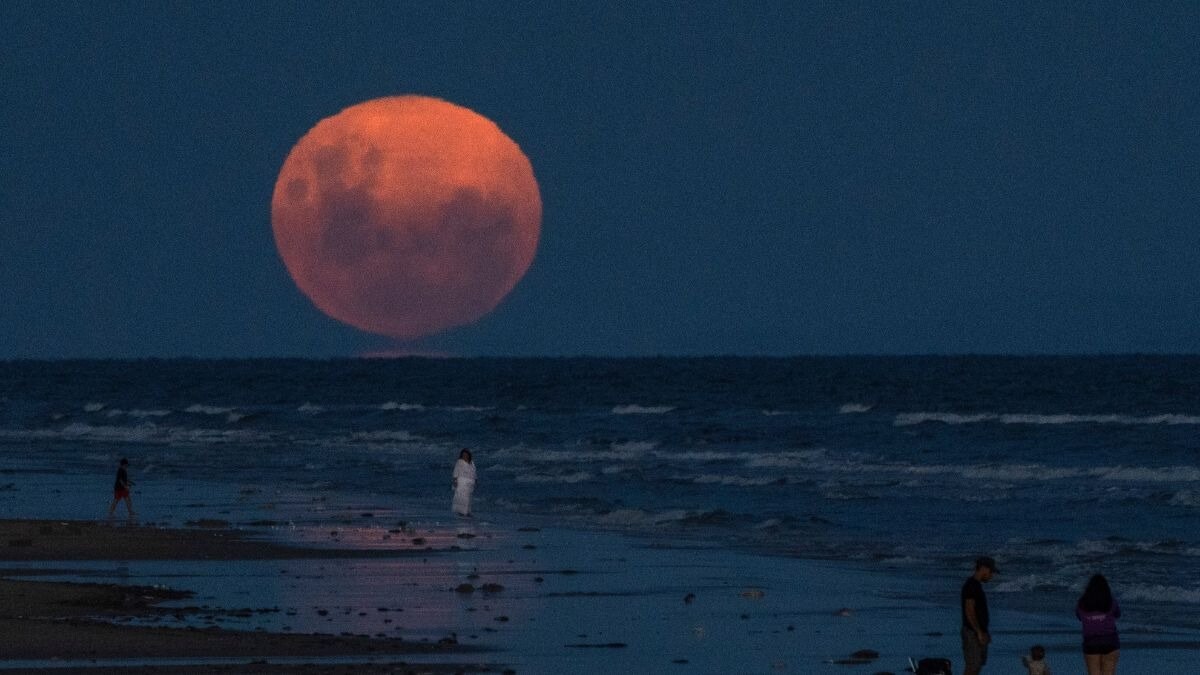
A spectacular deep partial lunar eclipse is set to grace the night sky tonight. As Earth's shadow sweeps across the lunar surface, observers can witness a mesmerizing celestial display.
- A deep partial lunar eclipse will be visible overnight.
- Earth's shadow will obstruct a significant portion of the Moon.
- The event offers a unique opportunity for amateur and professional astronomers.
Prepare your telescopes and clear your schedules, as a deep partial lunar eclipse is scheduled to occur tonight. This celestial phenomenon occurs when the Moon passes through the Earth's shadow, specifically the darker part known as the umbra, resulting in a partial obscuration of the lunar surface.
Unlike a total lunar eclipse where the entire Moon enters the shadow, a partial eclipse leaves a portion of the Moon illuminated. However, the 'deep' nature of tonight's event suggests that the shadow will cover a substantial area, creating a striking contrast between the bright lunar landscape and the dark, encroaching shadow.
The Mechanics of the Eclipse
A lunar eclipse is a cosmic alignment involving the Sun, Earth, and Moon. When these three bodies align in a straight line, Earth acts as a shield, casting its shadow into space and intercepting the sunlight that would otherwise illuminate the Moon.
Why This Matters
BozokMedia analysis shows that such celestial events serve as vital reminders of our place in the solar system. Beyond the visual beauty, these events provide data for scientists studying the Earth's atmosphere and the Moon's surface characteristics during shadow transitions.
Witnessing a deep partial eclipse is a profound way to connect with the rhythmic mechanics of our celestial neighborhood.
Historically, lunar eclipses have been recorded by civilizations for millennia, often interpreted as omens or used to refine astronomical calendars. Today, they remain a pinnacle event for astrophotographers looking to capture the subtle color shifts on the lunar limb.
Frequently Asked Questions
1. Is it safe to watch a lunar eclipse with the naked eye?
Yes, unlike solar eclipses, lunar eclipses are perfectly safe to observe without specialized eye protection.
2. What is the best way to view the eclipse?
While visible to the naked eye, using binoculars or a small telescope will provide a much more detailed view of the shadow's edge.