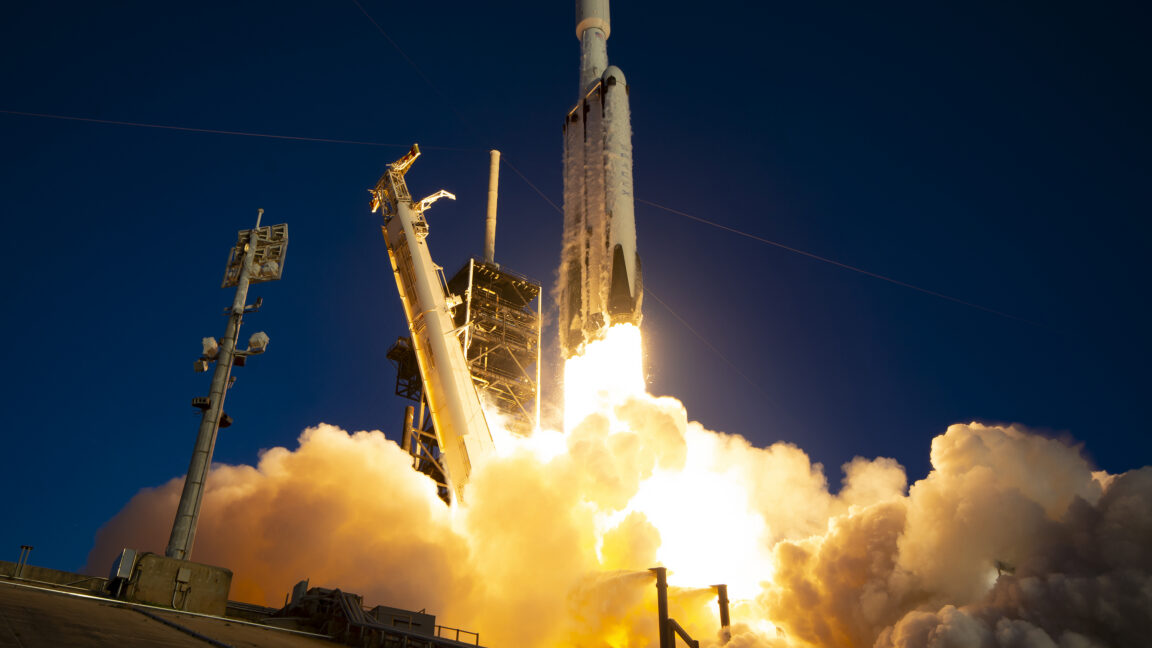
NASA has successfully launched the Nancy Grace Roman Space Telescope, a $4.3 billion observatory designed to map the universe with unprecedented scale and precision.
- Launched from Kennedy Space Center, Florida, with a $4.3 billion budget.
- Features a 300-megapixel camera and a refurbished spy mirror.
- Provides a field of view 100 times wider than the Hubble Space Telescope.
In a monumental leap for astrophysics, NASA has officially launched the Nancy Grace Roman Space Telescope. This state-of-the-art observatory, costing an estimated $4.3 billion, is engineered to probe the deepest reaches of the cosmos, specifically targeting the mysterious forces of dark energy and dark matter that dictate the expansion and fate of our universe.
The telescope's primary advantage lies in its sheer scale of vision. While the James Webb Space Telescope (JWST) acts as a powerful zoom lens focusing on specific distant objects, the Roman telescope serves as a wide-angle lens. With a field of view 100 times wider than the legendary Hubble Space Telescope, Roman will be able to capture massive swaths of the sky in a single image, allowing scientists to conduct large-scale surveys that were previously impossible.
Why This Matters
BozokMedia analysis shows that the synergy between Webb, Hubble, and Roman creates a comprehensive 'cosmic toolkit.' Where Webb provides the depth, Roman provides the breadth. By mapping millions of galaxies, Roman will help astronomers understand the large-scale structure of the universe and the acceleration of its expansion, potentially rewriting our understanding of physics.
The Roman telescope is not just a camera; it is a cosmic census taker that will redefine our place in the galactic neighborhood.
One of the most fascinating technical aspects of the mission is the telescope's hardware. It utilizes a 300-megapixel camera and a mirror that was originally designed for a spy satellite, demonstrating NASA's ability to repurpose high-end government technology for scientific advancement. The scale of the data is staggering; NASA officials noted that it would take over half a million 4K televisions to display a single full-resolution image from the telescope's largest survey.
Historical Background
The Roman telescope is only the second NASA-led astrophysics mission of the 21st century, following the 2021 launch of the James Webb Space Telescope. Unlike the JWST, which faced numerous delays and budget overruns, the Roman mission has been a model of efficiency, arriving at the launch pad nine months ahead of its May 2027 commitment deadline.
| Feature | Hubble | James Webb (JWST) | Roman |
|---|---|---|---|
| Primary Strength | General Purpose | Deep Infrared/Detail | Wide-Field Survey |
| Field of View | Standard | Narrow/Deep | 100x Hubble |
| Primary Goal | Galaxy Evolution | First Stars/Light | Dark Energy/Matter |
Frequently Asked Questions
Q1: How does Roman differ from the James Webb Telescope?
While Webb focuses on high-detail images of specific targets, Roman captures massive areas of the sky, providing a 'big picture' view of the universe.
Q2: What is the main scientific goal of the Roman mission?
Its primary goal is to investigate dark energy and dark matter to understand why the universe is expanding at an accelerating rate.