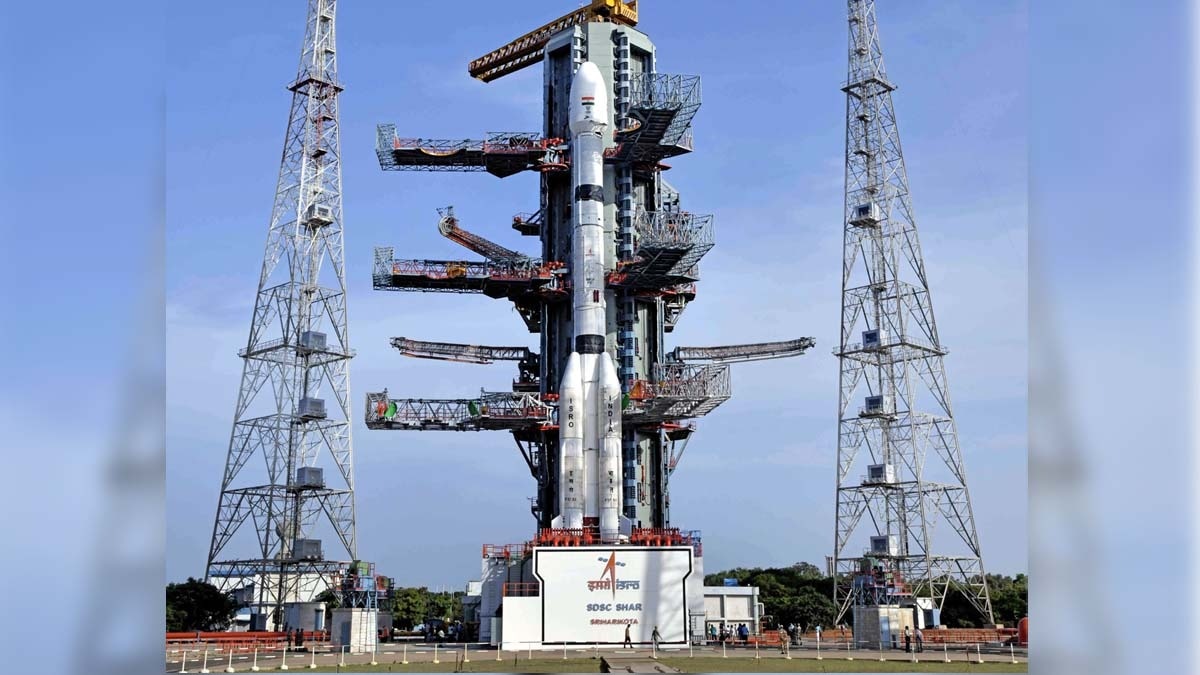
The Indian Space Research Organisation (ISRO) is set to launch the EOS-05 satellite via the GSLV-F17 rocket on September 4. Positioned 36,000 km above Earth, it will provide critical surveillance of India's borders and natural disasters.
- ISRO will launch the EOS-05 satellite from Satish Dhawan Space Centre on Sept 4 at 2:55 AM.
- The satellite will operate from a Geostationary orbit at an altitude of 36,000 km.
- Primary focus includes border monitoring and tracking cyclones, floods, and forest fires.
- The GSLV-F17 rocket measures 51.7 meters with a launch weight of 420.5 tonnes.
The Indian Space Research Organisation (ISRO) is preparing for a high-stakes mission on September 4, launching the EOS-05 satellite aboard the GSLV-F17 rocket. This mission is designed to significantly enhance India's surveillance capabilities, providing a persistent 'eye in the sky' over vast regions of the country.
What sets EOS-05 apart is its strategic placement. It will be deployed in a Geostationary orbit approximately 36,000 kilometers above the Earth's surface. In this orbit, the satellite matches the Earth's rotation speed, allowing it to remain fixed over a specific geographic area. Unlike Low Earth Orbit (LEO) satellites that pass over a region periodically, EOS-05 will provide continuous, real-time imagery and data.
Why This Matters
BozokMedia analysis indicates that this deployment is a critical upgrade for India's national security. By maintaining a constant vigil over the borders with China and Pakistan, India can detect troop movements or intrusions with far greater precision. Furthermore, the satellite's ability to monitor environmental crises—such as cloudbursts, cyclones, and forest fires—will empower disaster management agencies to act faster, potentially saving thousands of lives.
"The transition to continuous geostationary monitoring with EOS-05 marks a paradigm shift in India's strategic space assets."
The GSLV-F17, utilizing the GSLV Mk II variant, is a behemoth of engineering. Standing 51.7 meters tall and weighing 420.5 tonnes at lift-off, the rocket will operate in three stages to precisely inject the EOS-05 satellite into its target orbit.
This mission also carries significant symbolic weight. In 2021, a similar attempt to launch the EOS-03 satellite via the GSLV-F10 failed due to a technical glitch in the final stage. The success of EOS-05 will signify ISRO's resilience and its ability to overcome previous technical setbacks to restore essential satellite services.
| Feature | Typical LEO Satellite | EOS-05 (GEO) |
|---|---|---|
| Altitude | Low (200-2000 km) | 36,000 km |
| Observation | Intermittent/Periodic | Continuous/Persistent |
| Primary Use | High-res mapping | Real-time alerts & Security |
Frequently Asked Questions
Q1: What is the primary purpose of the EOS-05 satellite?
A: Its primary purpose is to provide continuous surveillance of India's borders and monitor natural disasters like floods and forest fires.
Q2: What are the specifications of the GSLV-F17 rocket?
A: It is 51.7 meters long and weighs 420.5 tonnes, designed to carry heavy payloads to high orbits.