In a groundbreaking observation, researchers at a deep-underground facility in South Dakota have recorded a particle interaction that could be the first evidence of dark matter.
- Researchers at the Sanford Underground Research Facility observed a potential dark matter interaction.
- The event involves a hypothesized particle known as a WIMP (Weakly Interacting Massive Particle).
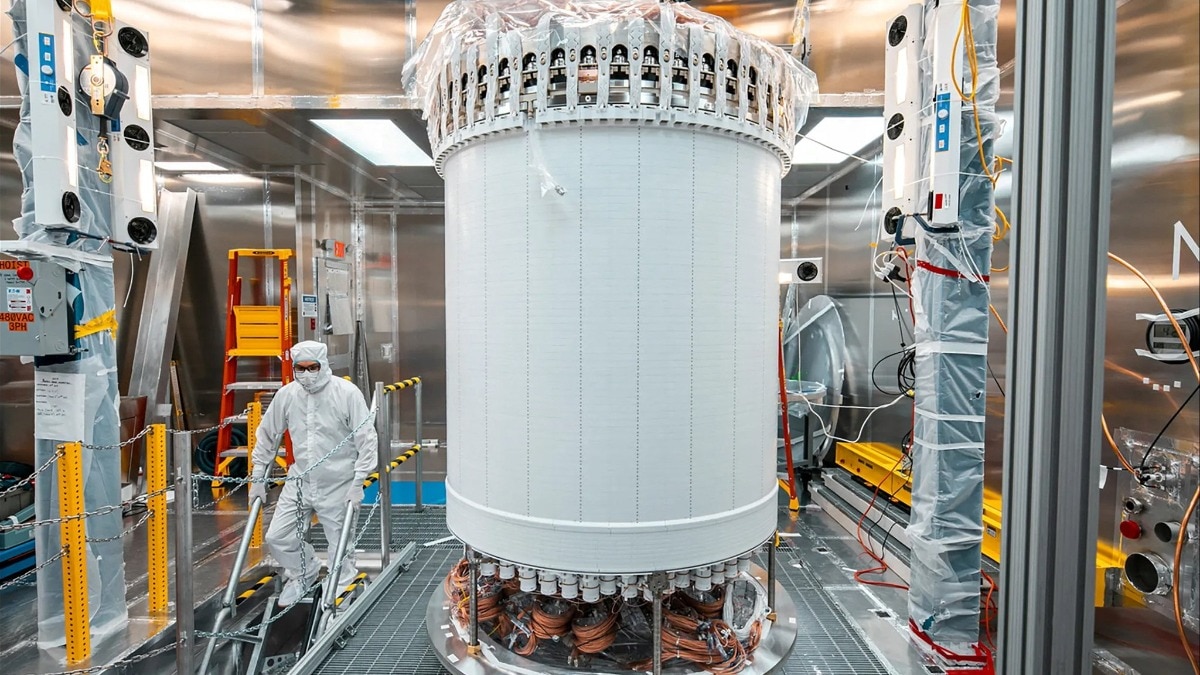
- The detection occurred within the LUX-ZEPLIN (LZ) experiment using liquid xenon.
In a monumental step toward unraveling the mysteries of the cosmos, scientists have reported a possible breakthrough in the hunt for dark matter. Deep beneath the Black Hills of South Dakota, within a former gold mine, researchers at the Sanford Underground Research Facility documented a particle interaction that could represent the first direct hint of this elusive substance.
The observation was made using the LUX-ZEPLIN (LZ) experiment, a sophisticated detector managed by the US Department of Energy's Lawrence Berkeley National Laboratory. The experiment utilizes 10 tons of liquid xenon to catch rare interactions between dark matter and ordinary matter. The researchers described an event where a particle appeared to collide with a xenon nucleus, creating a faint flash of UV light—a signature characteristic of a WIMP (Weakly Interacting Massive Particle).
Why This Matters
BozokMedia analysis shows that understanding dark matter is fundamental to modern cosmology. While visible matter—stars, planets, and humans—makes up only about 15% of the universe's mass, dark matter acts as the 'cosmic glue' that holds galaxies together. Without its gravitational influence, the Milky Way and other galactic structures would likely never have formed.
"We may be looking at something extraordinary, but we have to be exceptionally rigorous before drawing that conclusion." — Alvine Kamaha, UCLA Astrophysicist.
Despite the excitement, the scientific community remains cautious. Lead author Sam Eriksen of the University of Bristol emphasized that because this is currently a single event, it does not yet meet the statistical threshold required to officially claim a discovery. Scientists must now work to rule out other potential explanations or background noise that could mimic such an interaction.
Historical Background
The existence of dark matter was first inferred by observing the gravitational effects of galaxies. Astronomers noticed that galaxies rotate much faster than the visible mass within them should allow. This discrepancy led to the hypothesis that a vast amount of invisible matter provides the necessary gravitational pull to prevent galaxies from flying apart. Since then, experiments like LZ have been placed deep underground to shield them from cosmic rays, searching for that one elusive moment of contact.
The scientific community is now looking toward future data runs from the LZ detector to see if more of these events occur, which would provide the statistical certainty needed to rewrite physics textbooks.
Frequently Asked Questions
1. What is a WIMP?
A WIMP, or Weakly Interacting Massive Particle, is a leading theoretical candidate for what dark matter is made of.
2. Why is the experiment underground?
Experiments are placed deep underground to shield sensitive detectors from cosmic radiation, which could interfere with the detection of rare dark matter signals.