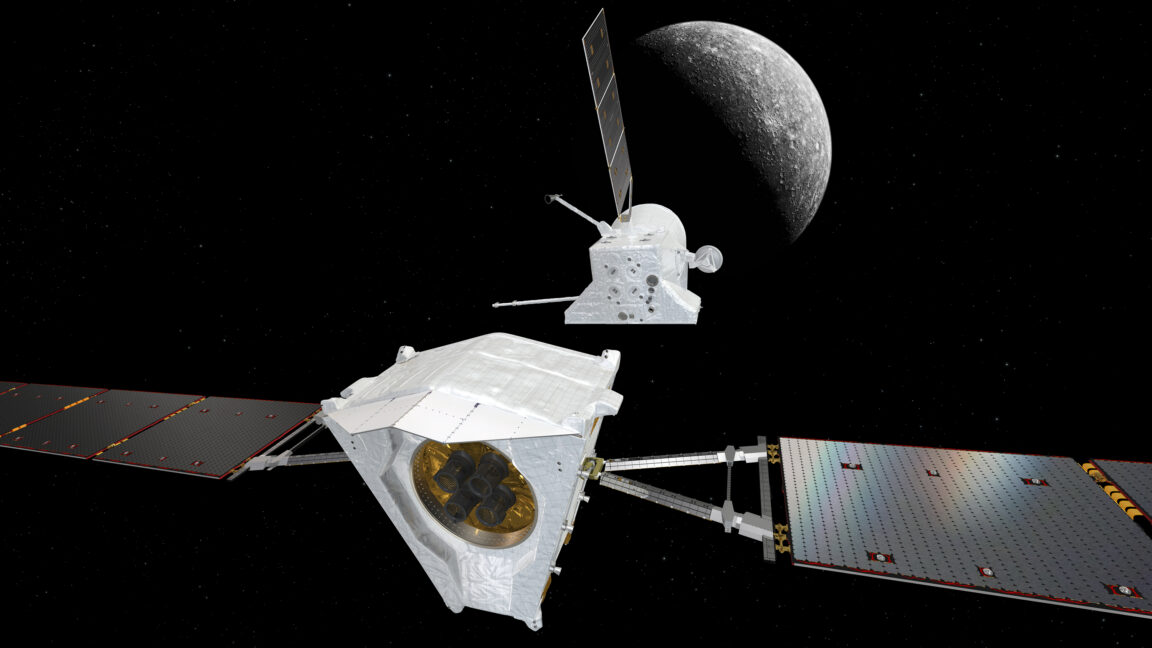
After an arduous eight-year interplanetary voyage, the BepiColombo mission has reached its final stage toward Mercury. This multi-billion dollar collaboration aims to unlock the mysteries of the solar system's innermost planet.
- BepiColombo has reached a major milestone in its 8-year journey to Mercury.
- The $2 billion mission is a collaboration between ESA, JAXA, and NASA.
- The spacecraft is preparing for orbital insertion later this year.
The BepiColombo mission cleared a monumental milestone this week, marking the final stretch of its eight-year odyssey toward Mercury. As one of the most difficult-to-reach destinations in our solar system, Mercury presents a punishing environment of extreme heat and intense solar radiation. This robotic science mission, valued at nearly $2 billion, represents a pinnacle of international cooperation.
Led by the European Space Agency (ESA), with significant contributions from Japan and the United States, the spacecraft has been on a complex trajectory since its launch in 2018. To navigate the sun's massive gravitational pull, BepiColombo has utilized advanced plasma propulsion and a series of strategic flybys of Earth, Venus, and Mercury to fine-tune its velocity.
Why This Matters
BozokMedia analysis shows that the physics of reaching Mercury is significantly more demanding than reaching the outer planets. While NASA's New Horizons took a decade to reach Pluto, the energy requirements—known as delta-v—to decelerate and enter orbit around the fast-moving, iron-rich Mercury are immense.
"Fundamentally, we want to learn about the origins of this planet and how it came to be like it is."
The upcoming encounter is critical. Upon its next approach, the spacecraft's speed will be precisely calibrated to allow Mercury's gravity to capture it into a stable orbit. This will enable a suite of scientific instruments to begin detailed mapping of the planet's surface and magnetic field.
Historical Context of Deep Space Travel
Space exploration is a game of patience and precision. The comparison between Mercury missions and Pluto missions highlights the unique challenges of the inner solar system. While Pluto is distant and cold, Mercury is fast and hot, requiring much more complex maneuvering to achieve orbital capture rather than a simple flyby.
Frequently Asked Questions
1. How long has BepiColombo been traveling?
The spacecraft has been in transit since its launch in 2018, totaling an eight-year journey.
2. Who is funding this mission?
The mission is a joint effort involving the European Space Agency, with support from Japan and the United States.