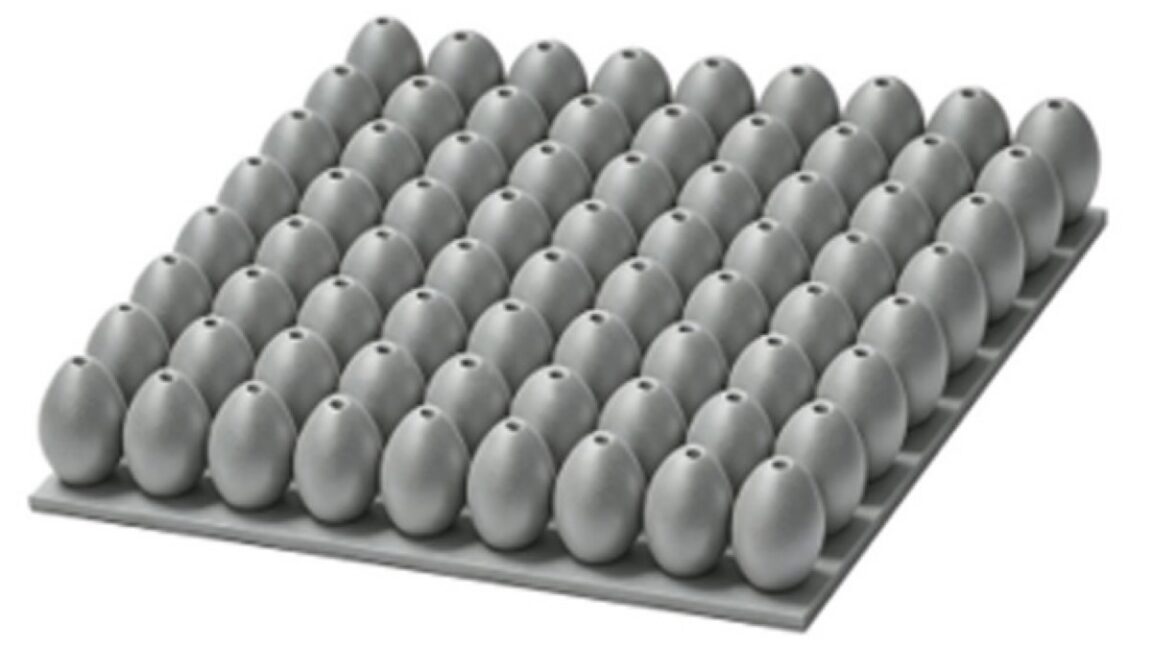
Chinese researchers have developed a bio-mimetic aluminum material inspired by eggshells to protect spacecraft from the growing threat of orbital debris.
- Chinese scientists developed a new aluminum material based on the geometric properties of eggshells.
- The design significantly enhances resistance against high-velocity space debris impacts.
- The use of 3D-printed aluminum arrays filled with water optimizes energy absorption.
The perils of orbital debris are not theoretical; they are a documented reality. In 2007, the US space shuttle Endeavor suffered a bullet-like puncture in its radiator panel caused by a fragment of space junk. While the shuttle era concluded in 2011, the proliferation of satellite constellations and telescopes has exponentially increased the risk of collisions in low Earth orbit. To combat this, scientists in China have unveiled a novel aluminum structure inspired by eggshells, as detailed in the Journal of Applied Physics.
Eggshells have long been a subject of scientific curiosity due to their unique mechanical properties. The ability of an egg to withstand significant pressure when force is applied to its poles, yet break cleanly when struck at the center, is a result of its specific ovoid geometry. This geometry contributes to the shell's rigidity, which is the critical factor in determining how much stress a structure can endure before failure.
Why This Matters
BozokMedia analysis shows that as the 'New Space' race accelerates with entities like SpaceX and Blue Origin, the vulnerability of spacecraft to micro-debris is a systemic risk. Moving from monolithic shields to bio-mimetic, distributed-stress structures represents a paradigm shift in aerospace engineering.
The intersection of biology and metallurgy is providing the keys to survival in the harshest environment known to man: the vacuum of space.
The research draws conceptual parallels to the work of MIT mechanical engineer Pedro Reis. Reis demonstrated that the narrow tip of an egg is its most crack-resistant part. By aligning these points and distributing weight across the surface, the shell can support weights far exceeding the force required to break a single egg. The Chinese team applied this logic by 3D-printing aluminum arrays that mimic this distribution, further enhancing them by filling the gaps with water to absorb kinetic energy.
| Feature | Traditional Aluminum Shields | Eggshell-Inspired Armor |
|---|---|---|
| Impact Distribution | Localized Stress | Distributed Stress |
| Weight Efficiency | Heavy/Solid | Lightweight/Lattice |
| Energy Absorption | Moderate | High (with fluid filling) |
Historically, space shielding relied on the 'Whipple shield' concept—multiple layers of metal. However, integrating the geometric efficiency of an eggshell allows for a lighter yet more resilient barrier, which is crucial for reducing launch costs while increasing safety.
Frequently Asked Questions
Q1: How does an eggshell design stop space debris?
Instead of the impact force being concentrated on one point, the ovoid geometry helps distribute the kinetic energy across a wider area of the structure.
Q2: Is there actual organic material in the shield?
No, the material is high-grade 3D-printed aluminum; only the structural design is borrowed from nature.