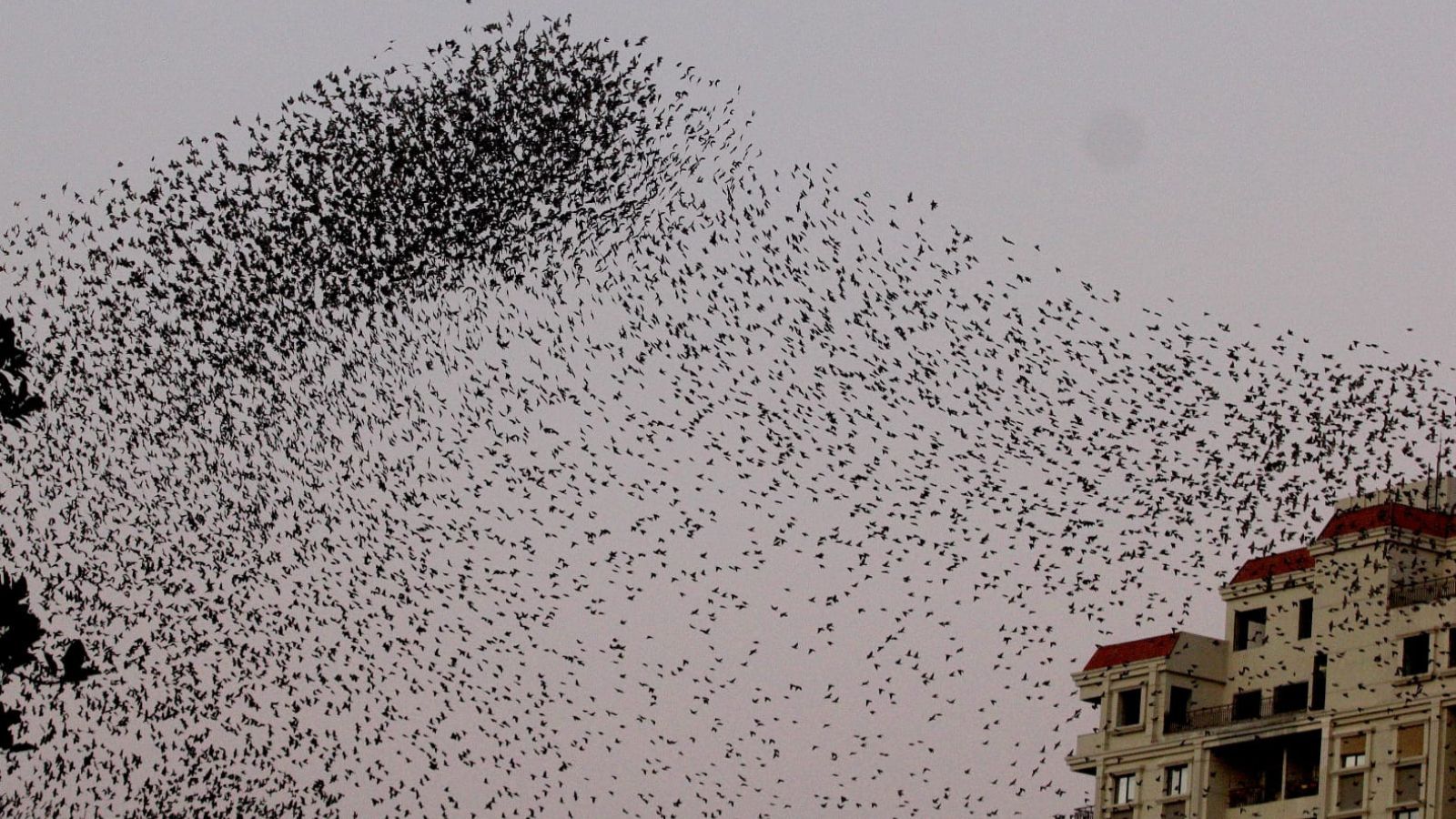
A groundbreaking study by Ahmedabad University has identified 12 distinct shapes in rosy starling murmurations, proving that their geometric shifts are a strategic response to avian predators.
- Researchers identified 12 distinct canonical shapes in rosy starling flocks.
- The 'Small Road' formation dominates (71.3%) when predators like Black Kites are present.
- The study is the first of its kind in India, published in the prestigious journal 'Integrative and Comparative Biology'.
As the monsoon progresses, the skies of Gujarat are once again graced by the mesmerizing spectacle of rosy starlings (Pastor roseus). These birds create 'murmurations'—swirling, synchronized flights that make thousands of individuals appear as a single, fluid organism rippling through the atmosphere. While visually stunning, these patterns are far from random.
Researchers Venu Divin and Jitesh Jhawar from the School of Arts and Sciences at Ahmedabad University have established a direct correlation between the geometry of these flocks and the proximity of aerial predators. Their findings, published in the internationally reputed journal Integrative and Comparative Biology (ICB), provide a quantitative analysis of survival instincts in the animal kingdom.
Why This Matters
BozokMedia analysis shows that this study elevates the understanding of collective animal behavior from mere observation to quantifiable science. By mapping specific shapes to specific threats, the research demonstrates how biological systems optimize for speed and escape in real-time, offering insights into the evolutionary pressure of predator-prey dynamics.
The study was conducted on the Ahmedabad University campus between January and February 2025. Using high-altitude videography and photography, the team analyzed 3,023 flocks. They categorized movements into 12 distinct shapes, including "Small Road", "Small Oval", "Globular", "Wave Shape", "Ovoidal", "Snake", and "C-Shape".
The transition to a 'Small Road' formation indicates a biological adaptation to maximize flight speed and facilitate a faster escape from avian threats.
The data revealed a stark contrast in behavior based on the presence of the black kite (Milvus migrans). In a predator-free environment, "Small Oval" (27.9%) and "Mini Flock" (27.7%) were the most frequent. However, when a predator entered a 10-meter radius, the "Small Road" shape became overwhelmingly dominant, accounting for 71.3% of the observations.
| Condition | Dominant Shape | Frequency (%) |
|---|---|---|
| No Predator | Small Oval / Mini Flock | ~27% each |
| Predator Present | Small Road | 71.3% |
Interestingly, the study noted that predator presence alone does not always trigger a murmuration. This suggests that flock size and other internal variables play a role, aligning with research on European starlings where murmurations typically occur only after the flock exceeds a certain size threshold.
Frequently Asked Questions
1. What is a murmuration?
A murmuration is a phenomenon where large flocks of starlings fly in a highly synchronized, shifting pattern, usually seen at dawn or dusk.
2. Why do starlings form a 'Small Road' shape?
This shape provides a larger surface area and pointed ends, which are believed to facilitate higher flight speeds, allowing the birds to escape predators more effectively.