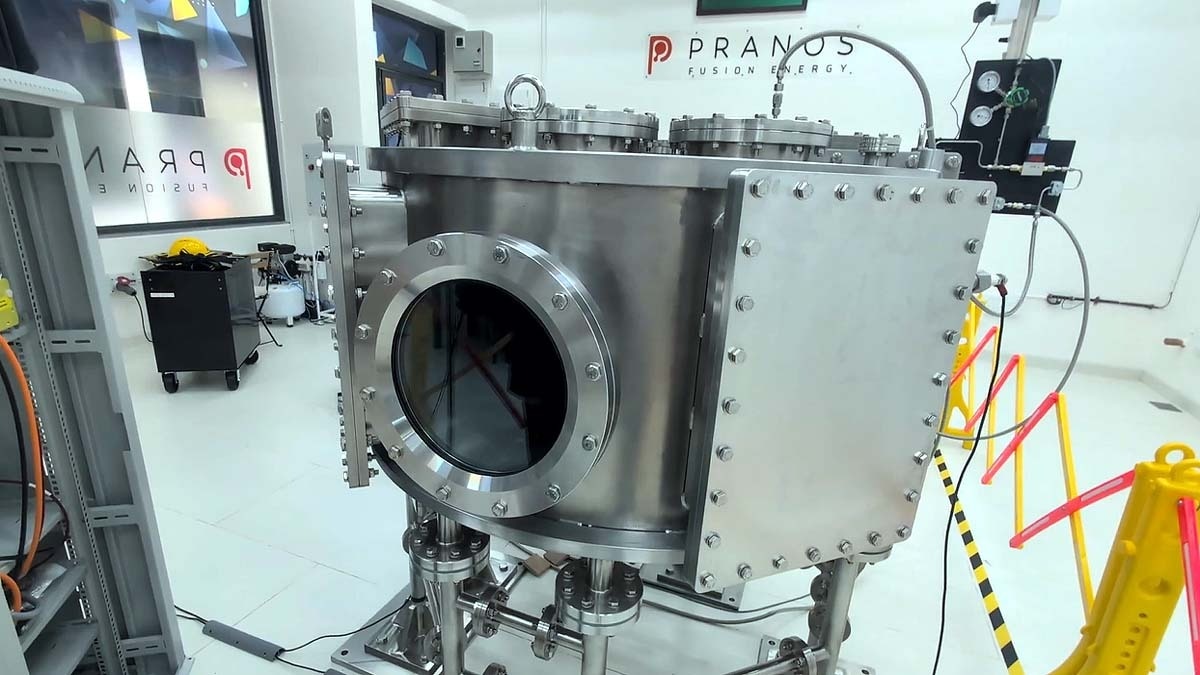
Bengaluru-based startup Pranos Fusion has achieved a major breakthrough by producing plasma in PRAGYA, India's first privately developed tokamak. This marks a pivotal step toward achieving sustainable, limitless fusion energy.
- Pranos Fusion has unveiled PRAGYA, India's first private compact tokamak reactor.
- The reactor successfully produced plasma, a critical step toward nuclear fusion.
- The company aims to build the 'PraniQ' net energy gain reactor by 2030.
India has entered the high-stakes race for clean energy with a significant milestone in nuclear fusion research. Pranos Fusion, a Bengaluru-based deep-tech startup, has announced the successful generation of plasma within its proprietary tokamak reactor, PRAGYA. This development signifies the entry of India's private sector into the complex realm of artificial sun technology.
The PRAGYA tokamak, featuring a radius of approximately 40 centimeters, was developed in a remarkably short span of eight months. Rather than immediate power generation, PRAGYA serves as a sophisticated testbed. The company plans to operate this machine for the next 20 years, executing roughly 3,000 plasma shots annually—averaging 10 to 12 shots per day—to gather critical data on plasma stability and control.
Understanding the Tokamak Technology
A tokamak is a toroidal (donut-shaped) device that uses powerful magnetic fields to confine and control plasma—a superheated state of matter. In nuclear fusion, light atomic nuclei are fused together under extreme heat and pressure to release immense energy, mimicking the process that powers the sun. The primary challenge is maintaining the plasma's stability long enough to achieve a sustainable reaction.
Why This Matters
BozokMedia analysis suggests that this initiative could decentralize fusion research in India, moving it beyond government laboratories. By focusing on High-Temperature Superconducting (HTS) magnets, Pranos Fusion is targeting a more compact and efficient design than traditional massive reactors. This could potentially accelerate the timeline for commercial fusion energy in the Global South.
"The transition from theoretical plasma physics to a functional private tokamak is a testament to India's growing capability in advanced materials and engineering."
Beyond the hardware, Pranos Fusion is positioning PRAGYA as an educational hub to train the next generation of plasma physicists and fusion scientists in India. The company's roadmap includes the activation of HTS magnets by 2027, leading up to the 2030 launch of PraniQ. PraniQ is envisioned as a 'Net Energy Gain' reactor, where the energy output from the fusion reaction exceeds the energy required to sustain it.
| Feature | PRAGYA (Current) | PraniQ (Target 2030) |
|---|---|---|
| Primary Goal | Research & Data Collection | Net Energy Production |
| Reactor Type | Compact Tokamak | Energy Gain Reactor |
| Focus Area | Plasma Control/Testing | Commercial Energy Viability |
Frequently Asked Questions
1. Is PRAGYA currently generating electricity?
No, PRAGYA is a research-grade machine designed to test plasma control and gather data, not to produce commercial power.
2. What is 'Net Energy Gain'?
Net energy gain (Q > 1) occurs when the energy produced by the fusion reaction is greater than the energy used to heat the plasma and power the magnets.