In a groundbreaking discovery, astronomers using the ALMA telescope have captured two massive protostars that joined together by chance just 60 years ago. This rare event challenges existing theories about how binary star systems are born.
- Two massive protostars in system IRAS 07299−1651 captured each other's gravity only 60 years ago.
- Unlike most binaries, these stars did not form from the same gas cloud but met by chance.
- Observation required a multi-telescope approach using ALMA, JWST, and VLT.
Astronomers have achieved a historic milestone by observing the birth of a massive stellar binary system in real-time. Utilizing the Atacama Large Millimeter/submillimeter Array (ALMA), researchers discovered that two massive protostars, located approximately 5,300 light-years away in the system IRAS 07299−1651, have recently coupled to form a binary pair.
For decades, the prevailing scientific consensus was that binary stars—stars that orbit a common center of mass—formed from the fragmentation of a single, collapsing cloud of gas and dust. However, the data from IRAS 07299−1651 tells a different story. The two stars in this system were born in separate natal cocoons and were brought together by a chance gravitational encounter, a phenomenon that is exceedingly rare to witness on a human timescale.
BozokMedia analysis shows that this discovery fundamentally alters our understanding of stellar evolution. While roughly 50% of sun-sized stars have companions, this figure jumps to 90% for massive stars. Because massive stars eventually end their lives as supernovas, they act as the primary architects of galactic chemistry. Understanding whether these systems form through fragmentation or capture is key to predicting the lifecycle of entire galaxies.
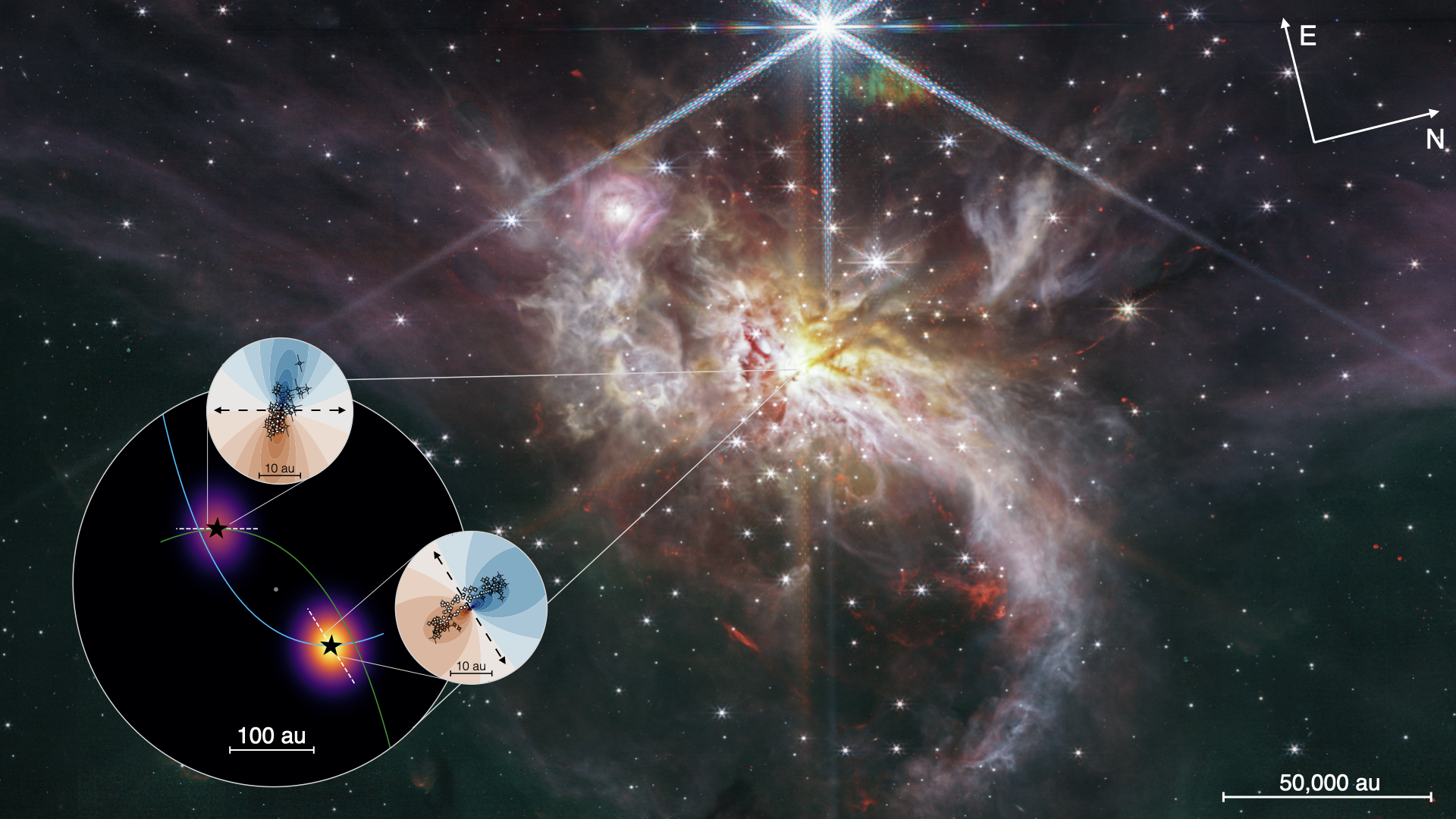
The research team, led by Yichen Zhang of Shanghai Jiao Tong University, spent eight years mapping the system. They combined radio data from ALMA and the Very Large Array (VLA) with high-resolution infrared imagery from the James Webb Space Telescope (JWST) and the Very Large Telescope (VLT). This multi-spectral approach allowed them to reconstruct a 3D model of the stars' orbits and the orientation of their accretion disks.
"This study demonstrates that the early lives of stars can be quite chaotic, with a chance encounter leading to this gravitational dance and stellar coupling."
The most striking evidence for the 'capture' theory was the misalignment of the circumstellar disks. If the stars had shared a common origin, their disks would be aligned. Instead, the disks are tilted at sharp, chaotic angles relative to each other and their orbital plane. Furthermore, the orbits were found to be highly eccentric—almost parabolic—rather than the neat circles typically seen in co-born binaries.
Tracing the orbital trajectories backward, the team concluded that the encounter occurred roughly 60 years ago. In cosmic terms, this is a mere blink of an eye. The fact that the stars' individual disks survived the encounter without being shredded indicates a precise and violent gravitational choreography.
| Feature | Standard Binary Formation | IRAS 07299−1651 (Capture) |
|---|---|---|
| Origin | Single Gas Cloud | Two Separate Clouds |
| Disk Alignment | Parallel/Aligned | Misaligned/Tilted |
| Orbit Shape | Near-Circular | Highly Eccentric/Parabolic |
Will these two stars stay together forever?
It is currently unknown. Their future depends on interactions with the surrounding interstellar gas, which could either stabilize the orbit or fling them apart.
How far away is this system from Earth?
The IRAS 07299−1651 system is located approximately 5,300 light-years away from our solar system.