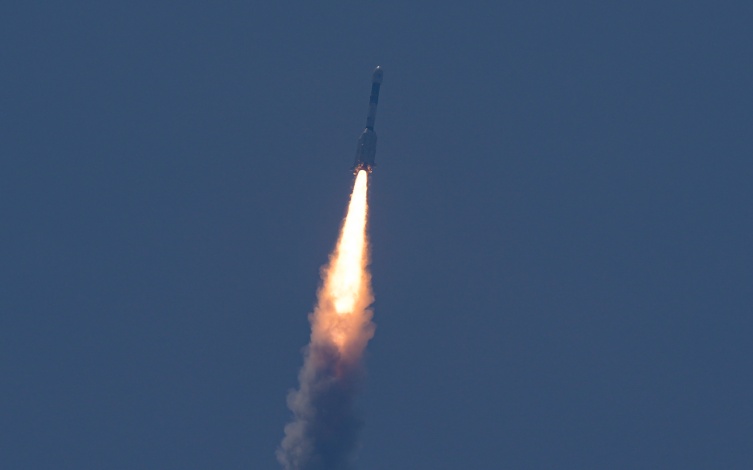
Following a successful launch by GSLV F17, ISRO's EOS-05 satellite is being positioned in a geosynchronous orbit. Discover why scientists opted for GSO instead of a standard circular geostationary orbit.
- EOS-05 is ISRO's first dedicated imaging satellite to operate from a geosynchronous orbit.
- The GSLV F17 rocket delivered a near-perfect launch, providing slightly more energy than required.
- The satellite is designed to provide critical strategic data, primarily for the Indian Navy.
- Successful onboard engine maneuvers have successfully raised the satellite's apogee.
The Indian Space Research Organisation (ISRO) has reached a pivotal moment with the successful deployment of the EOS-05 satellite. Launched via the GSLV F17 rocket, the satellite is undergoing complex orbit-raising maneuvers. In a strategic move that has caught the attention of space enthusiasts, ISRO scientists have indicated that the satellite will operate in a slightly elliptical geosynchronous orbit (GSO) rather than the traditional, perfectly circular geostationary orbit (GEO).
GSO vs. GEO: Decoding the Orbital Strategy
While a geostationary orbit (GEO) is often considered the 'gold standard' for Earth observation because it remains fixed over a single point on the equator, the geosynchronous orbit (GSO) offers a broader set of parameters. A GEO is a specific subset of GSO where the eccentricity and inclination are essentially zero. By choosing GSO, ISRO allows for a more versatile orbital path that meets the specific multi-band imaging requirements of the EOS-05 mission.
Why This Matters
BozokMedia analysis shows that this mission is a critical upgrade for India's defense capabilities. EOS-05 is intended to serve as an 'Eye in the Sky,' providing real-time, high-resolution imagery. The Indian Navy is expected to be a primary user, utilizing the satellite for strategic monitoring, maritime surveillance, and weather pattern tracking, which are vital for national security.
The EOS-05 is a complex, multi-band powerhouse, representing a significant leap in India's autonomous strategic imaging capabilities.
The success of the GSLV F17 launch is particularly noteworthy given ISRO's recent history. Following the setback of the GSLV F10 during the EOS-03 mission in 2021, and the engine failure of the NVS-02 navigation satellite last year, the precision of this launch marks a triumphant return to reliability. Spacecraft director Imteyaz Ahmed highlighted the 'precise injection' of this heavy-class satellite, noting that the vehicle provided even more energy than the mission requirements specified.
Historical Context of ISRO's Orbit Maneuvers
ISRO's journey has been defined by its ability to learn from technical challenges. The transition from sub-GTO (Geostationary Transfer Orbit) to a stable GSO involves multiple, high-precision engine burns. The successful execution of the LAM engine burns on Saturday and Sunday demonstrates the growing maturity of ISRO's spacecraft control systems, ensuring that even if a launch provides excess energy, the onboard systems can correct the trajectory into the desired slot.
| Feature | Geostationary Orbit (GEO) | Geosynchronous Orbit (GSO) |
|---|---|---|
| Shape | Perfectly Circular | Can be Elliptical |
| Positioning | Fixed over one spot | Repeats path over a period |
| Primary Use | Standard Comms/Weather | Advanced Strategic Imaging |
Frequently Asked Questions
1. What makes EOS-05 different from previous satellites?
It is India's first dedicated imaging satellite from a geo-orbit with unique multi-band operating capabilities.
2. Why was the GSLV F17 launch considered 'near-perfect'?
It delivered the satellite to a 171 km by 31,000 km orbit, which was remarkably close to the planned 170 km by 29,000 km target.