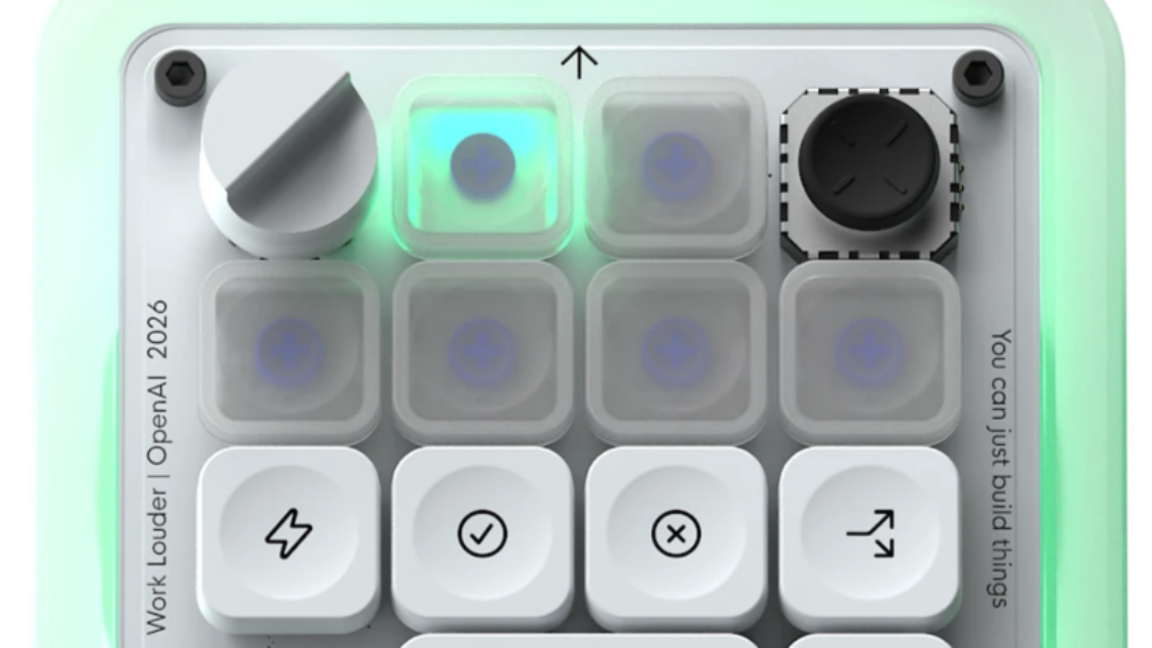
OpenAI has introduced its inaugural branded device, the $230 Codex Micro, a miniature RGB‑lit keyboard that visualises up to six AI agent threads. Color‑coded keys instantly convey each agent’s status, enabling rapid monitoring and interaction.
Key Takeaways
- Codex Micro is an RGB‑lit mini‑keyboard that displays up to six concurrent AI agent threads.
- Colored keys provide real‑time status cues—idle, processing, completed, error, or awaiting human input.
- The device is a limited‑run collaboration between OpenAI and hardware partner Work Louder.
OpenAI announced today the launch of its first branded hardware product, the Codex Micro. Priced at $230, this compact, RGB‑illuminated mini‑keyboard is engineered to let users monitor and interact with multiple Codex agents at a glance, signalling a strategic shift from purely cloud‑based services to tangible desktop tools.
Background and Partnership
The Codex Micro is the result of a limited‑run collaboration with Work Louder, a company already known for its Creator Micro line of customizable square keyboards aimed at creative professionals. While the two devices share a similar aesthetic, the Codex variant distinguishes itself with six frosted keys across the top two rows that provide live, color‑coded feedback for up to six concurrent Codex threads, even when those threads are not the active window.
Color‑Coded Feedback Mechanics
Each of the six keys cycles through a palette that reflects the thread’s state: white for idle, blue while the model is thinking, green when a task completes, amber when human feedback is required, and red if an error occurs. A simple tap on the illuminated key brings the corresponding Codex window to the foreground, allowing users to intervene or review results instantly.
Potential Use Cases
For designers, developers, writers, and data scientists, the Codex Micro could redefine multitasking with generative AI. A content creator might run parallel drafts, a programmer could generate code snippets across several projects, and a marketer could explore multiple ad copy variations—all monitored through a single, glance‑ready interface.
Implications for the AI Hardware Landscape
This launch signals OpenAI’s intent to embed its models into physical workstations, not just cloud APIs. If adopted widely, such hardware could set new standards for real‑time AI assistance, blending the immediacy of tactile input with the power of large‑scale language models. The move may also encourage competitors to explore niche, purpose‑built peripherals that make AI interaction more intuitive.