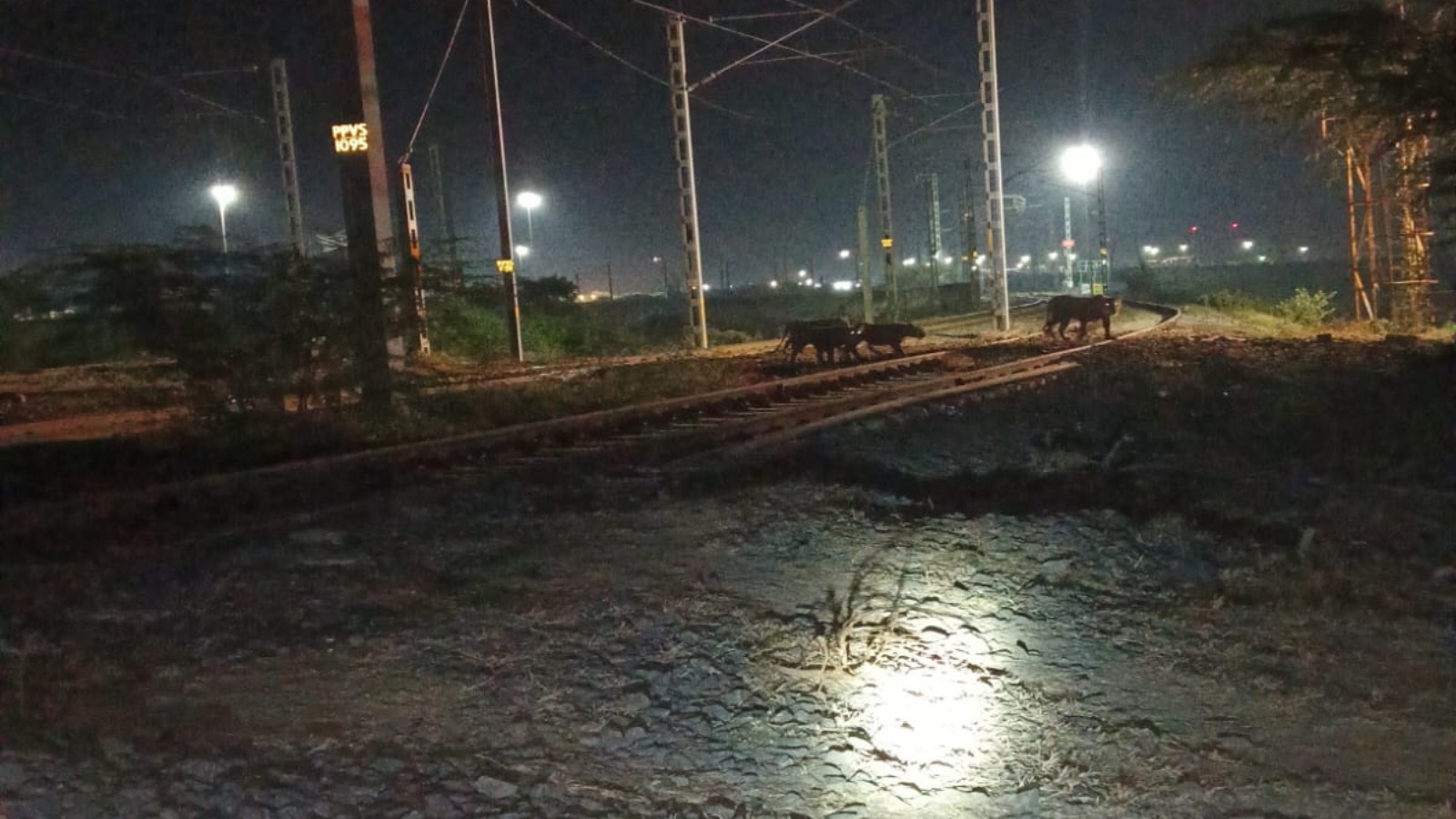
Through a sophisticated combination of AI-based monitoring and fiber-optic sensing, the Gujarat government has successfully diverted over 6,600 lions from railway tracks, resulting in zero lion fatalities due to trains in the last two years.
- Implementation of AI-based Intrusion Detection Systems (IDS) along railway tracks.
- Over 6,682 lions and 1,148 other animals successfully diverted from tracks.
- Zero lion deaths reported due to train collisions between August 2024 and May 2026.
For decades, the expansion of India's transport network through the Saurashtra region posed a lethal threat to the growing population of Asiatic Lions. Stepping onto a track in Junagadh or Amreli often meant a desperate race against time for manual trackers. However, a revolutionary shift is underway. The Gujarat Government has successfully integrated Artificial Intelligence (AI) and advanced sensing technology to safeguard these majestic predators, marking a significant milestone in wildlife conservation.
The Technological Shield: AI and Fiber-Optic Sensing
According to an affidavit filed by Conservator of Forests, Junagadh, Ram Ratan Nala, before the Gujarat High Court, the state has deployed a multi-layered safety regime. Central to this is the Intrusion Detection System (IDS), which utilizes AI-powered cameras and CCTV surveillance. A groundbreaking component involves laying 6-core optical-fibre cables in a zigzag pattern, specifically in the high-movement Liliya-Savarkundla section of Amreli district. These cables are designed to detect the unique 'movement signatures' of lions, providing an early warning to loco-pilots.
Why This Matters
BozokMedia analysis shows that as the Asiatic lion population expands beyond the traditional Gir landscape into districts like Amreli and Porbandar, the intersection with railway infrastructure becomes inevitable. This technological intervention serves as a global blueprint for mitigating human-wildlife conflict in rapidly developing nations, proving that infrastructure growth does not have to come at the cost of biodiversity.
The integration of trackside AI represents a paradigm shift from reactive rescue to proactive prevention in wildlife management.
The scale of the operation is immense. Between April and July 2026 alone, the authorities cleared 33.4 km of vegetation to improve visibility, deployed 70 railway trackers, and issued 1,356 caution orders. Furthermore, the government has focused on hardware upgrades, such as equipping locomotives in hotspots with twin-beam LED headlights to enhance visibility during night operations.
Safety Mechanism Comparison
| Feature | Traditional Methods | AI-Enabled System |
|---|---|---|
| Detection Method | Manual observation by trackers | Fiber-optic sensing & AI cameras |
| Warning System | Human alarms/signals | Automated detection & loco-pilot alerts |
| Visibility | Standard locomotive lights | Twin-beam LED headlights |
Despite the success, the High-Level Committee noted that the AI software's accuracy is still evolving. The current Standard Operating Procedure (SOP) involves a phased implementation, with further refinements expected as Western Railway completes the 'proof of concept' phase. The goal is to move toward a seamless early warning system that can predict lion movements near tracks with near-perfect precision.
Frequently Asked Questions
Question 1: How does the fiber-optic cable help in saving lions?
Answer: The cables detect subtle vibrations and movement signatures of lions near the tracks, alerting the railway authorities and loco-pilots immediately.
Question 2: Has the technology been fully implemented across all tracks?
Answer: No, it is being implemented in a phased manner, starting with high-risk hotspots like the Liliya-Savarkundla section.