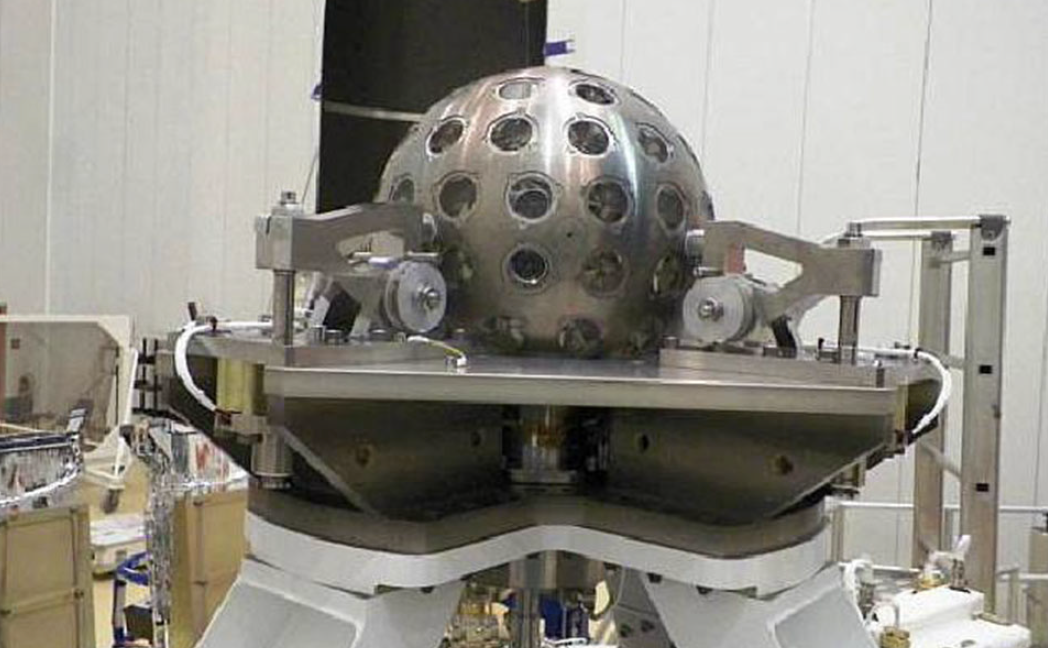
A novel satellite that looks like a hybrid of a golf ball and a disco globe has measured Earth’s frame‑dragging effect with just 0.2% uncertainty, delivering the most accurate Lense‑Thirring measurement to date. The result re‑affirms General Relativity with unprecedented precision.
मुख्य बिंदु (Key Takeaways)
- Earth’s frame‑dragging measured with 0.2% error margin.
- The new satellite outperforms previous missions by a factor of five.
- Findings further solidify Einstein’s General Relativity.
A breakthrough in experimental physics has been achieved using an orbiting satellite that resembles a glittering disco ball. Led by physicist Ignazio Ciufolini of the Wuhan Institute of Physics and Mathematics, the team reported the most precise terrestrial Lense‑Thirring measurement ever, shrinking uncertainty from a few percent to just 0.2%.
Background and Theory
Einstein’s General Theory of Relativity predicts that any rotating mass drags the surrounding space‑time fabric—a phenomenon known as frame‑dragging or the Lense‑Thirring effect, named after the 1918 calculations of Josef Lense and Hermann Thirring. The effect scales with mass and angular velocity, making it most evident near massive, fast‑spinning objects such as black holes.
Earlier Measurements
Prior attempts, notably NASA’s Gravity Probe B and the LAGEOS satellites, measured Earth’s frame‑dragging with uncertainties of about 1‑2 percent. While groundbreaking, those missions left a sizable error window that could accommodate exotic alternative gravity models. The new result narrows that window dramatically, offering a stringent test for any theory that deviates from Einstein’s equations.
The Disco‑Ball Satellite
Ciufolini’s team equipped the satellite with an ultra‑reflective, spherical surface and state‑of‑the‑art laser‑ranging retro‑reflectors. By tracking the satellite’s orbit to millimetre precision over several years, researchers isolated the tiny precession caused by Earth’s rotation. The satellite’s design—reminiscent of a glittering disco globe—maximizes signal return, enabling the unprecedented accuracy.
Implications and Future Prospects
Beyond confirming General Relativity, this level of precision opens avenues to probe subtle phenomena such as possible violations of the equivalence principle, dark‑matter interactions, or signatures of quantum gravity. Scientists are already contemplating similar missions around the Moon and Mars, where differing mass and spin rates could further stress‑test the theory.