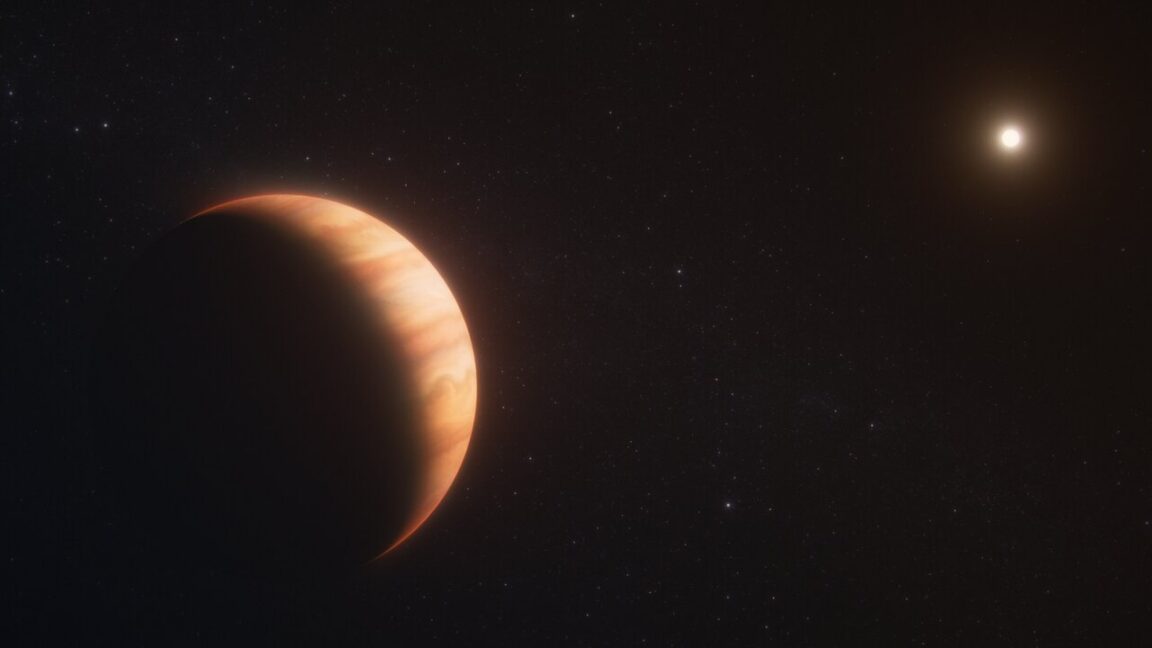
Astronomers have captured the first detailed JWST images of WD 1856 b, a Jupiter‑sized world orbiting a white dwarf. It is the only known planet that has endured the death throes of a Sun‑like star, bypassing the red‑giant expansion that usually engulfs nearby worlds.
Key Takeaways
- WD 1856 b is a Jupiter‑sized planet orbiting a white dwarf.
- It survived the host star’s red‑giant phase, a first in observational astronomy.
- James Webb Space Telescope provided the inaugural high‑resolution view, revealing surprising atmospheric features.
WD 1856, a white dwarf that is the remnant core of a Sun‑like star, now hosts a gas giant roughly the size of Jupiter. The star has already passed through a red‑giant bloating stage, shedding its outer layers before collapsing into a dense, Earth‑size object composed mainly of carbon and oxygen. The planet’s survival challenges conventional models of planetary destruction during stellar evolution.
Accidental Discovery by TESS
In 2020, NASA’s Transiting Exoplanet Survey Satellite (TESS) surveyed about 2,000 white dwarfs, primarily to spot comet‑ or asteroid‑like debris transiting the stellar remnants. During this campaign, a periodic dip in brightness was detected around WD 1856, which turned out to be a gas giant rather than a small rocky fragment. “As soon as they looked at it, they said, ‘Okay, that’s weird,’” recalled Christopher O’Connor, a theoretical astrophysicist at Cornell and co‑author of the recent Nature paper.
First Detailed Look with JWST
The James Webb Space Telescope then targeted the system with infrared imaging and spectroscopy. The observations revealed the planet’s atmospheric composition, temperature gradients, and possible cloud layers, offering clues to how it withstood the intense radiation and tidal forces of its dying star. JWST’s unprecedented sensitivity allowed scientists to map the planet’s day‑side heat distribution, a key metric for assessing survival mechanisms.
Possible Survival Mechanisms
Researchers propose several scenarios. One hypothesis suggests the planet migrated outward during the star’s red‑giant expansion, avoiding engulfment. Another posits that an unusually dense atmosphere acted as a shield against the star’s luminous outburst. Both ideas demand sophisticated dynamical modeling and further observations of similar systems to validate.
Implications for Exoplanetary Science
This singular case forces a reevaluation of planetary system evolution models. If planets can indeed escape their host star’s violent demise, the census of exoplanets around white dwarfs could expand dramatically, opening new avenues for habitability studies and the search for remnants of ancient planetary systems.