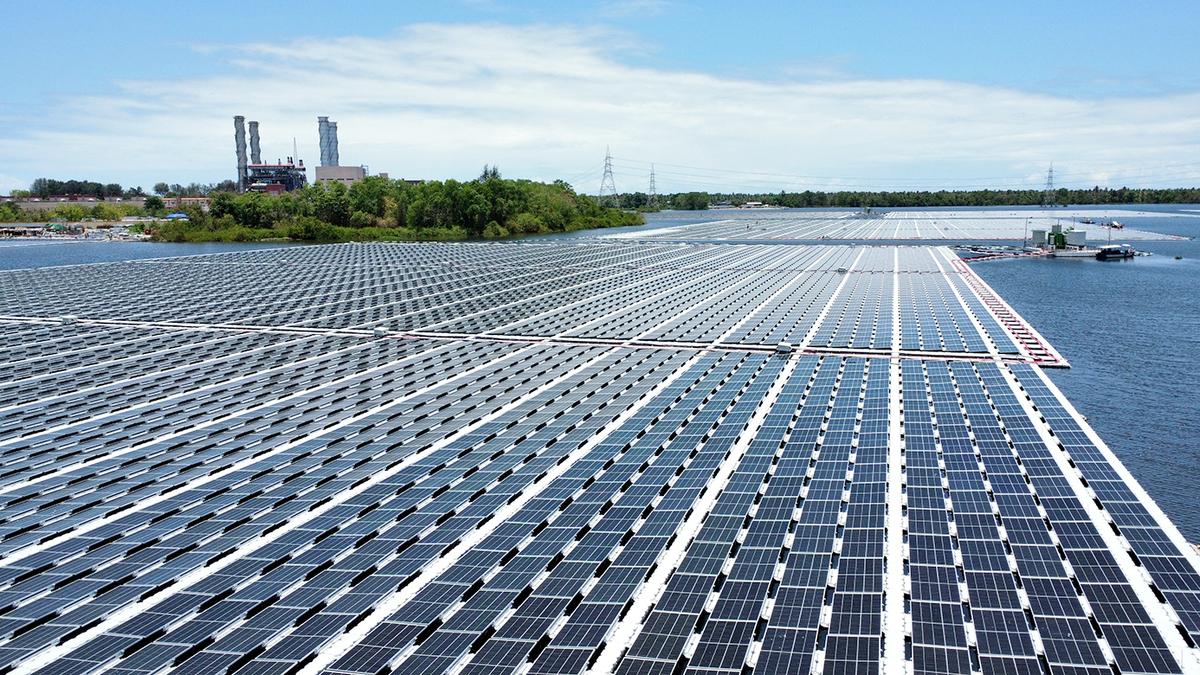
The Union Cabinet approved the PM‑SSY scheme to install 5,000 MW of floating solar PV on reservoirs, backed by a ₹5,070 crore budget and mandatory two‑hour storage. With only ~0.7 GW currently operational versus a 102 GW potential, water surfaces could become the next frontier for renewable growth.
Key Takeaways
- PM‑SSY targets 5,000 MW of floating solar with central funding
- Each project must include at least two hours of energy storage (10,000 MWh total)
- India’s floating solar potential stands at 102 GW, current capacity ~0.7 GW
What Is Floating Solar?
Floating solar photovoltaic (FSPV) systems consist of solar panels mounted on buoyant platforms that float on reservoirs, irrigation tanks, industrial ponds, or hydro‑electric lakes. Modular panel blocks are assembled on‑shore, floated out, and secured with anchors and mooring lines designed to withstand wind, waves, and fluctuating water levels. Inverters are placed either on the floats or on the shoreline, with cables routed to a sub‑station.
Government Initiative: Prime Minister Surya Sarovar Yojana
The Union Cabinet cleared the PM‑SSY scheme, allocating ₹5,070 crore to develop 5,000 MW of floating solar capacity. The program provides Central Financial Assistance of up to ₹1 crore per MW, payable only after commissioning. A mandatory storage system of at least two hours (totaling 10,000 MWh) is required for each project, enabling states to shift power to evening peaks.
Geographic and Economic Advantages
Land scarcity and competing uses—agriculture, urban expansion, and forests—have become the primary bottleneck for utility‑scale solar. By using water bodies that are already under state control, floating solar sidesteps land‑acquisition challenges, requiring land only for cabling and grid connection.
Why This Matters
BozokMedia analysis shows that integrating floating solar with mandatory storage could reduce India’s solar curtailment by up to 30 %, unlocking billions in renewable investments and easing grid stress during peak hours.
“Floating solar can be a game‑changer for India’s energy mix, especially if water‑level risks are proactively managed.” – Dr. Ajay Kumar, Renewable Energy Analyst
Comparison of India’s Floating Solar Potential
| Parameter | Current Capacity | Potential Capacity |
|---|---|---|
| Floating Solar (GW) | ~0.7 | 102 |
| Total Investment (₹ crore) | ≈ 2,000 | ≈ 28,500 |
| Storage (MWh) | — | 10,000 |
Frequently Asked Questions
Q1: Is floating solar more expensive than land‑based installations?
A: Initial capital costs can be slightly higher, but benefits such as reduced curtailment, water‑cooling efficiency, and minimal land acquisition often yield a better overall return on investment.
Q2: What happens if reservoir water levels drop significantly?
A: Lower water levels can affect float stability, which is why projects include robust anchoring systems and real‑time water‑level monitoring to mitigate operational risks.