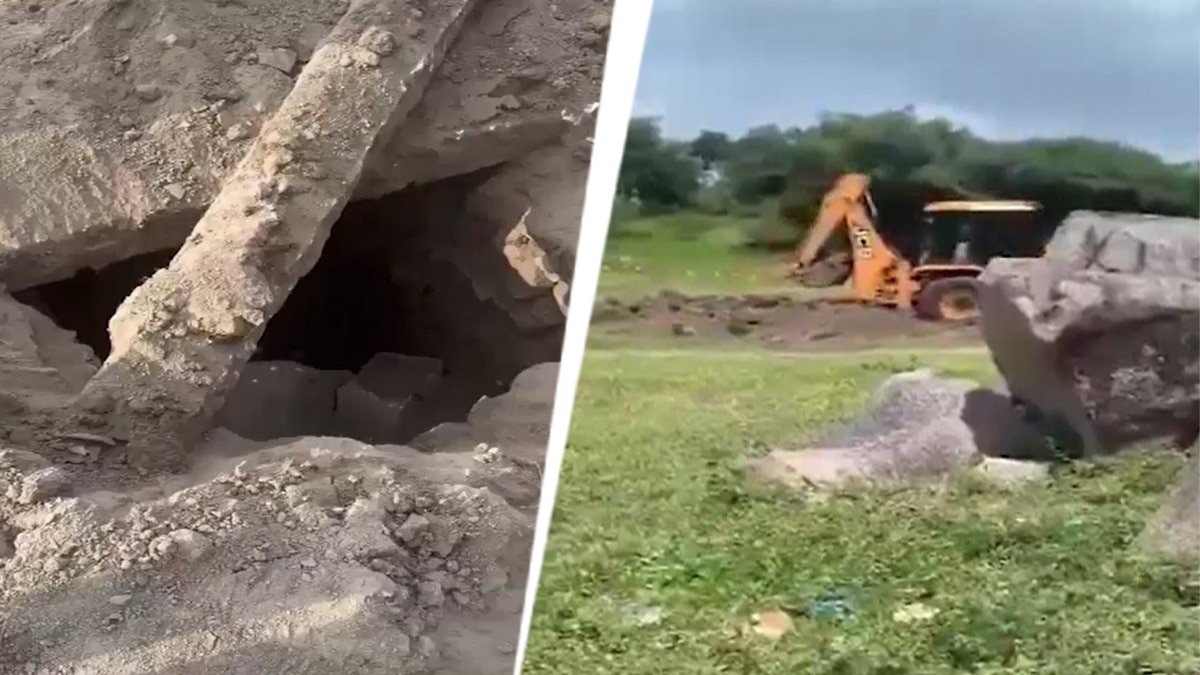
Following reports of a secret tunnel discovery near Hyderabad's iconic Golconda Fort, the Archaeological Survey of India (ASI) has provided a detailed clarification regarding the structure's true nature.
- A structure was discovered during leveling work by the Army's Artillery Centre behind Golconda Fort.
- The ASI confirmed the structure is a small granite chamber, not a tunnel.
- Medieval-era red pottery shards were found at the site.
- Work in the area has been halted pending a detailed investigation.
The historic Golconda Fort in Hyderabad has once again become the center of intense curiosity following reports of a newly discovered structure. While initial rumors suggested the finding of a 'secret tunnel'—a staple of local folklore—the Archaeological Survey of India (ASI) has stepped in to provide scientific clarity on the matter.
The discovery occurred during land-leveling activities conducted by the Army's Artillery Centre, Golconda, located just behind the fortification walls. In response to the mounting speculation, a multidisciplinary team comprising an archaeologist, an engineer, and a surveyor was dispatched to the site to conduct a preliminary assessment.
Structural Details and Findings
According to the official release from the ASI, the structure is not a tunnel but a rectangular-shaped chamber constructed of granite stone. The chamber measures approximately 1.2 meters in length, 1.8 meters in width, and reaches a depth of 2.2 meters. The internal walls consist of rough stone masonry, characteristic of historical local construction techniques.
Adding a layer of historical significance, the team also unearthed several red-colored potsherds. Preliminary analysis suggests these artifacts belong to the medieval period, hinting that the chamber may have been part of a larger, interconnected complex of utility structures used when the fort was a bustling residential settlement.
Why This Matters
BozokMedia analysis shows that such discoveries are critical for understanding the urban planning of medieval Deccan sultanates. The presence of small chambers near the main fortification suggests a sophisticated system of public utilities or secondary defensive structures that have remained hidden for centuries beneath the modern landscape.
The distinction between a tunnel and a chamber is vital; one implies transit, while the other implies a specific, perhaps ritualistic or utilitarian, purpose.
The area where the chamber was found lies within the 100-meter 'prohibited zone' of the Golconda Fort. Consequently, the ASI Hyderabad Circle has issued a formal directive to the Artillery Centre to cease all leveling operations until a comprehensive investigation is completed and approved by the Director General of the ASI.
Historical Background
Golconda Fort, once the capital of the Qutb Shahi dynasty, is renowned for its advanced architectural features, including sophisticated acoustic systems and water management. The 'Bala Hissar' area, situated on a hillock, contains various minor structures that served the inhabitants of the fort during its peak as a major regional power center.
Frequently Asked Questions
Question 1: Is there a secret tunnel in Golconda Fort?
Answer: No, the ASI has officially clarified that the recently discovered structure is a small granite chamber, not a tunnel.
Question 2: What was found inside the chamber?
Answer: While the exact purpose is unknown, archaeologists found medieval-era red pottery shards at the site.