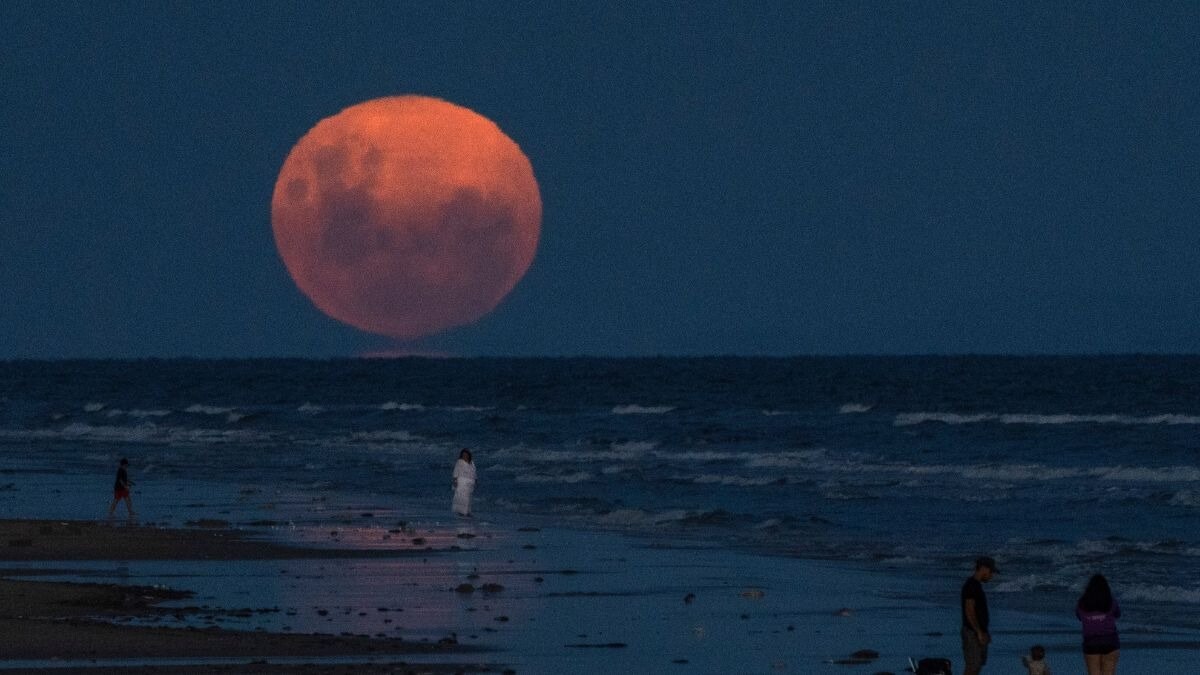
A rare 'Blood Moon' lunar eclipse illuminated the night sky as the Sun, Earth, and Moon aligned in a spectacular celestial display.
- Stargazers globally witnessed a near-total lunar eclipse on Thursday night.
- The 'Blood Moon' effect occurs during a specific alignment of the Sun, Earth, and Moon.
- This follows a major solar eclipse witnessed by millions just weeks prior.
Astronomy enthusiasts and scientists across the globe turned their eyes to the heavens on Thursday night and early Friday morning to witness a breathtaking celestial phenomenon. The event, widely known as a 'Blood Moon', transformed the lunar surface into a deep, crimson hue during a near-total lunar eclipse.
This rare astronomical event occurs when the Sun, Earth, and Moon align in a straight line, causing the Earth to cast its shadow across the Moon. During a total eclipse, the Earth's atmosphere filters out most of the sunlight, allowing only the longer, red wavelengths to pass through and reach the lunar surface, creating the iconic reddish glow.
Historical and Scientific Context
The occurrence of a 'Blood Moon' is a significant event in the field of astronomy. This particular eclipse comes on the heels of one of the most significant solar eclipses witnessed in nearly three decades, making this month a period of extraordinary celestial activity. Such frequent high-profile eclipses provide invaluable data for researchers studying orbital mechanics and atmospheric composition.
Why This Matters
BozokMedia analysis shows that these astronomical events serve as powerful tools for public engagement in science, bridging the gap between complex orbital physics and collective human wonder.
The crimson glow of a Blood Moon is a direct visual manifestation of Earth's atmospheric filtering of sunlight.
While visibility varied depending on geographical location, the global community reacted with immense fascination. From professional observatories using high-powered telescopes to amateur stargazers with simple binoculars, the event was documented extensively across digital platforms.
Frequently Asked Questions
Question 1: What causes the Moon to turn red during an eclipse?
Answer: It is caused by Earth's atmosphere bending sunlight and filtering out shorter blue wavelengths, leaving only red light to hit the Moon.
Question 2: Is it safe to watch a lunar eclipse without protection?
Answer: Yes, unlike solar eclipses, lunar eclipses are perfectly safe to view with the naked eye.