Arizona-based astrophotographer Andrew McCarthy has captured a stunning timelapse of NASA's Nancy Grace Roman Space Telescope as it journeys toward its destination 1.6 million kilometers from Earth.
- Astrophotographer Andrew McCarthy captured the telescope as a moving dot shortly after its launch.
- The observatory is heading to the second Sun-Earth Lagrange point (L2).
- The Roman telescope features a field of view 100 times larger than that of the Hubble Space Telescope.
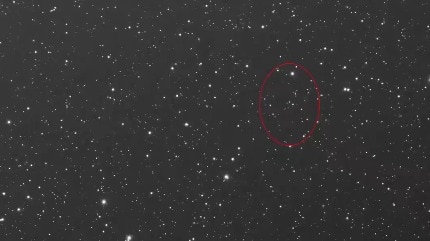
A faint, moving dot crossing the midnight sky might seem insignificant to the untrained eye, but for the global scientific community, it represents a giant leap in astronomy. Andrew McCarthy, a skilled astrophotographer from Arizona, recently captured NASA's Nancy Grace Roman Space Telescope in a timelapse video just days after its successful deployment into the void.
Sharing the footage on September 8, McCarthy challenged viewers to spot the telescope. He later highlighted the object and pointed out other celestial bodies in the frame, including the asteroid 9 Metis, which spans roughly 100 miles in width and resides over 100 million miles away. This capture underscores the growing synergy between professional space agencies and the amateur astronomy community.
Why This Matters
BozokMedia analysis shows that the Roman Space Telescope is not merely a replacement for previous observatories but a complementary powerhouse. While the Hubble Space Telescope provided deep, narrow views of the cosmos, the Roman Telescope is designed for breadth. Its Wide Field Instrument can survey patches of sky 100 times larger than Hubble's while maintaining identical sharpness, allowing NASA to map the universe at an unprecedented scale.
The Roman telescope is designed to solve the cosmic puzzle of dark energy, potentially rewriting our understanding of how the universe expands.
Named after Nancy Grace Roman, NASA's first chief astronomer, the observatory was launched on August 30, 2026, via a SpaceX Falcon Heavy rocket from Kennedy Space Center in Florida. It is currently on a three-month transit to the L2 point, a stable gravitational pocket shared by the James Webb Space Telescope.
NASA Administrator Jared Isaacman praised the mission's efficiency, noting that it was delivered ahead of schedule and within budget. This operational success sets a high benchmark for future deep-space deployments.
| Feature | Hubble Space Telescope | Roman Space Telescope |
|---|---|---|
| Field of View | Narrow/Detailed | 100x Wider Survey |
| Primary Mirror | 2.4 Meters | 2.4 Meters |
| Primary Mission | Deep Space Imagery | Dark Energy & Exoplanets |
The coming weeks will be critical as engineers activate the Wide Field Instrument and begin a rigorous three-month calibration process. Once fully operational in early 2027, the telescope is expected to measure light from over a billion galaxies and discover approximately 100,000 new exoplanets over its five-year primary mission.
Frequently Asked Questions
Q1: What is the primary scientific goal of the Roman Telescope?
A: It aims to investigate the nature of dark matter and dark energy and search for planets beyond our solar system.
Q2: Where is the telescope heading?
A: It is traveling to the second Sun-Earth Lagrange point (L2), located approximately 1.6 million kilometers from Earth.