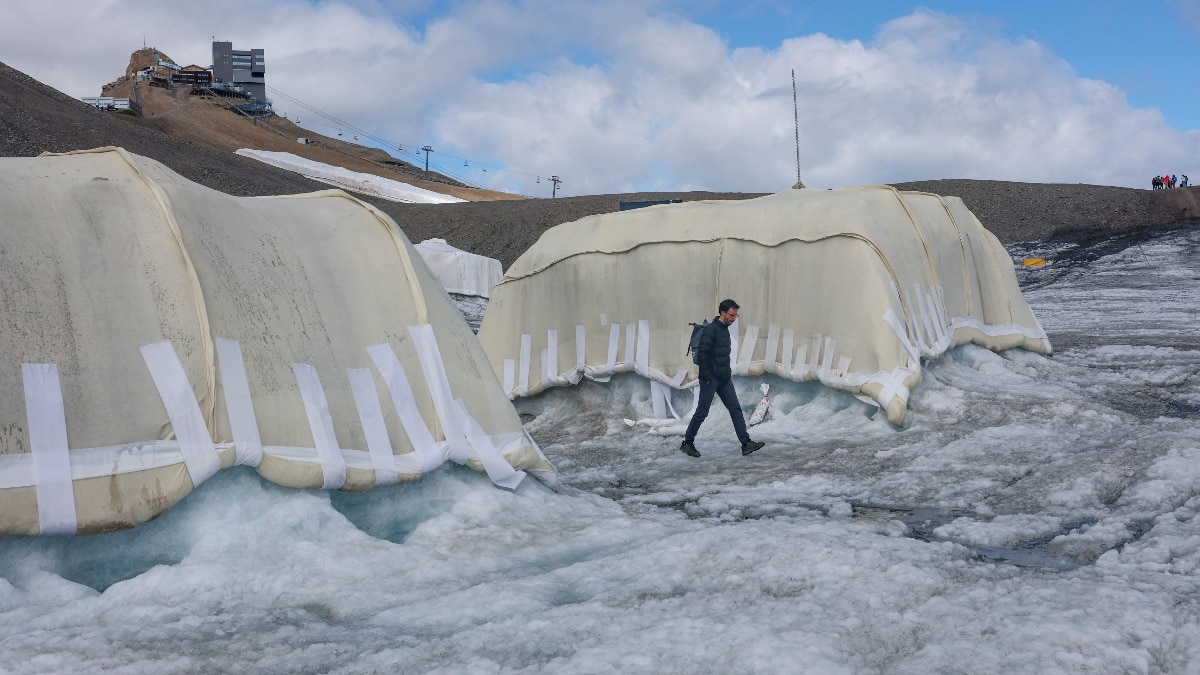
Swiss researchers are testing biodegradable sheep's wool blankets as an eco-friendly alternative to synthetic sheets to slow the melting of Alpine glaciers.
- Swiss researchers tested sheep's wool blankets on the Tsanfleuron Glacier to reduce ice loss.
- Wool blankets proved as effective as synthetic geotextiles but are fully biodegradable.
- The project aims to repurpose the 40-70% of Swiss wool that is typically discarded annually.
As global temperatures soar, glaciers across the Alps and the rest of the planet are shrinking at an alarming rate. In a bid to find sustainable mitigation strategies, researchers from the University of Lausanne and the Summit Foundation have turned to an unconventional material: sheep's wool.
The experiment, titled 'Keep It Wool', focuses on the Tsanfleuron Glacier in western Switzerland. For years, Swiss authorities have used synthetic tarpaulins to protect critical patches of ice during the summer. These plastic sheets reflect sunlight and reduce heat absorption, thereby slowing the melting process. However, these synthetic materials shed harmful microplastics into the pristine mountain environment.
Why This Matters
BozokMedia analysis shows that this initiative represents a critical shift toward "circular science." By utilizing the 40-70% of Swiss wool that is discarded each year, the project transforms agricultural waste into a tool for environmental preservation, reducing the carbon footprint associated with plastic production.
"The wool prototypes worked incredibly well, proving that natural materials can match the performance of synthetic textiles in extreme conditions."
In June, the team deployed two prototype blankets manufactured by the Swiss company Fisolan over 200 square meters of the glacier. Bi-weekly measurements conducted throughout the summer revealed that the wool blankets limited melting as effectively as conventional coverings, with thicker wool prototypes showing slightly superior results.
Despite the encouraging results, the project's scale is limited. Currently, only about 0.02% of Switzerland's glacier surface is covered by any form of protective sheet. The researchers emphasize that while blankets can protect small, high-value areas—such as those critical for tourism or snow management—they cannot save entire glaciers.
| Feature | Synthetic Sheets | Sheep Wool Blankets |
|---|---|---|
| Environmental Impact | Microplastic Pollution | Biodegradable |
| Effectiveness | High | High (Thicker wool is better) |
| Resource Origin | Petrochemicals | Agricultural Waste |
The scientific consensus remains clear: there is no blanket large enough to cover the world's disappearing ice. The only meaningful long-term solution to prevent the total loss of glaciers is the drastic reduction of global greenhouse gas emissions.
Frequently Asked Questions
Q1: Can wool blankets stop glaciers from disappearing entirely?
A: No, they can only protect tiny, specific areas. They are a local mitigation tool, not a global solution.
Q2: Why is wool preferred over plastic geotextiles?
A: Wool is biodegradable and does not release microplastics into the ecosystem, making it far more sustainable.