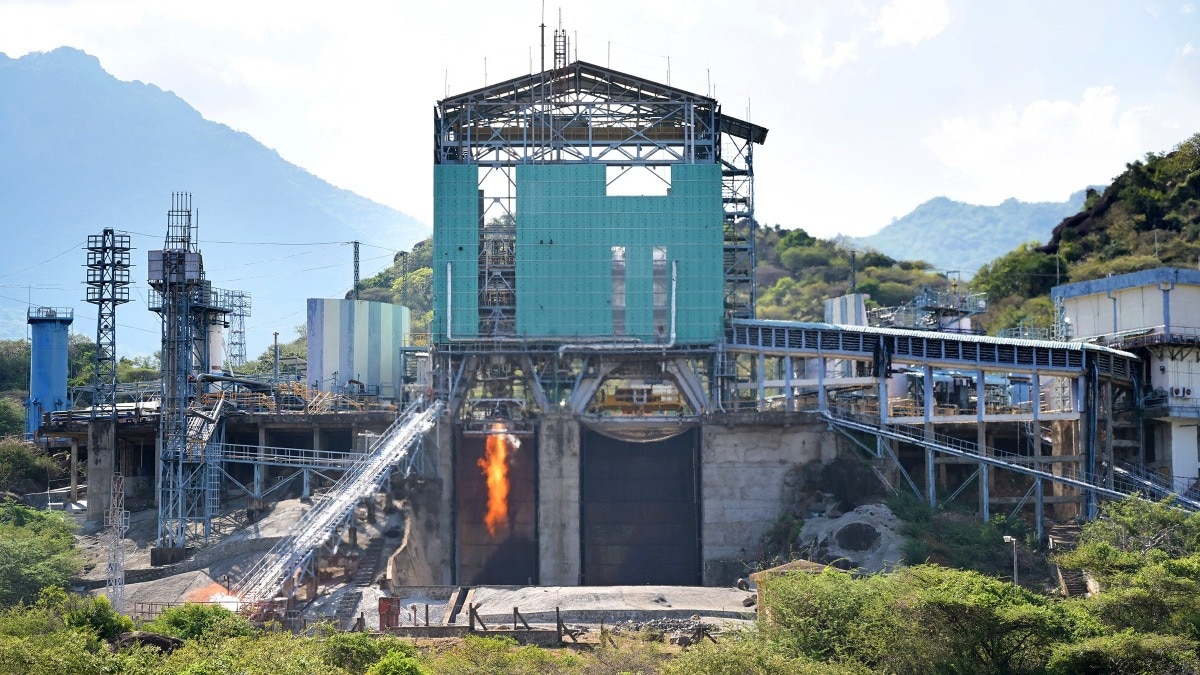
In a major leap for India's space capabilities, ISRO has successfully tested the uprated CE20 cryogenic engine. This milestone enhances the LVM3 rocket's payload capacity and paves the way for the ambitious Gaganyaan human spaceflight mission.
- ISRO successfully completed a flight acceptance hot test of the CE20 cryogenic engine at 220 kN thrust.
- The upgraded C32 upper stage allows the LVM3 rocket to carry significantly heavier payloads into orbit.
- The test validated the LOX Tank Pressurisation Module (LTPM), a critical component for the Gaganyaan human spaceflight mission.
India's space odyssey reached a pivotal milestone on September 9, 2026, as the Indian Space Research Organisation (ISRO) conducted a high-stakes test of its home-grown cryogenic engine. The test, carried out at the ISRO Propulsion Complex in Mahendragiri, Tamil Nadu, focused on the CE20 engine, which is the heart of the C32 upper stage for the LVM3 rocket.
The CE20 engine operates using super-cooled liquid oxygen and liquid hydrogen. In this specific flight acceptance hot test, the engine achieved a thrust of 220 kN. This represents an 'uprated' level of performance, meaning the engine is now capable of generating more power than previous iterations, directly translating to an increased capacity for the LVM3—India's heaviest operational launch vehicle.
Why This Matters
BozokMedia analysis shows that this upgrade is not merely a technical tweak but a strategic shift in India's orbital capabilities. By increasing the thrust and expanding the fuel capacity of the C32 upper stage, ISRO is reducing its reliance on foreign launch providers for heavy satellite deployments. This ensures greater autonomy in deploying sophisticated communication and Earth-observation satellites.
The transition to a 220 kN thrust level marks the evolution of the LVM3 from a reliable workhorse to a high-performance heavy-lift vehicle capable of competing on a global commercial scale.
Beyond commercial satellites, the implications for the Gaganyaan program are profound. The test successfully demonstrated the performance of the LOX Tank Pressurisation Module (LTPM). This module is essential for maintaining the precise pressure required to ensure a steady flow of liquid oxygen, a non-negotiable safety requirement when human lives are on board the spacecraft.
Historical Background
The LVM3 (Launch Vehicle Mark 3) has already established its legacy as the backbone of India's heavy-lift missions, most notably powering the Chandrayaan lunar missions. The shift toward the CE20 and the C32 stage represents the next generation of propulsion technology, moving away from older designs toward more efficient, higher-thrust cryogenic systems developed entirely within India.
| Feature | Standard LVM3 Stage | Upgraded C32 Stage |
|---|---|---|
| Engine Thrust | Standard Level | Uprated 220 kN |
| Fuel Capacity | Baseline | Increased Volume |
| Primary Goal | Satellite Deployment | Heavy Payloads & Human Flight |
Frequently Asked Questions
Q1: What is a cryogenic engine?
A cryogenic engine uses fuels (liquid hydrogen) and oxidizers (liquid oxygen) that are stored at extremely low temperatures to achieve high efficiency and thrust.
Q2: How does this test help the Gaganyaan mission?
It validates the LOX Tank Pressurisation Module, ensuring that the fuel flow remains stable and safe for astronauts during the ascent to space.