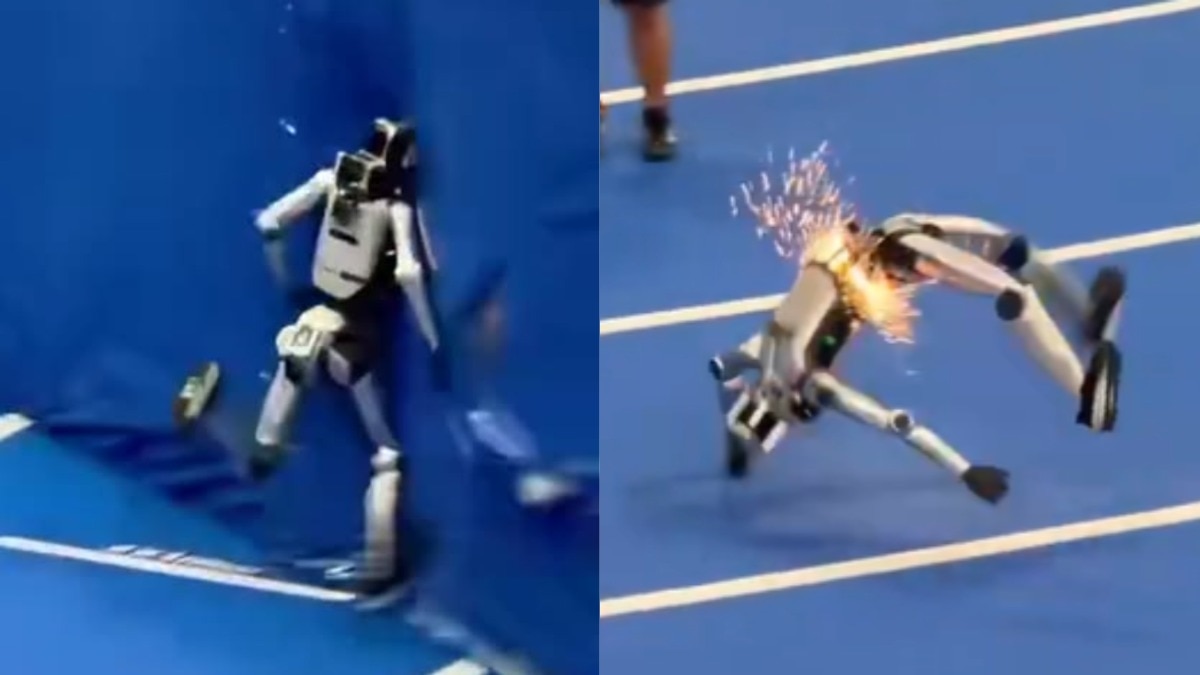
During the Second World Humanoid Robot Games in China, a high-speed humanoid robot failed to stop in time, crashing violently into a safety barrier. The impact caused sparks to fly and rendered the machine non-functional.
- A humanoid robot experienced a high-speed crash at the World Humanoid Robot Games in China.
- The robot's speed reportedly exceeded Usain Bolt's peak sprinting velocity.
- The collision resulted in mechanical failure and visible sparks.
- The robotics industry is seeing massive investment, with Unitree's stock surging 600%.
The Second World Humanoid Robot Games held in China witnessed a spectacular yet disastrous moment when a high-performance humanoid robot lost control. While the robot demonstrated near-perfect coordination and rhythm during its sprint, its inability to decelerate effectively led to a violent collision with a safety wall.
Viral footage shows the robot, believed to be a model from Unitree, sprinting with incredible precision. However, as the track ended, the machine's momentum proved too great to manage. The impact was so forceful that the robot was thrown backward, emitting sparks like fireworks, before falling into a state of total dormancy. The incident left the spectators in a state of shock.
Why This Matters
BozokMedia analysis shows that while the industry is achieving unprecedented milestones in locomotive speed, the critical gap remains in 'active deceleration' and sensor-based obstacle avoidance. The ability to move fast is being mastered, but the ability to stop safely is the next great engineering frontier.
The race for robotic speed is outstripping the current capabilities of autonomous braking systems.
The technical specifications mentioned during the games are staggering. The Unitree 'Superman' robot reportedly clocked a speed of 12.6 m/s. To put this in perspective, Olympic legend Usain Bolt reached a peak speed of approximately 12.4 m/s during his 2009 world-record run. This suggests that machines are officially entering the territory of human athletic supremacy.
Historical Background
The evolution of humanoid robotics has transitioned from stationary industrial arms to highly mobile autonomous entities. Companies like Tesla (Optimus) and Boston Dynamics in the US, alongside Chinese giants like Unitree, are engaged in a global arms race to create the most capable human-like machines. This competition is no longer just scientific; it is deeply economic, as seen by the massive IPO success of robotics firms.
The economic implications are massive. Following its recent public listing in mainland China, Unitree saw its stock price skyrocket by over 600% on its first day of trading, signaling immense investor confidence in the future of humanoid technology.
Frequently Asked Questions
Question 1: Was the robot permanently destroyed?
Answer: While the impact caused significant sparks and a loss of function, the extent of the internal damage to the hardware is still being assessed.
Question 2: Which companies are leading the humanoid robot race?
Answer: Major players include Unitree in China, and Tesla and Boston Dynamics in the United States.