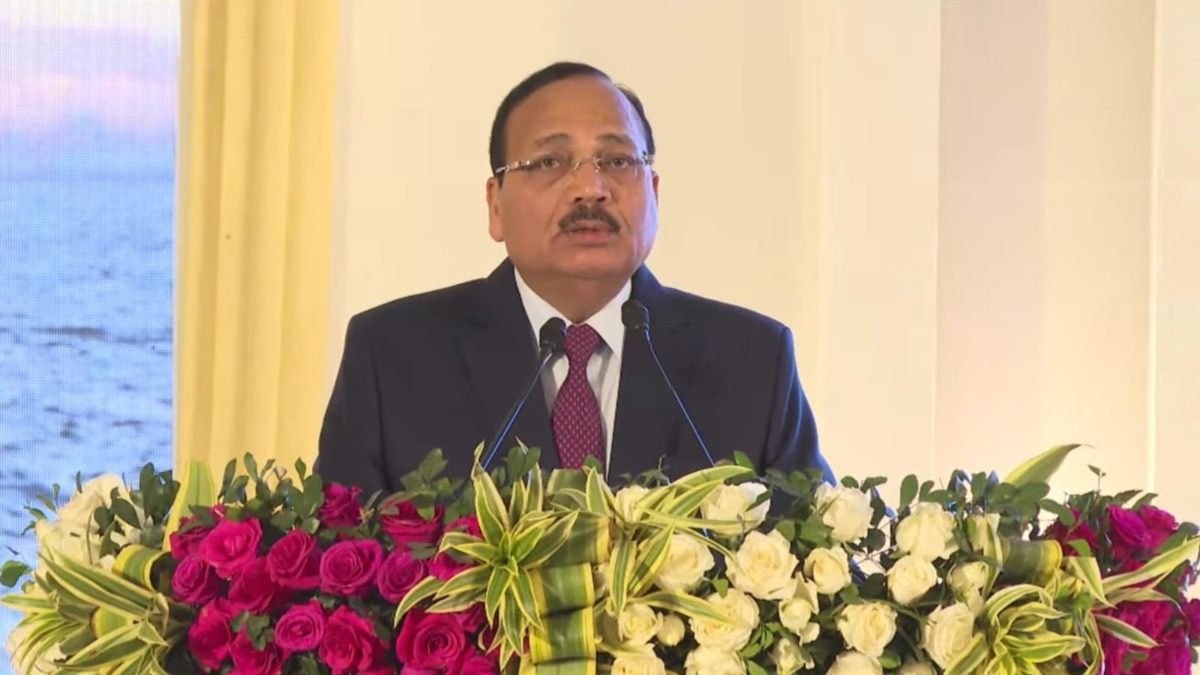
Chief Justice of India Surya Kant stated in London that the judiciary has taken swift action against emerging economic crimes like 'digital arrest' scams without waiting for legislative intervention.
- CJI Surya Kant emphasized the judiciary's proactive role in tackling new-age economic frauds.
- The Supreme Court has directed the government to assess 'digital arrest' scams and create specific offenses.
- India's defense against economic crime is a 'layered architecture' of laws and institutions.
- International cooperation via MLATs is crucial for recovering illicit wealth.
Speaking at the closing session of the 43rd International Symposium on Economic Crime in London, Chief Justice of India (CJI) Surya Kant asserted that the Indian judiciary has been proactive in responding to evolving forms of economic crime. He highlighted that the courts do not necessarily wait for Parliament to act when faced with urgent threats like the 'digital arrest scam'.
The digital arrest scam involves fraudsters posing as law enforcement officials, judicial officers, or bureaucrats via video calls to intimidate victims into believing they are under arrest, subsequently extorting money. CJI Kant noted that the Supreme Court has recently taken cognizance of this issue, directing both the Union and state governments to evaluate the scale of the problem and consider establishing a distinct offense with penalties proportionate to the harm caused.
Why This Matters
BozokMedia analysis shows that as cybercriminals exploit technological loopholes, the judiciary's ability to issue immediate directives fills the gap between emerging crimes and formal legislation, providing a vital layer of protection for citizens.
The Indian judiciary proactively responds to emerging fraudulent schemes rather than waiting for Parliament to address them.
CJI Kant described India's response to economic crime as a "layered architecture," built over decades through legislation, institutions, and judicial doctrine. He specifically cited the Prevention of Money Laundering Act (PMLA), 2002, and the Fugitive Economic Offenders Act, 2018. However, he maintained a balanced view, acknowledging that these mechanisms are not infallible and noting that the judiciary often intervenes to prevent the misuse of investigative powers.
Addressing the global scale of money laundering, the CJI remarked that the volume of illicit wealth is staggering—enough to provide a laptop to every person on Earth. He emphasized that since illicit wealth does not respect national borders, Mutual Legal Assistance Treaties (MLATs) are often more effective in recovering assets than traditional extradition processes.
Invoking ancient wisdom, he referenced Kautilya’s Arthashastra, noting how the ancient text described the impossibility of an official handling the king's revenue without tasting it, much like holding honey or poison on the tip of the tongue. He concluded by calling for global vigilance and strict adherence to the rule of law to combat the tide of illicit wealth.
Frequently Asked Questions
1. What is a digital arrest scam?
It is a cybercrime where fraudsters impersonate officials on video calls to trap victims in a fake legal situation to extort money.
2. How is the judiciary helping?
The Supreme Court is pushing for specific legal frameworks and penalties to address these new-age crimes effectively.