The Bombay High Court has struck down a Maharashtra policy that shifted compensation liability to private employers, ordering the state to pay victims' families first. The court slammed the persistence of the caste system in India.
- Bombay HC invalidated Maharashtra's policy that made private employers directly liable for compensation in sanitation deaths.
- The State Government must now pay ₹30 lakh to the dependents of deceased workers immediately.
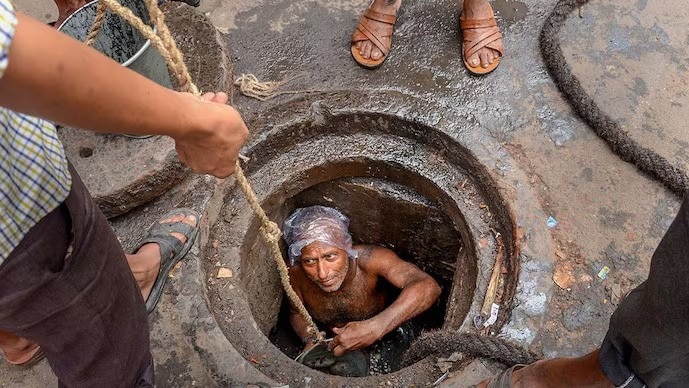
- The court highlighted that manual scavenging is a caste-driven practice that violates human dignity.
In a landmark judgment, the Bombay High Court has struck down a Maharashtra government policy that sought to make private employers and housing societies directly responsible for paying compensation to the families of workers who died during hazardous cleaning tasks. A division bench comprising Justices Bharati Dangre and Manjusha Deshpande ruled that the state government must prioritize immediate compensation to the victims' families and subsequently recover the amounts from the responsible private parties.
A Critique of Social Inequality
The court's observations went beyond legal technicalities, touching upon the deep-seated social issues in India. "In the 21st century, we boast about reaching the other side of the moon, yet the hard reality that stares us in the face is that the social evil of the caste system is still followed in our country," the bench remarked. The judges noted that this system forces certain citizens into work that is "below human dignity."
The bench further emphasized that despite 75 years of constitutional governance and guarantees of equality, India remains haunted by age-old social evils. They pointed out that manual scavenging is a practice that forces a specific community into inhumane conditions for generations, despite numerous Supreme Court judgments and statutory prohibitions.
Compensation Mandates and Legal Framework
The court directed the state government to identify all individuals who died during "hazardous cleaning" as defined under Section 2(d) of the Prohibition of Employment as Manual Scavengers and their Rehabilitation Act, 2013. The court mandated a compensation of ₹30 lakh for the dependents of each deceased worker within a six-month timeframe.
The court's ruling shifts the burden of empathy and immediate relief from private entities back to the State, where it legally belongs.
Why This Matters
BozokMedia analysis shows that this ruling is a significant victory for labor rights and social justice. By removing the hurdle of proving private liability before receiving aid, the court has ensured that grieving families do not have to endure prolonged legal battles to receive much-needed financial support during their time of crisis.
Historical Background
Manual scavenging has been a systemic issue in India for centuries, deeply intertwined with the caste hierarchy. While the 2013 Act was intended to eradicate the practice and rehabilitate workers, implementation gaps and the lack of accountability in the private sector have allowed the practice to persist in various forms, often leading to preventable fatalities in sewers and manholes.
Frequently Asked Questions
1. What was the primary flaw in the Maharashtra government's policy?
The policy made private employers directly liable for compensation, which the court found violative of equality and a delay tactic for victims.
2. How much compensation has the court ordered?
The court has ordered the state to pay ₹30 lakh to the dependents of each worker who died during hazardous cleaning.