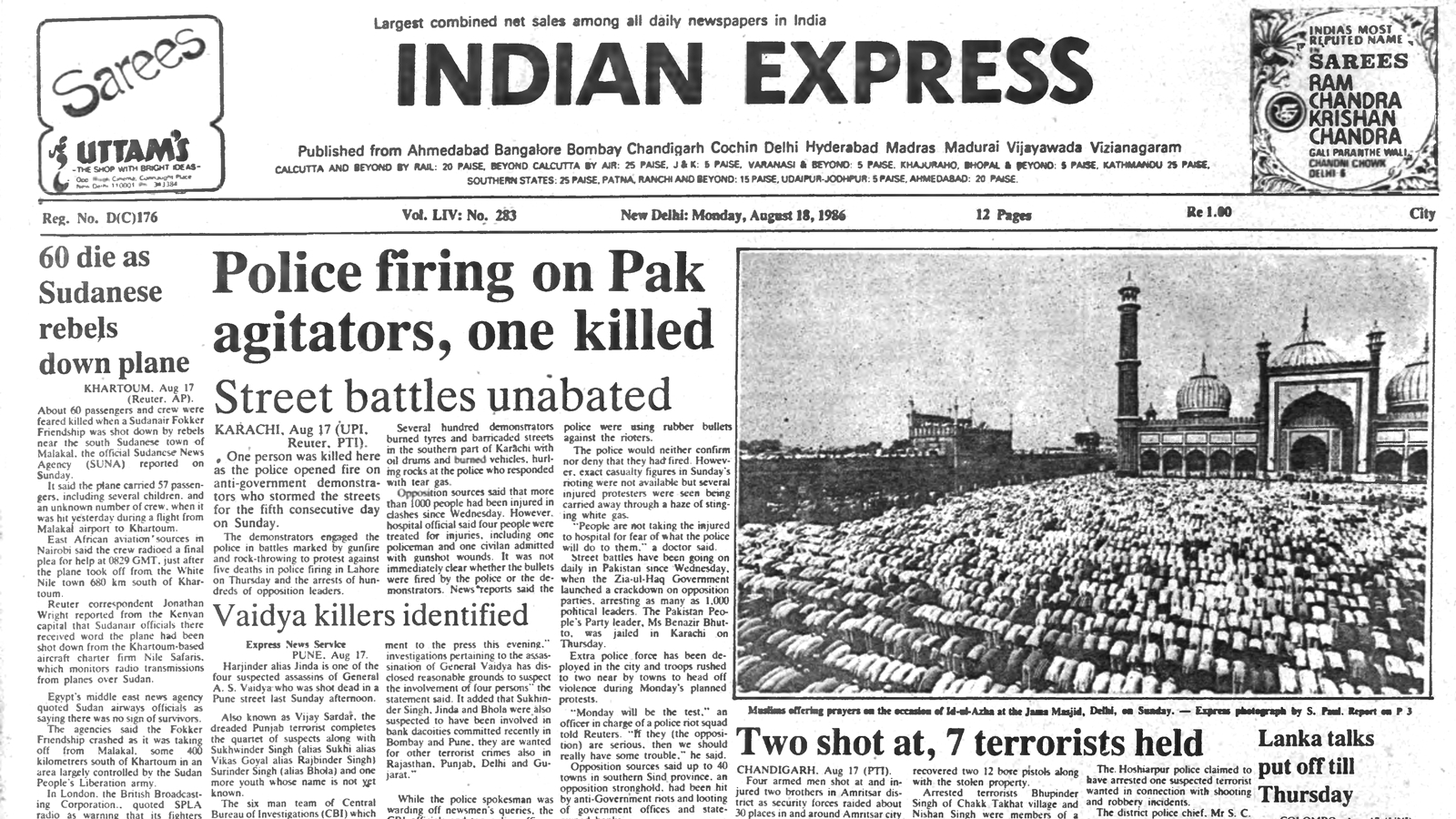
Forty years ago, Karachi witnessed deadly clashes between anti-government protesters and police. This comprehensive look back explores the political unrest in Pakistan and significant global events of the day.
- Deadly clashes in Karachi left one person dead as police opened fire on anti-government protesters.
- Protests were sparked by the killing of five people in Lahore and the mass arrest of opposition leaders.
- A Sudan Airways aircraft was shot down by rebels, resulting in approximately 60 casualties.
- The Indian Air Force (IAF) moved to acquire the Soviet Mi-26, the world's heaviest lift helicopter.
On August 18, 1986, the city of Karachi became a battleground. Hundreds of demonstrators paralyzed the southern part of the city, burning tires and erecting barricades using oil drums and vehicles. The atmosphere was electric with tension as protesters hurled rocks at security forces, who initially responded with tear gas before escalating to live ammunition. One person lost their life in the chaos, marking the fifth consecutive day of street battles.
The root of this violence lay in the city of Lahore, where police firing had previously claimed five lives. The subsequent arrest of hundreds of opposition leaders acted as a catalyst, pushing the populace toward open rebellion against the government's oppressive tactics.
Why This Matters
BozokMedia analysis shows that the events of August 1986 were symptomatic of the systemic instability within Pakistan's political framework during the mid-80s. The cycle of protest, state repression, and further unrest highlighted a critical failure in democratic engagement. This period serves as a historical reminder of how the suppression of political dissent often leads to uncontrollable civic volatility.
"The 1986 unrest was not merely a series of riots, but a manifestation of a society pushed to its breaking point by authoritarian governance."
Simultaneously, the world witnessed a tragedy in Sudan. A Sudan Airways Fokker Friendship aircraft was shot down by rebels near the town of Malakal. The official Sudanese News Agency (SUNA) reported that 57 passengers and several crew members were on board. The final radio plea for help was received in Nairobi, marking a grim chapter in East African aviation security.
In a significant strategic move, the Indian Air Force (IAF) decided to augment its fleet with the Soviet Union's Mi-26 heavy-lift helicopter. Codenamed "Halo-7" by NATO, the Mi-26 was renowned as the most powerful helicopter in existence, providing India with unprecedented logistical capabilities for heavy military transport.
Meanwhile, domestic issues in India revealed administrative friction. The Ministry of Urban Development faced setbacks as critical housing finance and urban improvement projects remained stalled in the Finance Ministry for over six months, illustrating the persistent challenge of bureaucratic delays in infrastructure development.
Frequently Asked Questions
Q1: What triggered the protests in Karachi on August 18, 1986?
A: The protests were a reaction to the deaths of five people in police firing in Lahore and the mass arrests of opposition political leaders.
Q2: What is the significance of the Mi-26 helicopter for the IAF?
A: It provided the IAF with the world's heaviest lift capacity, significantly enhancing their ability to move heavy equipment and troops quickly.