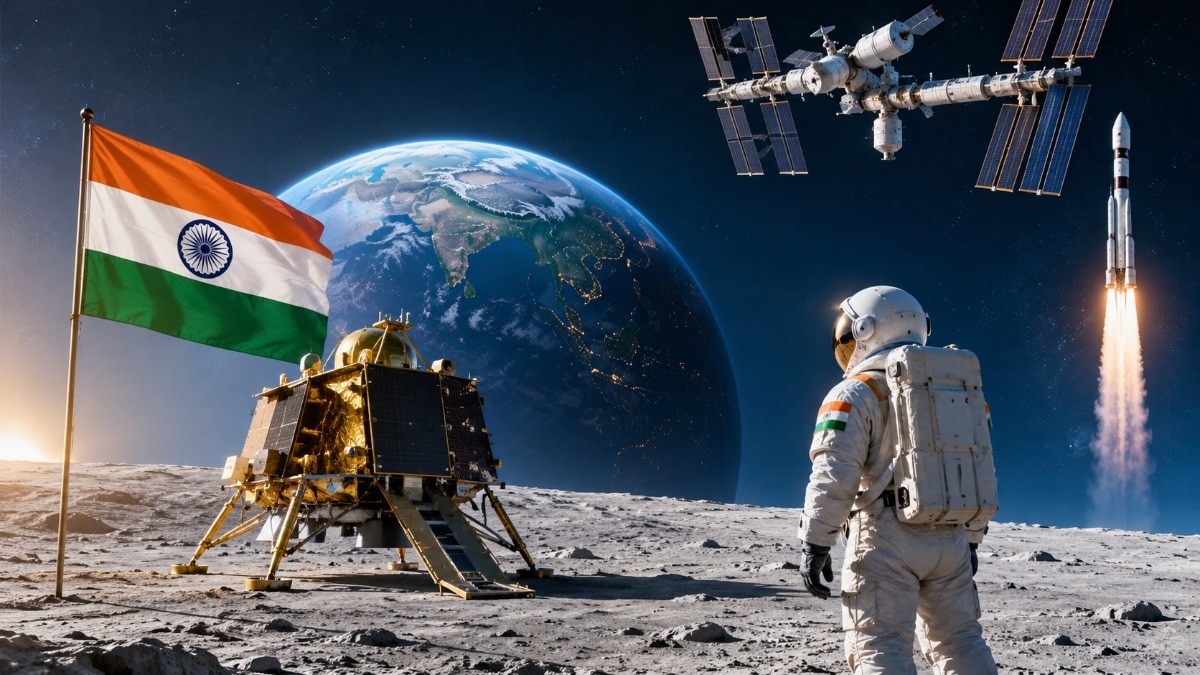
Marking National Space Day, we explore how India is evolving from the success of Chandrayaan-3 toward human spaceflight and a permanent space station.
- August 23 is celebrated as National Space Day to honor the Chandrayaan-3 landing.
- India is transitioning from robotic lunar missions to human spaceflight via Gaganyaan.
- Long-term goals include the Bharatiya Antariksh Station by 2035 and human Moon landings by 2040.
August 23rd has transitioned from a mere date on the calendar to a symbol of India's cosmic triumph. Three years ago, the successful soft landing of Chandrayaan-3 near the Moon's south polar region changed the global space landscape forever. To commemorate this feat, the Indian government declared this day as National Space Day.
The mission, involving the Vikram lander and the Pragyan rover, was much more than a technical demonstration. It provided critical data on lunar soil, seismic activity, and the presence of sulphur, offering a treasure trove of information for global scientists. It wasn't just about reaching the Moon; it was about proving that India could operate in the most challenging terrains of our solar system.
Why This Matters
BozokMedia analysis shows that the momentum generated by Chandrayaan-3 has fundamentally shifted India's space policy from 'exploration for knowledge' to 'exploration for presence.' This shift is driving unprecedented investment in human-centric space technologies.
Chandrayaan-3 gave India not just a moment of national pride, but the confidence to think bigger, from human spaceflight to deeper planetary exploration.
Today, the spotlight has shifted to Gaganyaan, India's first crewed space mission. ISRO is currently undergoing rigorous testing, including parachute drop tests and crew module validations, to ensure that Indian astronauts can safely reach orbit and return to Earth. This mission serves as the gateway to becoming a true spacefaring nation.
Looking further ahead, the ambitions are even more staggering. ISRO has already begun designing systems for the Bharatiya Antariksh Station (BAS). The roadmap suggests that the first module of India's own space station could be in low-Earth orbit by 2035. This would grant India the capability to conduct long-term scientific research in microgravity.
| Mission | Primary Objective | Target Timeline |
|---|---|---|
| Chandrayaan-3 | Lunar South Pole Soft Landing | 2023 |
| Gaganyaan | Human Spaceflight Capability | 2027 (Est.) |
| Bharatiya Antariksh Station | Indigenous Space Station | 2035 |
| Lunar Human Mission | Human Presence on the Moon | 2040 |
Frequently Asked Questions
Question 1: Why is August 23rd celebrated as National Space Day?
Answer: It commemorates the historic landing of the Chandrayaan-3 Vikram lander on the Moon's south pole.
Question 2: What is the ultimate goal of the Gaganyaan mission?
Answer: The goal is to demonstrate India's ability to send humans into space and bring them back safely to Earth.